
DrPlus Skin Education · Acne Scar Science
Collagen Remodeling After Acne Scar Treatment: What Actually Happens?
Every effective acne scar treatment is really a controlled trigger for one slow biological process: collagen remodeling. Understand that process and you understand why results take months — and why patience is part of the treatment.
Quick answer
When a laser, RF microneedling, subcision or a focal acid treats a scar, it does not directly 'fill' the depression. What it actually does is create a controlled, contained injury that switches on the skin's own repair machinery. From there, the body rebuilds — and the rebuilding is what improves the scar. That rebuilding process is called collagen remodeling.
Collagen remodeling is deliberately slow. The skin first lays down quick, weaker collagen to stabilise the area, then spends weeks to months replacing it with stronger, better-organised collagen that genuinely firms and lifts the scar. Understanding this explains the two facts patients most often find surprising: results keep improving for months, and treatments are staged rather than done in one go.
Why this is worth understanding
Misunderstanding collagen remodeling is behind some of the biggest frustrations in scar treatment. People judge results in the first week (when the skin is still healing, not improved), expect a single session to finish the job, or assume that 'nothing happened' because change is gradual. Each of these is a misreading of the underlying biology.
Knowing how remodeling works recalibrates expectations to match reality. It explains why your doctor reviews progress over months, why sessions are spaced, and why pushing for faster, more aggressive treatment usually backfires — more injury does not mean faster collagen, it means more inflammation and risk.
Key terms in this guide
The three phases of healing
Skin repair runs through three overlapping phases. First is inflammation (days): the body clears damaged tissue and signals repair cells to the area. Second is proliferation (days to weeks): fibroblasts move in and rapidly lay down provisional tissue, new collagen and blood vessels to plug the gap — fast, but disorganised. Third is remodeling (weeks to months): that hasty tissue is slowly replaced and reorganised into stronger, aligned collagen.
Every credible scar treatment is, in effect, a way of deliberately re-running this cascade in a controlled way at the site of an old scar. The treatment provides the trigger; the body provides the rebuild. The remodeling phase is the one that does most of the visible scar improvement — and it is also the slowest.
— Healing timeline
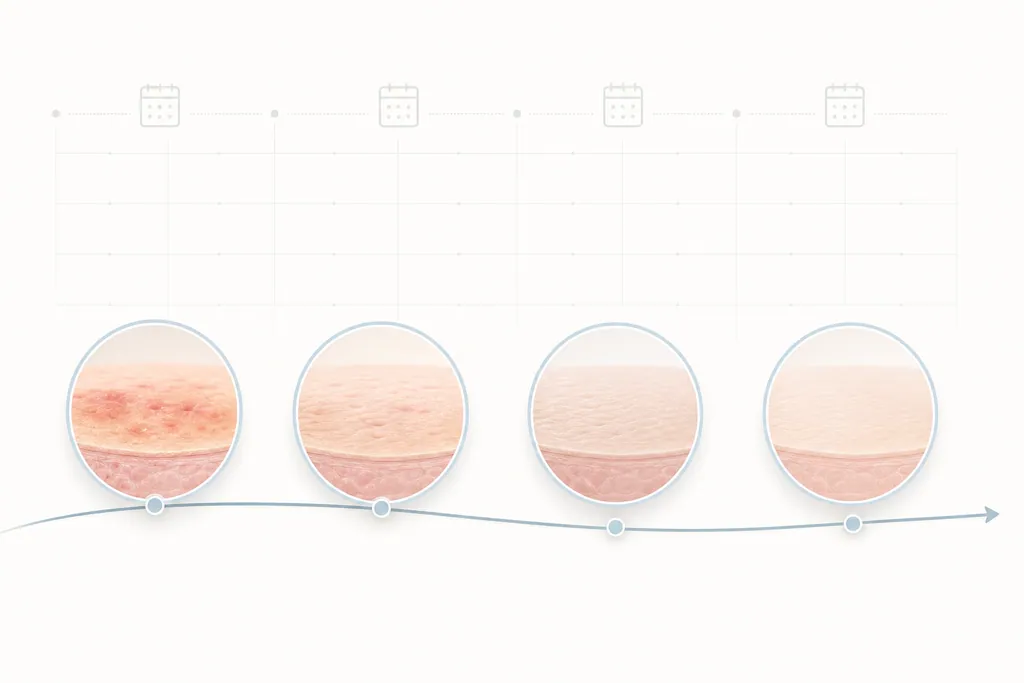
The healing cascade, after treatment
Days 0–3
Inflammation
The controlled injury is cleared and repair cells are recruited. Redness and swelling here are the start of repair, not a problem.
Days 3–21
Proliferation
Fibroblasts lay down rapid, provisional type III collagen and new vessels. The area gains bulk and strength but the collagen is disorganised.
Weeks 3 to months
Remodeling
Type III collagen is gradually replaced by stronger, aligned type I collagen. This slow maturation is where scars actually firm and lift.
A general guide only. Individual healing speed varies with skin type, scar depth, aftercare and the treatment used.
Type III to type I: the quality upgrade
The collagen the body makes first is not the collagen it keeps. Early repair favours type III collagen — thin, quickly produced and somewhat disorganised, useful for fast stabilisation but not for lasting structure. During remodeling, fibroblasts progressively swap this out for type I collagen: thicker, stronger, and laid down in a more organised arrangement that restores firmness and supports the surface.
This conversion is the heart of why time matters. The visible improvement in a scar tracks the maturation from disordered type III to organised type I collagen. You cannot see this happening, and it does not finish in a week — which is precisely why a scar that looks only modestly better at one month can look meaningfully better at three to six months.
— Comparison
Two collagens, two roles
| Property | Type III (early) | Type I (mature) |
|---|---|---|
| When produced | First, during early repair | Later, during remodeling |
| Structure | Thin, disorganised | Thick, aligned, organised |
| Role in scars | Quick stabilisation | Lasting firmness and lift |
When produced
- Type III (early)
- First, during early repair
- Type I (mature)
- Later, during remodeling
Structure
- Type III (early)
- Thin, disorganised
- Type I (mature)
- Thick, aligned, organised
Role in scars
- Type III (early)
- Quick stabilisation
- Type I (mature)
- Lasting firmness and lift
Fibroblasts: the cells doing the work
Fibroblasts are the dermis's resident builders. When a treatment delivers controlled injury — micro-columns from a laser, heat from RF needling, the space opened by subcision — fibroblasts are recruited and activated. They synthesise new collagen, then spend the following weeks reorganising and cross-linking it into a stronger network. Essentially, every scar treatment is a way of giving fibroblasts a reason, and a location, to build.
This also explains why a single session has a ceiling. Fibroblasts produce and mature collagen at a biological pace; one trigger yields one increment of new, maturing collagen. Adding more triggers (more sessions), appropriately spaced, yields more increments. There is no known way to make fibroblasts safely sprint — heat or injury intense enough to force the pace tends to cause scarring, not faster smoothing.
— Where treatments reach
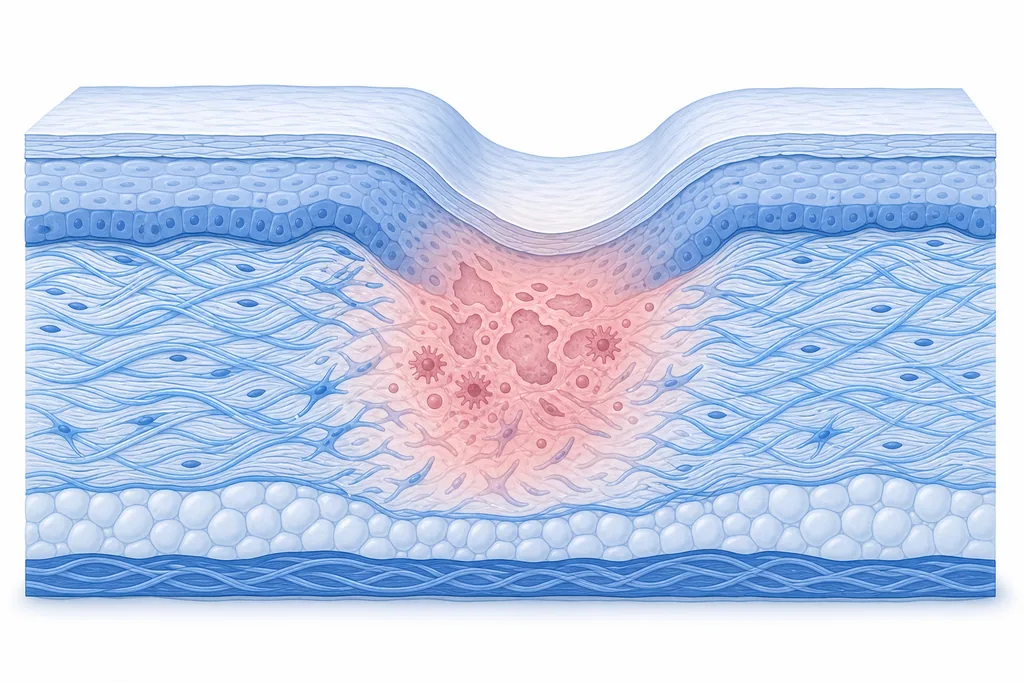
Skin layers, in plain English
- Epidermis: Outer protective layer — pigmentation marks and surface texture live here.
- Dermis: Collagen and elastin layer — where atrophic scars are anchored and where most regenerative treatments work.
- Subcutis: Deeper fat / connective layer — beyond the reach of most aesthetic treatments.
A simplified illustration — actual skin layers are more nuanced. Your doctor will explain what is relevant to your case at consultation.
Why results keep improving for months
Put the pieces together and the timeline becomes obvious. The week after treatment is dominated by inflammation and surface recovery — not improvement. Over the following weeks, fibroblasts build provisional collagen. Then, across one to six months, that collagen matures from type III to organised type I, and the scar gradually firms and lifts. The final result of a single session is therefore only fully visible months later.
This is why honest clinics ask you to assess results at the right time, not the impatient one, and why they review across months. It is also the biological basis for spacing sessions: each session needs time for its remodeling to play out before the next trigger is added. Patience here is not a marketing softener — it is the literal mechanism of improvement.
A common misconception
Many people assume that if a treatment 'worked', they would see the finished result quickly — and that slow change means failure. The opposite is usually true: meaningful, lasting scar improvement is inherently slow because it depends on collagen maturation. Fast, dramatic surface change is more often a sign of aggressive treatment that carries higher risk, not better results.
When to consider a medical consultation
Understanding collagen remodeling helps you set expectations, but a consultation translates the biology into a realistic plan for your specific scars — including how many sessions, how they are spaced, and when to fairly judge results.
At DrPlus in Johor Bahru, treatment plans are built around this timeline, with progress reviewed over months so the plan can be adjusted — and with honest expectations from the start, free of any promise to remodel scars away overnight.
Summary
Acne scar treatments do not fill scars directly — they trigger collagen remodeling, the slow biological process by which the dermis rebuilds. Healing moves through inflammation and proliferation into a long remodeling phase, where disorganised type III collagen is gradually replaced by stronger, aligned type I collagen. Fibroblasts do this work at a fixed biological pace that cannot be safely rushed.
That is why results keep improving for months, why the fair checkpoint is three to six months rather than one week, and why treatments are staged across sessions. Far from being a delay, the timeline is the mechanism — and matching your expectations to it is one of the most useful things you can do for your own treatment.
— Frequently asked
Common questions
The remodeling phase unfolds over roughly one to six months, with collagen continuing to mature and reorganise throughout. This is why scar results keep improving long after the session and why the fair checkpoint is months, not weeks.
Because treatments work by triggering the skin to rebuild collagen, and that rebuild — especially the maturation from weaker type III to stronger type I collagen — is inherently slow and cannot be safely rushed.
Type III collagen is thinner, disorganised and produced quickly during early repair. Type I collagen is thicker, organised and stronger, and gradually replaces type III during remodeling to give lasting firmness and lift.
Not safely. Fibroblasts build and mature collagen at a biological pace. Treatment intense enough to force the pace tends to cause more inflammation and scarring rather than faster smoothing. Spacing sessions appropriately is the sound approach.
Each session yields one increment of new, maturing collagen. Adding more sessions, properly spaced, adds more increments. The cumulative collagen across sessions is what produces meaningful improvement.
At around three to six months, once collagen has matured. Assessing at one or two weeks mostly measures healing and residual redness, not the actual scar improvement, which appears later.
— Related treatments
Continue with the relevant DrPlus treatment pages
Each page goes deeper into mechanism, suitability and recovery — your final plan is confirmed at consultation.
Primary money page
Acne Scar Treatment Hub
Doctor-led plans built around the real collagen-remodeling timeline, reviewed over months.
acne scar treatment in Johor BahruSupporting
RF Microneedling
Stimulates dermal collagen remodeling while sparing the surface.
RF microneedling for acne scarsSupporting
CO₂ Laser
Triggers collagen remodeling alongside surface resurfacing.
fractional CO₂ laser for acne scarsSupporting
Subcision
Opens space beneath tethered scars for new collagen to organise.
subcision for rolling scars— Continue reading
 Acne Scar Science
The Complete Science of Acne Scarring
Acne scars are not a surface problem. They are the visible record of how inflammation reshaped the collagen scaffold beneath your skin. Understand that, and every treatment decision starts to make sense.
Why Acne Scar Treatments Usually Need Multiple Sessions
Multiple sessions are not a sales tactic — they are how the biology of collagen actually works. Here is why staging treatment over time is the honest, effective way to improve scars.
 Acne Scars
Acne Scar Treatment Recovery: What to Expect Week by Week
Recovery worries put many people off treatment. Here is an honest, practical timeline for what healing usually looks like.