
DrPlus Skin Education · Acne Scar Science
Why Acne Scar Treatments Usually Need Multiple Sessions
Multiple sessions are not a sales tactic — they are how the biology of collagen actually works. Here is why staging treatment over time is the honest, effective way to improve scars.
Quick answer
Acne scar treatments are staged across several sessions because of how collagen is built. Each session delivers a controlled trigger that prompts one cycle of new collagen, and that collagen then matures and organises over weeks to months. One trigger yields one increment of improvement — so meaningful change for established scars usually requires several increments, added in sequence.
There is also a safety ceiling: a single session can only do so much before the intensity needed to force more change starts causing harm rather than help, especially in darker skin. Spacing sessions lets each cycle of remodeling complete and keeps risk low. Far from being a way to sell more visits, multiple sessions are simply the shape the biology takes.
Collagen builds in cycles
When a treatment injures a scar in a controlled way, the skin responds by recruiting fibroblasts that lay down new collagen and then spend weeks reorganising it into stronger, aligned fibres. This is one collagen cycle. The amount of new, matured collagen from a single cycle is real but limited — it firms and lifts the scar a little, not all at once.
Add another session, appropriately spaced, and you start another cycle that builds on the last. Across several cycles, the cumulative collagen gradually fills and supports the depressed area. The visible result you eventually see is the sum of these cycles, which is precisely why a course of treatment outperforms any single session.
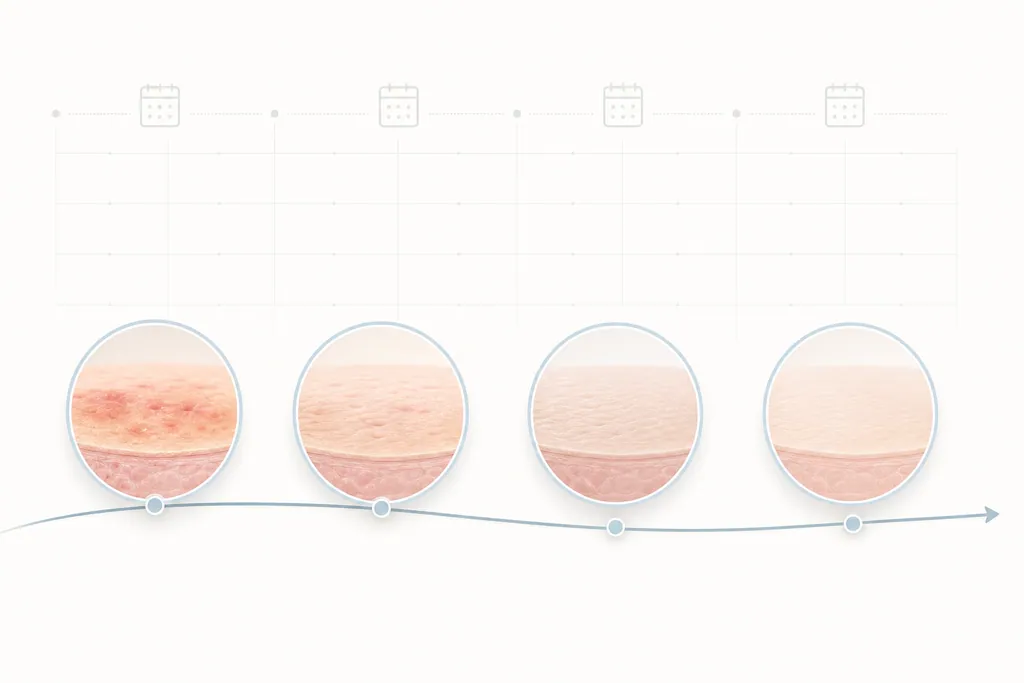
— Healing timeline
One session, one cycle
Days 0–7
Trigger & heal
The controlled injury heals at the surface; the deeper rebuild is just beginning.
Weeks 2–6
Collagen laid down
Fibroblasts produce new collagen in response to this session's trigger.
Weeks 6 to months
Maturation
Collagen organises and strengthens — one increment of improvement. The next session adds another.
A general guide only. Individual healing speed varies with skin type, scar depth, aftercare and the treatment used.
There is a biological ceiling per session
It is reasonable to ask: why not just do one very aggressive session and get it over with? The answer is that the skin can only tolerate so much controlled injury before the response tips from helpful remodeling into harmful inflammation, prolonged redness, pigmentation or even new scarring. Beyond a certain point, more intensity buys more risk, not more improvement.
This ceiling is lower in deeper Asian skin, where aggressive treatment readily triggers post-inflammatory pigmentation. Staging respects the ceiling: each session stays within the safe, effective zone, and the course as a whole accumulates the result that a single dangerous session could never safely deliver.
Session count scales with scar severity
Not everyone needs the same number of sessions. Shallow, limited scarring may improve substantially in a few sessions, while deep, numerous or mixed scarring needs more cycles to accumulate enough collagen and to address each scar type appropriately. Mixed faces often combine methods — subcision, collagen stimulation, focal techniques — each of which has its own session rhythm.
This is why honest clinics give a realistic range rather than a fixed promise, and review progress along the way. The plan is calibrated to your scars: the deeper and more complex the scarring, the more staging it reasonably requires.
— Comparison
Severity and staging (illustrative)
| Scarring | Typical staging | Why |
|---|---|---|
| Mild / shallow | Fewer cycles | Less collagen to rebuild; responds sooner. |
| Moderate | A planned course | More cycles to accumulate meaningful change. |
| Deep / mixed | Combination over more sessions | Different scar types each need their own approach and rhythm. |
Mild / shallow
- Typical staging
- Fewer cycles
- Why
- Less collagen to rebuild; responds sooner.
Moderate
- Typical staging
- A planned course
- Why
- More cycles to accumulate meaningful change.
Deep / mixed
- Typical staging
- Combination over more sessions
- Why
- Different scar types each need their own approach and rhythm.
Why sessions are spaced out
Spacing is as important as the number of sessions. Because each collagen cycle takes weeks to months to mature, treating again too soon does not speed things up — it stacks fresh inflammation on tissue that has not finished remodeling, raising risk without adding benefit. Appropriate spacing lets each cycle largely complete so the next session builds on a stable foundation.
It also lets your doctor see how your skin responded and adjust the plan — settings, technique, or which method to use next. The interval between sessions is therefore working time, not waiting time: the remodeling that delivers your result is happening precisely during those gaps.
— Where treatments reach
Skin layers, in plain English
- Epidermis: Outer protective layer — pigmentation marks and surface texture live here.
- Dermis: Collagen and elastin layer — where atrophic scars are anchored and where most regenerative treatments work.
- Subcutis: Deeper fat / connective layer — beyond the reach of most aesthetic treatments.
A simplified illustration — actual skin layers are more nuanced. Your doctor will explain what is relevant to your case at consultation.
Judging results across the course
Because improvement is incremental and collagen matures slowly, results should be judged across the whole course and at the right time — generally a few months after sessions, once collagen has organised. Assessing after a single early session, while the skin is still settling, gives a misleadingly modest picture and tempts premature conclusions.
Set the expectation up front: steady, cumulative improvement reviewed over months, with the realistic goal of scars becoming meaningfully less noticeable. Patience across the course is not passive — it is the mechanism by which the result is built.
— Pathway
How a staged plan unfolds
- 1
Assess & plan
Map scar types and skin tone, and agree a realistic course and spacing.
- 2
Treat in cycles
Each session triggers a collagen cycle; sessions are spaced to let it mature.
- 3
Review & adjust
Progress is reviewed between sessions so the plan can be fine-tuned.
- 4
Judge at the end
Assess the cumulative result a few months after the course, not after one early session.
- 1
Assess & plan
Map scar types and skin tone, and agree a realistic course and spacing.
- 2
Treat in cycles
Each session triggers a collagen cycle; sessions are spaced to let it mature.
- 3
Review & adjust
Progress is reviewed between sessions so the plan can be fine-tuned.
- 4
Judge at the end
Assess the cumulative result a few months after the course, not after one early session.
When to consider a medical consultation
If you want to understand how many sessions your scars realistically need, and how they would be spaced, that is exactly what an assessment provides. A consultation calibrates the plan to your scar severity and skin tone and sets honest expectations on timeline and likely improvement.
At DrPlus in Johor Bahru, plans are staged around the biology, reviewed across the course, and explained transparently — with no pressure to commit to more than is appropriate for your scars.
Summary
Acne scar treatments need multiple sessions because collagen builds in cycles: each session triggers one cycle that matures over months, and established scars need several cycles to accumulate meaningful improvement. A per-session biological ceiling means pushing harder raises risk rather than results, so measured, spaced sessions are both safer and more effective.
Session count scales with scar severity, spacing lets each cycle complete, and results are fairly judged across the whole course. Understood this way, multiple sessions are not an upsell but the honest shape of how skin rebuilds — and a proper plan calibrates them to your scars and skin.
— Frequently asked
Common questions
Each session triggers one cycle of collagen building that matures over months, and established scars need several cycles to improve meaningfully. There is also a safety limit on how much one session can do, so staging is both necessary and safer.
It depends on scar depth, number and type, but several sessions spaced over months are typical. Deeper or mixed scarring usually needs more, and combination treatments have their own rhythm. Your doctor will give a realistic range.
Because each collagen cycle takes weeks to months to mature. Treating again too soon stacks inflammation on tissue that hasn't finished remodeling, raising risk without adding benefit. Spacing lets each cycle complete first.
No — it reflects how collagen actually rebuilds. A single session can only deliver one increment of improvement, and exceeding the safe per-session limit causes harm rather than faster results. Staging is the honest, effective approach.
Across the whole course and a few months after sessions, once collagen has matured. Judging after a single early session, while the skin is still settling, understates the eventual result.
Generally yes. Deeper and more numerous scars require more collagen cycles to accumulate meaningful change, and mixed scarring often needs combined methods over more sessions.
— Related treatments
Continue with the relevant DrPlus treatment pages
Each page goes deeper into mechanism, suitability and recovery — your final plan is confirmed at consultation.
Primary money page
Acne Scar Treatment Hub
Doctor-led plans staged around the collagen biology and reviewed across the course.
acne scar treatment in Johor BahruSupporting
RF Microneedling
Builds dermal collagen incrementally across a planned series.
RF microneedling for acne scarsSupporting
CO₂ Laser
Resurfacing that triggers collagen remodeling over multiple sessions.
fractional CO₂ laser for acne scarsSupporting
Subcision
Releases tethered scars; often combined with staged collagen work.
subcision for rolling scars— Continue reading
Collagen Remodeling After Acne Scar Treatment: What Actually Happens?
Every effective acne scar treatment is really a controlled trigger for one slow biological process: collagen remodeling. Understand that process and you understand why results take months — and why patience is part of the treatment.
 Acne Scars
Acne Scar Treatment Recovery: What to Expect Week by Week
Recovery worries put many people off treatment. Here is an honest, practical timeline for what healing usually looks like.
Why Some Acne Scar Treatments Fail
When acne scar treatment disappoints, it is rarely because the technology failed. It is almost always one of five avoidable reasons — and understanding them is the best way to get a result that lasts.