
DrPlus Skin Education · Acne Scar Science
The Complete Science of Acne Scarring
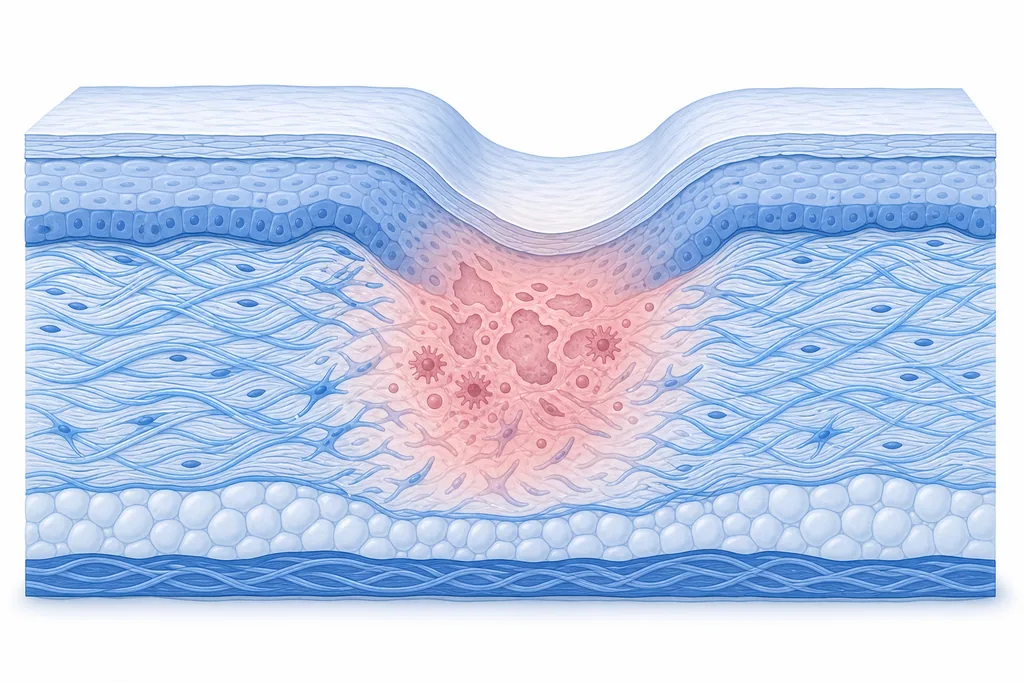
Acne scars are not a surface problem. They are the visible record of how inflammation reshaped the collagen scaffold beneath your skin. Understand that, and every treatment decision starts to make sense.
On this page
- Quick answer
- Why the biology matters before any treatment
- The layers of skin: where scars actually live
- The vocabulary, defined once
- Step one: inflammation does the damage
- Step two: the collagen scaffold collapses
- Step three: imperfect wound healing
- Why one event produces different scar shapes
- Pigmentation marks are not scars
- Why Asian and deeper skin tones need a tailored approach
- Why scar improvement takes months, not days
- When to consider a medical consultation
- Summary
Quick answer
Acne scars form when an inflamed breakout damages the deeper layer of the skin (the dermis) and the body's repair process either removes too much tissue or rebuilds it imperfectly. The result is a permanent change in the collagen scaffold that holds your skin's shape — which is why scars sit in the structure of the skin, not on its surface.
Understanding this single idea explains almost everything that follows: why creams cannot 'erase' a scar, why different scar shapes behave differently, why treatments work at depth, and why improvement takes months rather than days. This guide walks through that biology in plain English so the rest of your treatment decisions make sense.
Why the biology matters before any treatment
It is tempting to skip straight to 'which laser is best'. But choosing a treatment without understanding the underlying problem is like choosing a tool before you know whether you are cutting, drilling or sanding. A scar that is tethered down from below needs a completely different approach to one that is simply a shallow dish in the surface.
When you understand what is happening beneath the skin, three things change. You ask better questions at consultation. You set expectations that treatment can actually meet. And you understand why a doctor might recommend combining methods or spacing sessions over months — not as upselling, but because the biology genuinely requires it.
The layers of skin: where scars actually live
Skin has three working layers. The epidermis is the thin outer sheet you can see and touch — it handles pigment and surface texture. Beneath it sits the dermis, a thicker layer packed with collagen and elastin fibres that give skin its strength, bounce and smoothness. Deeper still is the subcutis, a fatty connective layer.
Almost all acne scarring is a dermis problem. The collagen scaffold in the dermis is what holds the surface up to a smooth, even level. When that scaffold is damaged or lost, the surface above it has nothing to rest on — so it sinks. This is the core reason surface-only products cannot fix a structural problem several millimetres down.
— Where treatments reach
Skin layers, in plain English
- Epidermis: Outer protective layer — pigmentation marks and surface texture live here.
- Dermis: Collagen and elastin layer — where atrophic scars are anchored and where most regenerative treatments work.
- Subcutis: Deeper fat / connective layer — beyond the reach of most aesthetic treatments.
A simplified illustration — actual skin layers are more nuanced. Your doctor will explain what is relevant to your case at consultation.
The vocabulary, defined once
A handful of terms come up repeatedly in any honest discussion of acne scars. Knowing them makes the rest of this guide — and your consultation — far easier to follow.
Step one: inflammation does the damage
A pimple is, biologically, a small zone of inflammation. When a pore becomes blocked and bacteria multiply, the immune system floods the area with inflammatory cells and enzymes to clear the problem. This is normal and usually harmless. The trouble begins when the inflammation is intense, deep, or prolonged — as in cystic or nodular acne — and the immune response spills beyond the pore into the surrounding dermis.
Among the tools the immune system uses are enzymes called matrix metalloproteinases, which break down collagen to clear damaged tissue. Useful in moderation, destructive in excess. When a deep, angry lesion sits for days or weeks, these enzymes dismantle a region of the collagen scaffold. The deeper and longer the inflammation, the more scaffold is lost — which is why severe, slow-healing acne carries the highest scarring risk.
Step two: the collagen scaffold collapses
Imagine the dermis as scaffolding holding up a flat ceiling (the skin surface). Inflammation removes several poles from one section of that scaffolding. With the support gone, the ceiling above sags into the gap. That sag, seen from above, is an atrophic acne scar — a depression where the surface has dropped because the structure beneath it was lost.
Crucially, the body does not always rebuild the missing scaffold to its original specification. Sometimes it lays down too little collagen, leaving a lasting dip. Sometimes it lays down disorganised, fibrous collagen that contracts and pulls the surface down — the mechanism behind rolling scars. The shape of the final scar is decided by exactly how, and how much, the dermis was lost and repaired.
Step three: imperfect wound healing
Skin repair runs through ordered, overlapping phases. First inflammation clears debris. Then a proliferation phase builds quick, provisional tissue and new blood vessels to plug the gap. Finally, a long remodeling phase gradually replaces that hasty tissue with stronger, better-organised collagen. In a clean wound this sequence restores near-normal skin.
Acne scarring is essentially this sequence going slightly wrong — too much early breakdown, not enough or poorly-organised rebuild. Understanding these phases is also the key to understanding treatment: nearly every modern scar treatment works by deliberately triggering a controlled version of this same healing cascade, so the body re-runs the remodeling phase and lays down fresh, organised collagen where it is missing.
— Healing timeline
How skin heals — the cascade every treatment borrows
Days 0–3
Inflammation
The body clears damaged tissue and signals repair cells to the area. Too much, too long is what drives scarring in the first place.
Days 3–21
Proliferation
Fibroblasts move in and lay down rapid, provisional collagen and new blood vessels to fill the gap — strength returns but the tissue is still disorganised.
Weeks to months
Remodeling
Provisional collagen is slowly swapped for stronger, better-aligned type I collagen. This slow phase is why scar treatment results keep improving for months.
A general guide only. Individual healing speed varies with skin type, scar depth, aftercare and the treatment used.
Why one event produces different scar shapes
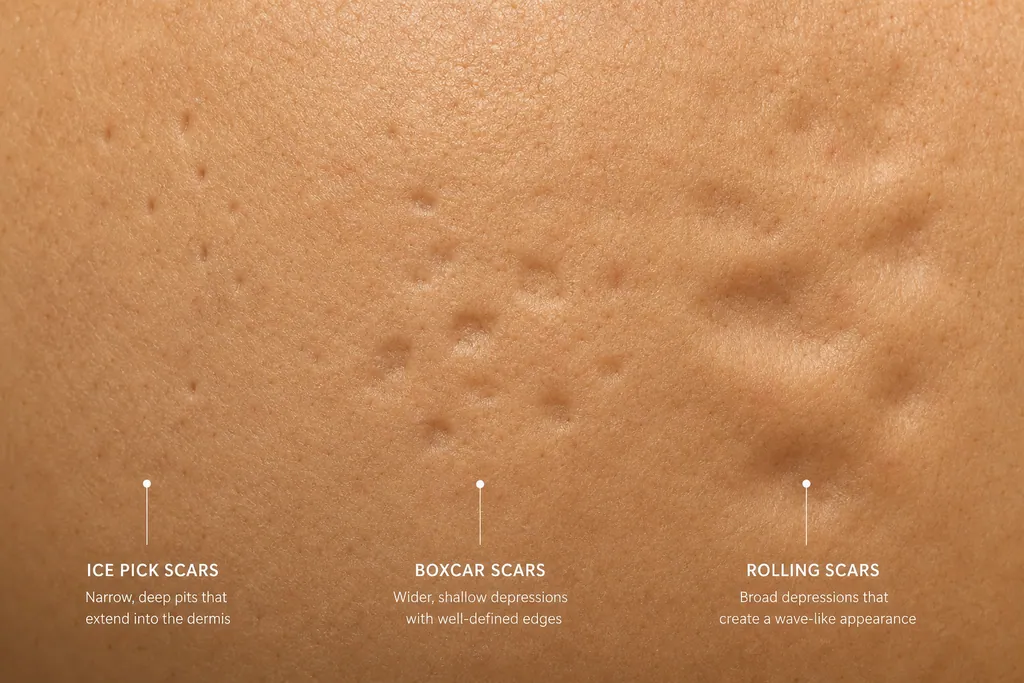
Because the amount and pattern of collagen loss varies, atrophic acne scars fall into recognisable shapes. Ice pick scars are narrow and deep, like tiny punctures, where loss was concentrated in a small column. Boxcar scars are wider depressions with sharp, defined walls, like small craters. Rolling scars are broad, soft undulations caused by fibrous bands tethering the surface from below.
These shapes are not just cosmetic labels — they predict which treatments will help. A deep, narrow ice pick scar resists broad surface resurfacing because the energy cannot reach the base of the channel. A tethered rolling scar will not lift from resurfacing at all until the underlying band is released. Reading the scar shape is the first step in any rational treatment plan.
Ice pick
Narrow, deep channels that extend down into the dermis — like a small puncture wound.
Depth-first treatments usually needed
Boxcar
Wider, shallow-to-medium depressions with clearly defined, punched-out edges.
Often responsive to fractional resurfacing
Rolling
Wave-like undulations caused by fibrous bands tethering the skin downward.
Structural release commonly needed first
Pitted / marks
Includes deeper pits and flat post-inflammatory marks left after acne heals.
Pigment marks often respond to topicals + peels
Pigmentation marks are not scars
One of the most common and costly mix-ups is treating flat dark marks as if they were scars. After a breakout, many people — especially those with deeper skin tones — are left with brown, red or grey patches where the spot used to be. These are post-inflammatory hyperpigmentation (and post-inflammatory erythema): the skin's pigment and blood-vessel response to inflammation, sitting at or near the surface.
The defining test is simple: stretch the skin or shine angled light across it. A true scar has depth — it casts a shadow and changes the surface contour. PIH is flat; it disappears when you stretch the skin because there is no structural change, only colour. This matters enormously because PIH often fades on its own over months and responds to gentle, pigment-focused care — whereas aggressive resurfacing aimed at 'scars' that are really PIH can actually provoke more pigmentation.
Why Asian and deeper skin tones need a tailored approach
Skin tone is graded on the Fitzpatrick scale, and the higher-melanin skin common across Malaysia and much of Asia (typically Fitzpatrick types III–V) behaves differently during healing. The pigment-producing cells, called melanocytes, are more reactive: any significant heat, abrasion or inflammation can switch them into overdrive and leave a fresh dark mark — the very PIH the patient came in to avoid.
This does not mean lasers and resurfacing are off the table. It means the strategy shifts toward controlled, lower-inflammation energy delivery, careful settings, diligent sun protection, and treatments that preserve the surface while working in the dermis. It is a major reason approaches that protect the epidermis — such as certain microneedling and fractional techniques — are popular for deeper skin tones, and why an experienced assessment in a local context like Johor Bahru genuinely matters.
Why scar improvement takes months, not days
If treatment works by re-triggering the remodeling phase of healing, then the speed of results is capped by the speed of that biology. Fibroblasts need weeks to produce new collagen, and that collagen continues to organise and mature for months afterward. There is no way to compress this safely — heat or injury intense enough to force faster change tends to cause more scarring, not less.
This is why a single session rarely finishes the job, and why honest clinics frame scar treatment as a staged programme reviewed over time. Each session adds another increment of collagen and another remodeling cycle; the visible result is the sum of those cycles. Patience is not a marketing softener here — it is a biological fact of how skin rebuilds.
When to consider a medical consultation
You do not need to diagnose your own scars — that is exactly what an assessment is for. But a few signs suggest it is worth speaking to a doctor rather than continuing with over-the-counter products alone.
A consultation maps your scar types, your skin tone and any active acne, then explains which approaches are realistic and how they would be sequenced. At DrPlus in Johor Bahru this is done at your pace, with no pressure to proceed on the day.
Summary
Acne scars are the lasting footprint of inflammation on the collagen scaffold of the dermis. Intense or prolonged inflammation breaks down collagen; imperfect wound healing fails to rebuild it fully; and the surface drops or is tethered into the shapes we recognise as ice pick, boxcar and rolling scars. Flat dark marks are a separate pigment issue that often fades.
Every credible treatment works by safely re-triggering the body's own remodeling phase to rebuild collagen — which is why results take months, why scar shape dictates method, and why deeper skin tones call for a gentler, more protective strategy. Knowing this turns treatment from a leap of faith into an informed, staged plan you can actually evaluate.
— Frequently asked
Common questions
True atrophic scars involve permanent structural loss of collagen and do not fully resolve without treatment. Flat dark marks (post-inflammatory hyperpigmentation) are different and often fade over months. A doctor can tell the two apart at assessment.
No. Acne scars are anchored in the dermis, the deeper support layer, where collagen was lost or disorganised. That is why surface-only creams cannot lift a depressed scar — the problem sits below where they act.
A scar is a structural change with depth that casts a shadow and stays when you stretch the skin. A dark mark (PIH) is flat colour that disappears when the skin is stretched and often fades on its own. They need different approaches.
Higher-melanin skin has more reactive pigment cells, so heat, abrasion or inflammation can trigger post-inflammatory hyperpigmentation more easily. Treatment is tailored toward gentler, controlled energy and careful aftercare to protect pigment.
Treatments work by re-triggering the skin's natural collagen remodeling, which unfolds over weeks to months and cannot be safely rushed. Improvement is the cumulative result of several remodeling cycles, usually across multiple sessions.
Often, but not always. Deep, inflammatory or cystic acne carries the highest scarring risk, but factors like genetics, picking at lesions and delayed treatment also matter. Some people scar from relatively mild acne.
— Related treatments
Continue with the relevant DrPlus treatment pages
Each page goes deeper into mechanism, suitability and recovery — your final plan is confirmed at consultation.
Primary money page
Acne Scar Treatment Hub
Doctor-led category hub covering assessment and the full range of scar treatment pathways at DrPlus.
acne scar treatment in Johor BahruSupporting
CO₂ Laser
Resurfacing that triggers collagen remodeling for texture and shallower scars.
fractional CO₂ laser for acne scarsSupporting
RF Microneedling
Dermal heating to stimulate collagen while preserving the surface — popular for deeper skin tones.
RF microneedling for acne scarsSupporting
Subcision
Releases the fibrous bands that pull rolling scars down from below.
subcision for tethered rolling scars— Continue reading
 Acne Scars
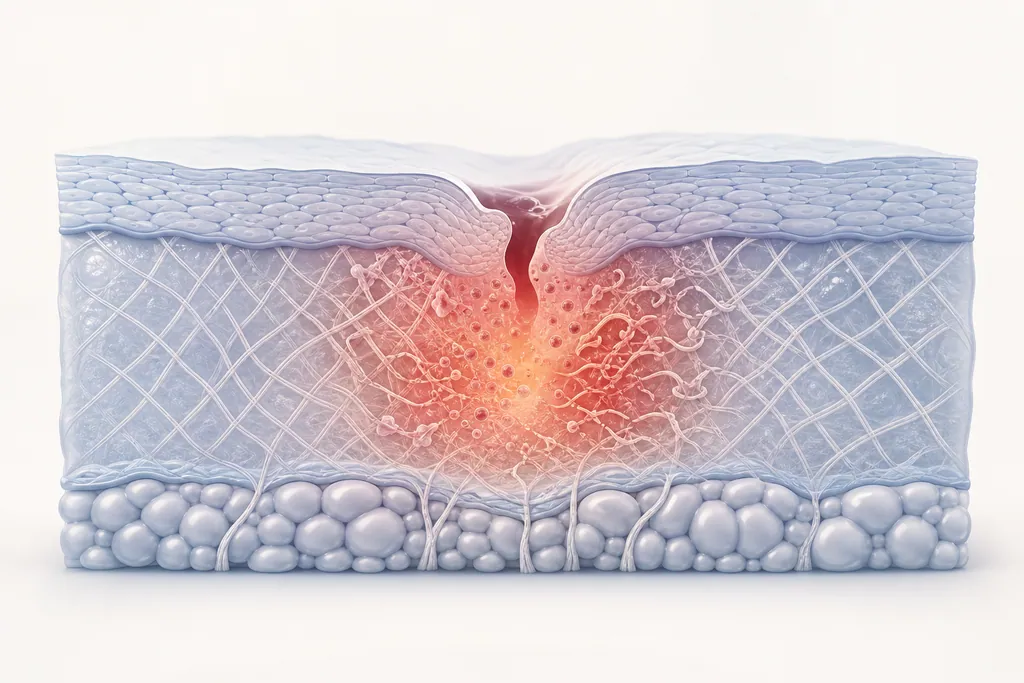
What Causes Acne Scars? The Science Behind Scar Formation
Acne scars are not just leftover marks — they are the result of how the skin healed after inflammation. Here is the science, explained clearly.
 Acne Scars
Types of Acne Scars: Ice Pick, Boxcar, Rolling and Pitted Scars
Atrophic acne scars come in distinct shapes — and the shape often determines what treatment may actually help.
 Acne Scar Science
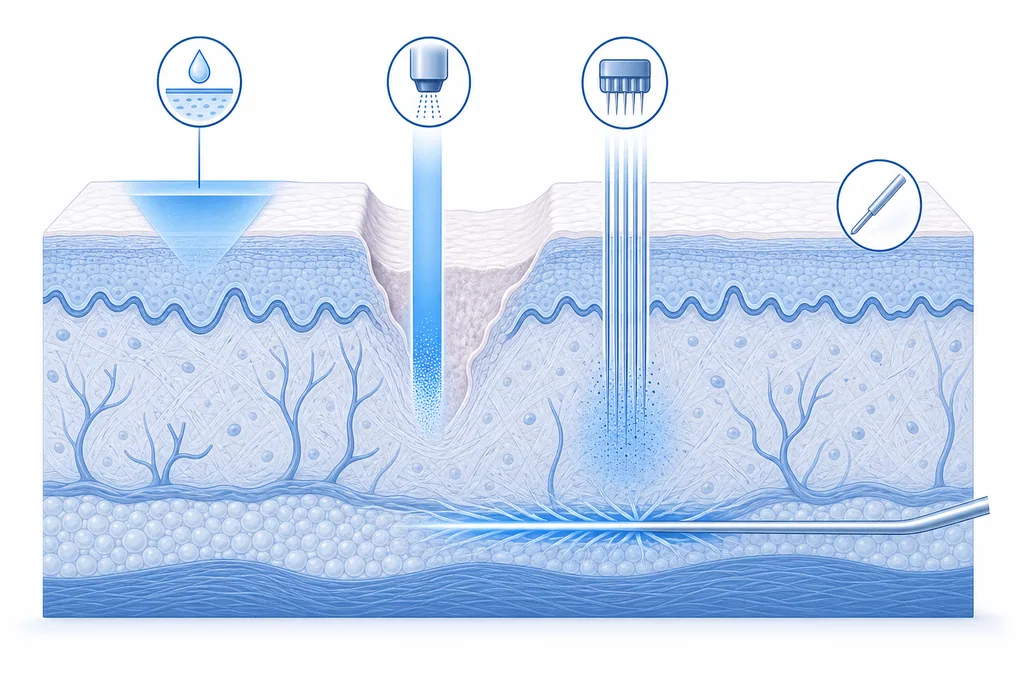
Acne Scar Treatment Comparison: CO₂ Laser, RF Microneedling, Subcision & Peels
There is no single 'best' acne scar treatment — only the right tool for a specific scar at a specific depth. This guide compares the four main options on the dimensions that actually decide outcomes.