

Acne & Acne Scars · Collagen Remodelling
RF Microneedling for Skin Texture & Acne Scars in Singapore & Johor Bahru
Stimulate deeper collagen remodelling to soften acne scars, improve enlarged pores, and refine uneven texture — with less surface downtime than ablative laser. Doctor-led in Johor Bahru, welcoming patients from Singapore and across Malaysia.
- Suitable for
- Rolling scars and uneven skin texture
- Downtime
- Redness and sensitivity for 1–3 days
- Usually with
- Subcision first when scars are tethered
- Performed by
- Dr Kenneth















From scarred to renewed.
Picture waking up and noticing your skin looks different — not dramatically, but meaningfully. Pores smaller, texture softer, the scars fading into background noise. That's what collagen remodelling builds toward.
- Scars gradually become something you stop noticing
- Less downtime than ablative laser — fits your life
- Improvements compound over 3–4 sessions
- Suitable for darker skin tones with calibrated settings
— How RF microneedling works
A simple way to picture the mechanism
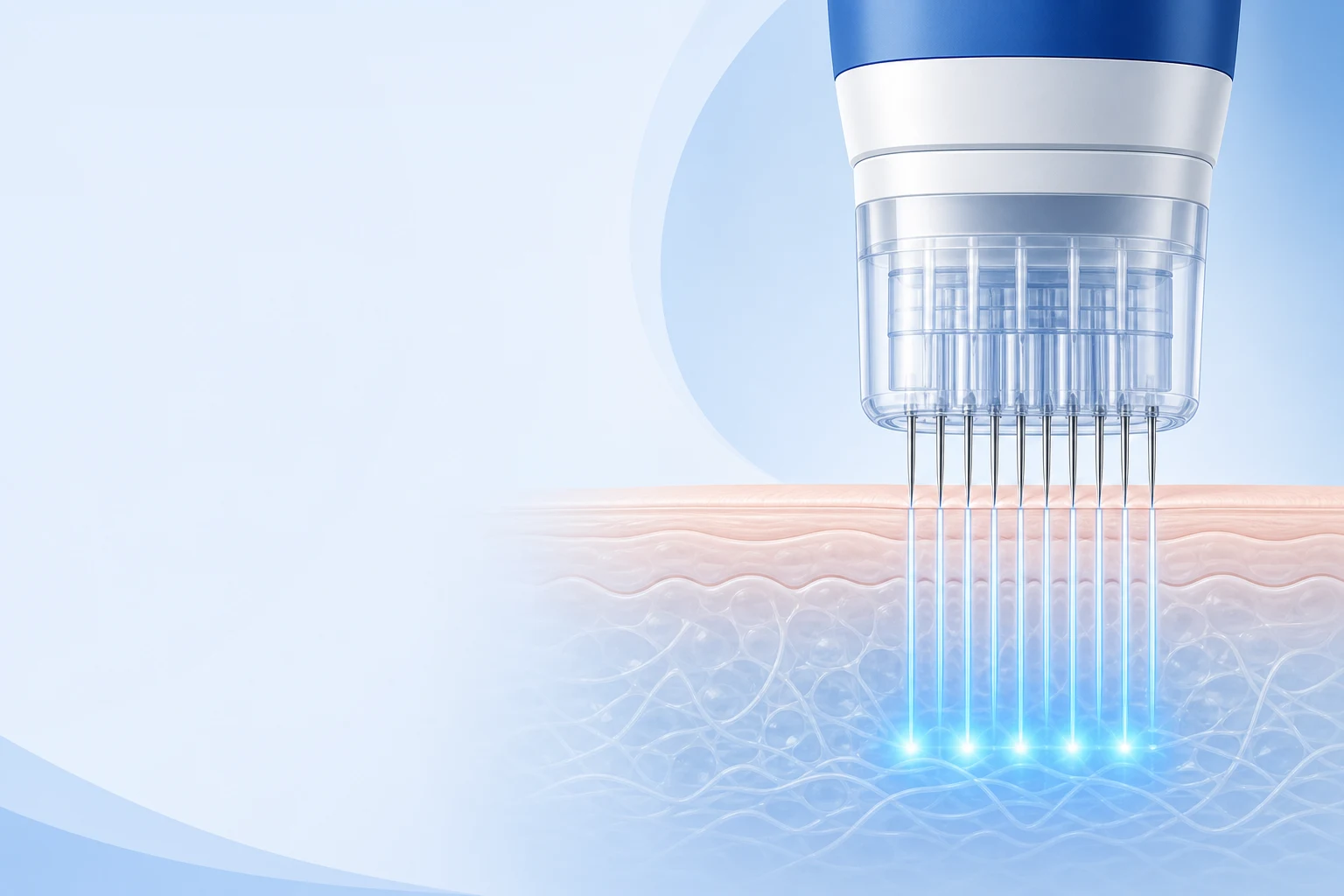
RF microneedling combines two signals to the dermis at once. Here is a simplified view of what happens beneath the skin during and after the treatment.
- Stage 01
Micro-channels
Fine insulated needles penetrate the skin and deliver into the dermis at a controlled depth, creating precise entry points for energy delivery.
- Stage 02
RF energy delivery
Radiofrequency energy is released at the needle tips deep within the dermis — generating heat that encourages collagen contraction and new formation.
- Stage 03
Progressive remodelling
As the dermis heals, new collagen and elastin fibres form around each treated zone — gradually improving scar depth and skin texture over weeks to months.
This is a simplified illustration. Your doctor will select needle depth and RF energy settings based on your scar type, skin tone, and treatment goals before each session.
— How it works
The treatment process
Micro-channels
Fine needles create controlled entry points into the dermis.
RF energy delivery
Heat from radiofrequency may encourage collagen contraction and new formation.
Progressive improvement
Results develop over weeks to months as remodelling continues between sessions.
— Quick clarification
RF microneedling vs CO₂ laser: what is the difference?
Patients often ask which is “better”. The honest answer is that they work in different layers and serve different goals.
RF Microneedling
Energy delivered beneath the surface
Radiofrequency energy is delivered into the dermis through fine needles to support collagen remodelling. Typically suits rolling scars, enlarged pores, and mild-to-moderate texture irregularity. Downtime is usually shorter than ablative laser.
CO₂ Laser
Resurfacing from the surface down
CO₂ laser is more focused on resurfacing texture and scar edges from the surface. It tends to give stronger refinement for boxcar scars and uneven texture, but typically involves more visible downtime than RF microneedling. Learn more about CO₂ laser →
Some patients need one; some need both depending on scar type, downtime tolerance, and skin tone. Your doctor will recommend the order — neither is universally better.
— Suitability
Who RF Microneedling suits — and who it doesn't
RF microneedling is best understood as a collagen remodelling treatment, especially for rolling scars, enlarged pores, and mild-to-moderate texture irregularity.
Often suitable for
- Rolling scars and mild-to-moderate texture irregularity
- Enlarged pores in scarred areas
- Collagen support after subcision or as part of a staged plan
- Patients who prefer moderate downtime over ablative resurfacing
Usually not the right choice for
- Deeply tethered scars without prior subcision
- Active severe acne
- Ice pick scars — usually need targeted techniques
- Cases where the dominant concern is surface pigmentation only
RF microneedling sits in the middle of the acne scar pathway — quieter than CO₂ laser, more remodelling-focused than peels. It is most powerful when paired with subcision for tethered scars.
— Recovery
What to expect after RF Microneedling
Recovery varies by individual, treatment intensity, and aftercare adherence. This is a general guide — your doctor will provide specific instructions.
Day 1–2
Redness and mild swelling are expected, similar in appearance to a sunburn.
Day 3–5
Skin calms and redness fades. Gentle skincare resumes as directed.
Week 2–4
Texture begins improving as the initial healing phase completes.
Month 1–3+
Collagen remodelling continues beneath the surface. Gradual improvements in scar depth and skin quality.
Your doctor will provide a tailored aftercare guide. If you have questions about downtime or planning around an event, ask during your consultation.
— Your plan
How your plan is built
No two plans are identical, because no two presentations are. What your RF Microneedling plan involves — and what it costs — is set by clinical findings at assessment, not by a menu.
Assessment comes first. The doctor examines your concern in person — type, severity, and skin response all change what is appropriate.
The plan is sized by clinical need. Number of sessions, spacing between them, and whether treatments are combined are set by what the assessment finds — never by a predetermined package.
You see the plan and its cost before anything is booked. Take it home, think it over — there is no obligation to proceed on the day.
You leave the assessment knowing the plan and what it costs — nothing left to guess at home.
— Cost factors
What determines RF microneedling cost
We do not publish package prices because RF microneedling is planned as a course — the number of sessions, the areas treated, and whether it is combined with subcision or laser resurfacing all shape the fee. After assessment you receive a written, personalised quote for your plan, with no obligation to proceed.
Quotes are in Malaysian ringgit at our Johor Bahru clinic and Singapore dollars at our Singapore clinics. WhatsApp us first if you want to understand what would shape your quote before you book.
- Number of sessions in your recommended course
- Treatment area — full face, cheeks only, or face plus other zones
- Whether numbing, review visits, and aftercare are bundled
- Whether RF microneedling is combined with subcision or laser
— Your doctor and where you're treated
One doctor, in a real clinic — not a treatment menu

Dr Kenneth Lee
Aesthetic Physician · DrPlus Aesthetics Clinic
- MBBCh · Cardiff University · UK
- GDipFP Dermatology · NUS · Singapore
- Aesthetic Medicine · AAAM · USA
- LCP Certified · Malaysia

Dr Plus Aesthetic Clinic Johor Bahru
B0223, Jalan Eko Botani 3, Taman Eko Botani
79100 Iskandar Puteri, Johor, Malaysia
Your assessment is with the doctor directly — not a consultant, not a sales room.
— Honest expectations
Risks and realistic expectations
No medical treatment is risk-free, and honest expectations matter more than impressive promises. Here is what a realistic course looks like.
What results realistically look like
- Results build gradually and vary by individual — skin type, severity, and how your body responds all shape the outcome.
- Some concerns need more than one session, and some need maintenance. If that applies to you, the doctor will say so at assessment — before you commit.
- If RF Microneedling is unlikely to reach the result you have in mind, you will be told that plainly. An honest "this won't get you there" protects you more than an optimistic plan.
Risks, plainly stated
- Temporary redness, swelling, or sensitivity in the treated area is common and expected — the downtime section above describes the usual course.
- Less common reactions exist for every procedure. The doctor walks through the ones relevant to you at consultation, before any treatment is scheduled.
If something doesn't feel right afterwards
If anything doesn't look or feel right after treatment, contact the clinic — describe what you're seeing and the team will advise whether it is an expected part of recovery or needs the doctor to review it.
— Where we treat
RF Microneedling in Johor Bahru & Singapore
Johor Bahru
Dr Plus Aesthetic ClinicB0223, Jalan Eko Botani 3Taman Eko Botani79100 Iskandar Puteri, Johor
SBF Center
160 Robinson Road #03-10SBF CenterSingapore 068914
The Flow Mall
66 East Coast Road #03-05The Flow MallSingapore 428778
Novena Medical Centre
10 Sinaran Drive #10-30Novena Medical CentreSingapore 307506
— FAQ
RF Microneedling FAQ
Yes. RF microneedling is not only for acne scars — it is also used to improve overall skin texture, refine enlarged pores, and support collagen remodelling for smoother, firmer-looking skin. Your doctor will assess whether your texture concern is best addressed with RF microneedling alone or as part of a combination plan.
DrPlus Aesthetic Clinic in Iskandar Puteri, Johor Bahru offers doctor-led RF microneedling for acne scars, skin texture, and enlarged pores. We welcome patients from across Johor Bahru and Singapore — the clinic is roughly 20–30 minutes from the Tuas Second Link, and you can start with a consultation at our Singapore clinics in Tanjong Pagar or East Coast, or send photos over WhatsApp for an initial doctor's opinion.
Standard microneedling uses fine needles to create micro-channels in the skin, relying on the body's wound-healing response alone. RF microneedling adds radiofrequency energy delivered through the needle tips at a controlled depth in the dermis — this generates heat that stimulates deeper collagen contraction and remodelling. RF microneedling is generally more effective for atrophic acne scars and skin texture improvement because it reaches deeper structural layers.
Many protocols involve 3–6 sessions spaced 4–6 weeks apart. Your doctor will adjust based on scar type and response.
Neither is universally better. CO₂ may offer stronger resurfacing with more downtime; RF microneedling often suits rolling scars with milder recovery. Your doctor will recommend based on assessment.
Usually after 24–48 hours, once redness subsides and your doctor confirms the skin barrier has recovered.
Aftercare is simple but matters for results. For the first 24–48 hours: keep the skin clean with a gentle cleanser, avoid makeup, actives (retinoids, exfoliating acids, vitamin C), saunas, swimming, and strenuous exercise. Sun protection is strict — SPF daily and direct sun avoided while the skin recovers. Moisturise as directed; mild flaking mid-week is normal. Your doctor gives you a written plan and confirms when your usual routine and actives can resume, usually within a week.
Yes. RF microneedling stimulates collagen around pores which can help reduce their visible appearance over a series of sessions. Results develop gradually and vary by individual.
A typical protocol involves 3–6 sessions spaced 4–6 weeks apart. Your doctor will recommend based on scar severity and your skin's response to treatment.
Yes. RF microneedling is commonly used on Asian skin types because the radiofrequency energy is delivered beneath the surface, reducing surface pigmentation risk compared to ablative lasers.
Significant improvement is achievable with the right treatment plan, but complete removal is not always realistic. Scar depth, type, and your skin's healing response all affect outcomes. Your doctor will give an honest assessment.
Yes. RF microneedling is often used after subcision for tethered scars, and can be combined with chemical peels for surface pigmentation. Your doctor will plan the appropriate sequence.
— Request a Consultation
Take the first step toward smoother skin
Your future skin starts with a private assessment — scar type, skin tone, and what's realistic for you. No pressure, just a clear path forward.
- Doctor-led assessment and recommendations
- Reviewed personally — not auto-routed
- Discreet handling of sensitive concerns
- Reply typically within one business day
— Related treatments
Other treatments sometimes used alongside RF Microneedling
Subcision
For deeper tethered scars, subcision may be needed before collagen remodelling.
Learn about SubcisionCO₂ Laser
For stronger surface resurfacing, CO₂ laser may be considered.
Learn about CO₂ LaserChemical Peel
For pigmentation and acne marks, chemical peels may complement treatment.
Learn about Chemical Peel— Skin Education
Related Skin Education
Doctor-led guides written to help you understand your options before consultation. Each article links back to the relevant treatment pages.
Microneedling in Singapore & Johor Bahru: RF Microneedling vs Dermapen
Both are called 'microneedling' — but a Dermapen session and an RF microneedling session are different treatments with different depth, downtime and results.
RF Microneedling for Acne Scars: Mechanism, Benefits and Limitations
RF microneedling rebuilds collagen deep in the dermis while leaving the skin's surface largely intact — a combination that makes it one of the most versatile and pigment-friendly scar treatments.
 Microneedling
Microneedling and Dermapen for Acne Scars Explained
Microneedling is one of the most asked-about acne scar treatments. Here is how it actually works, where it helps, and how it differs from RF microneedling.
Why RF Microneedling Is Popular for Asian Skin Types
For deeper skin tones, the biggest treatment risk is not the scar — it is the dark mark a treatment can leave behind. Understanding that risk explains why RF microneedling has become a go-to for Asian skin.
Stretch Marks: Why They Form and Which Clinic Treatments Help
Stretch marks are dermal scars, not a surface stain — which is why creams disappoint and remodelling treatments help. A doctor explains the red-vs-white window and the realistic options.
The quiet trust of those we care for.
The most considered medical experience I have had. Results that feel like myself, only quieter.
Dr Kenneth's restraint is rare. I trust him completely with the long-term care of my skin.
Everything about the clinic — the light, the silence, the precision — feels deliberate.
A QUICKER SCROLL
Clinic life, in short clips
Take a breather from the detail — swipe through Facebook and TikTok moments from DrPlus, then continue when you're ready to book.