
DrPlus Skin Education · Acne Scars
Types of Acne Scars: Ice Pick, Boxcar, Rolling and Pitted Scars
Atrophic acne scars come in distinct shapes — and the shape often determines what treatment may actually help.
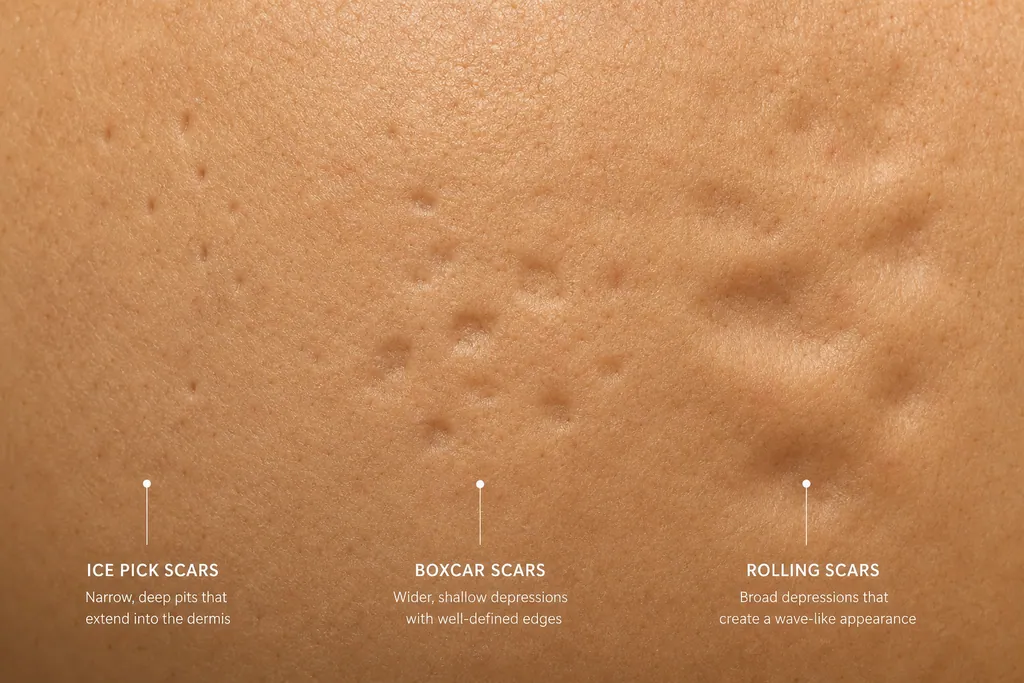
What are atrophic acne scars?
Atrophic acne scars are depressions in the skin left after deeper or inflammatory acne lesions heal. During healing, the body sometimes loses collagen or fails to replace it evenly — leaving the surface lower than the surrounding skin.
Unlike post-inflammatory pigment marks (which are usually flat and discoloured), atrophic scars involve a structural change to the skin. That structural piece is why surface skincare alone usually cannot resolve them.
Atrophic scars are commonly classified into four shapes — ice pick, boxcar, rolling and pitted scars — because the shape gives clues about what is going on beneath the surface, and therefore what kinds of treatment may actually help.
— Where treatments reach
Skin layers, in plain English
- Epidermis: Outer protective layer — pigmentation marks and surface texture live here.
- Dermis: Collagen and elastin layer — where atrophic scars are anchored and where most regenerative treatments work.
- Subcutis: Deeper fat / connective layer — beyond the reach of most aesthetic treatments.
A simplified illustration — actual skin layers are more nuanced. Your doctor will explain what is relevant to your case at consultation.
The four common atrophic scar shapes
Most people have a mix of more than one scar type, which is one reason combination treatment is so common. Identifying the dominant pattern guides which treatment is considered first.
Ice pick
Narrow, deep channels that extend down into the dermis — like a small puncture wound.
Depth-first treatments usually needed
Boxcar
Wider, shallow-to-medium depressions with clearly defined, punched-out edges.
Often responsive to fractional resurfacing
Rolling
Wave-like undulations caused by fibrous bands tethering the skin downward.
Structural release commonly needed first
Pitted / marks
Includes deeper pits and flat post-inflammatory marks left after acne heals.
Pigment marks often respond to topicals + peels
Ice pick scars
Ice pick scars are narrow, deep channels that extend down into the dermis or deeper, resembling a small puncture wound. They often form after cystic acne and are among the most challenging atrophic scars because broad-area resurfacing cannot reach the bottom of the scar.
Treatment usually involves targeted approaches that work depth-first rather than surface-first. Combination protocols — where deep scars are addressed individually and surface work is added later — are common.
Boxcar scars
Boxcar scars are wider, shallower depressions with sharply defined edges — similar in shape to chickenpox scars. They result from inflammation that destroys a wider area of collagen in the upper or middle dermis.
Because the depression has a defined edge, surface-resurfacing treatments and collagen-stimulating approaches can usefully soften both the depth and the edge over a sequence of sessions.
Rolling scars
Rolling scars give the skin a wave-like, undulating texture. They are not just on the surface — they are caused by fibrous bands tethering the skin downward to deeper tissue.
Because the issue is structural, surface treatments alone are limited. Many rolling-scar plans begin with releasing the tethering, then layer in collagen-stimulating treatments to lift and smooth the surface.
Pitted scars and post-inflammatory marks
The term 'pitted' is sometimes used loosely to describe deeper ice-pick or boxcar scars. It is also used informally for flat post-inflammatory marks (red or brown) left after acne — these are pigment changes rather than true scars and usually behave differently.
Distinguishing structural scars from pigmentation marks is important because the treatment pathway is different. A consultation is the most reliable way to separate the two.
Why different scar types need different approaches
Scar shape is a clue about depth and structure. A wide, shallow scar with a defined edge usually responds well to a different treatment than a narrow, deep channel — and a tethered rolling scar may need to be released structurally before any surface work makes a difference.
There is rarely a single device that addresses every scar type adequately. This is why combination treatment is common, and why an in-person assessment matters before any plan is built.
— Suitability matrix
Common fits for atrophic scar types
A teaching guide, not a prescription. Your doctor will confirm what is appropriate for your skin at consultation.
| Scar type | CO₂ Laser | Subcision | RF Microneedling | Chemical Peel |
|---|---|---|---|---|
| Ice pick | ||||
| Boxcar | ||||
| Rolling | ||||
| Pitted / marks |
Treatment options that may be considered
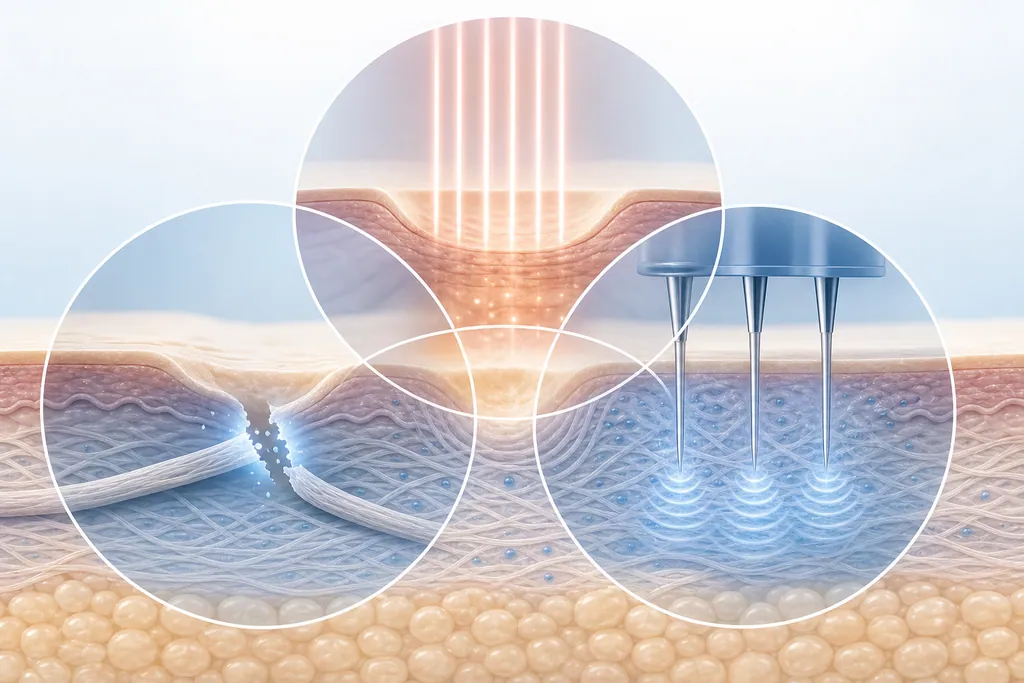
Depending on scar type, skin condition and personal goals, your doctor may consider treatments such as CO₂ laser, subcision, RF microneedling and chemical peels — usually in combination over a planned sequence rather than as standalone fixes.
Each treatment has different mechanisms, recovery times and suitability ranges. The right combination depends on your assessment.
Treatment option
CO₂ Laser
Best for: Boxcar, surface textureFractional ablative resurfacing for atrophic scars with defined edges and broader textural irregularity.
Learn moreTreatment option
Subcision
Best for: Rolling, tethered scarsTargeted release of fibrous bands that pull the skin downward — often the first step for rolling scars.
Learn moreTreatment option
RF Microneedling
Best for: Mixed scar typesRadiofrequency delivered at depth to stimulate collagen with a controlled, skin-tone friendly profile.
Learn moreTreatment option
Chemical Peel
Best for: Marks, surface toneControlled exfoliation to address post-inflammatory marks, surface irregularity and pigmentation overlap.
Learn moreWhen to book a scar assessment
A scar assessment is useful once active acne is under control. Treating scars while breakouts are still active can sometimes irritate the skin and is not always the right starting point — your doctor will advise on timing.
Bring photos taken in natural light if you can; this helps when comparing changes after treatment. A consultation is consultation-only — you do not need to commit to any treatment on the day.
— Frequently asked
Common questions
Often not as a standalone approach. Ice pick scars are narrow and deep, so broad resurfacing has limited reach. Combination plans that address the deep component first and add surface treatment later are common.
Most patients have a mix. The most reliable way to identify the dominant pattern is an in-person assessment in good lighting — photos help but cannot replace examination.
They are different rather than necessarily harder. Rolling scars are tethered by fibrous bands and often need a structural release step (such as subcision) before surface treatment can make a meaningful difference.
Atrophic scar treatment is generally a planned sequence rather than a single visit. A realistic expectation is gradual improvement across multiple sessions, with consolidation and maintenance afterwards.
It can be when device choice, settings and protocols are matched to skin type. Inappropriate settings can trigger post-inflammatory pigmentation, which is why a doctor-led plan matters.
— Related treatments
Continue with the relevant DrPlus treatment pages
Each page goes deeper into mechanism, suitability and recovery — your final plan is confirmed at consultation.
Primary money page
Acne Scar Treatment Hub
Category hub with the full range of doctor-led acne scar pathways at DrPlus.
acne scar treatment in Johor BahruSupporting
Acne Scar Treatment in Singapore
The Singapore pathway for mapping mixed scars and matching each type to a suitable option.
doctor-led acne scar treatment in Singapore by scar typeSupporting
CO₂ Laser
Fractional resurfacing for boxcar scars, surface texture and broader irregularity.
CO₂ laser for acne scarsSupporting
Subcision
Targeted release of fibrous bands that pull rolling scars down — often the first step.
subcision for rolling acne scarsSupporting
RF Microneedling
Radiofrequency-delivered collagen stimulation suited to mixed scar profiles.
RF microneedling for acne scarsSupporting
Chemical Peel
Controlled exfoliation for post-inflammatory marks and surface tone overlap.
chemical peel for acne marks— Continue reading
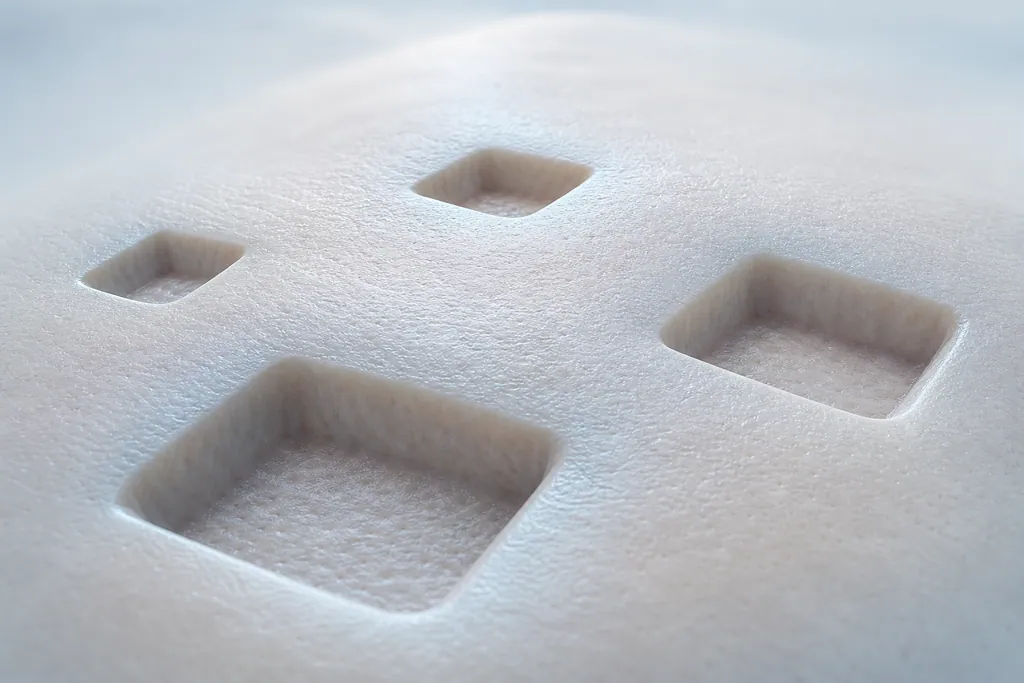 Acne Scars
Boxcar Acne Scars: What They Are and Treatment Options
Boxcar scars are broad depressions with sharp, defined edges. Their shape explains why creams rarely help — and what may.
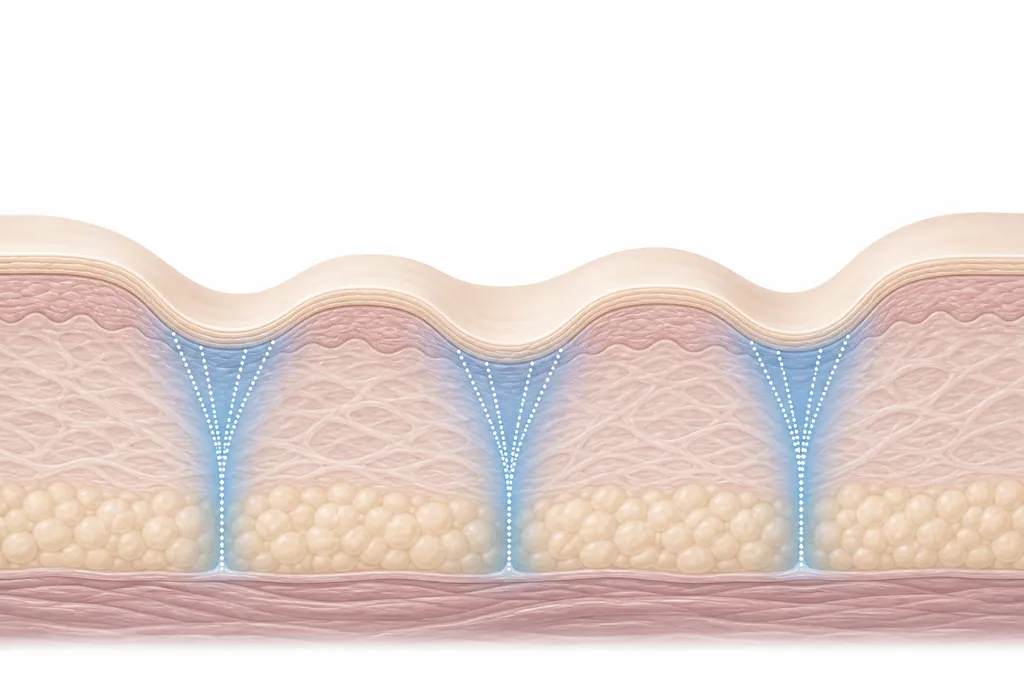 Acne Scars
Rolling Acne Scars: Why They Form Beneath the Skin
Rolling scars are pulled down from below by fibrous bands. Until that tethering is released, surface treatments often disappoint.
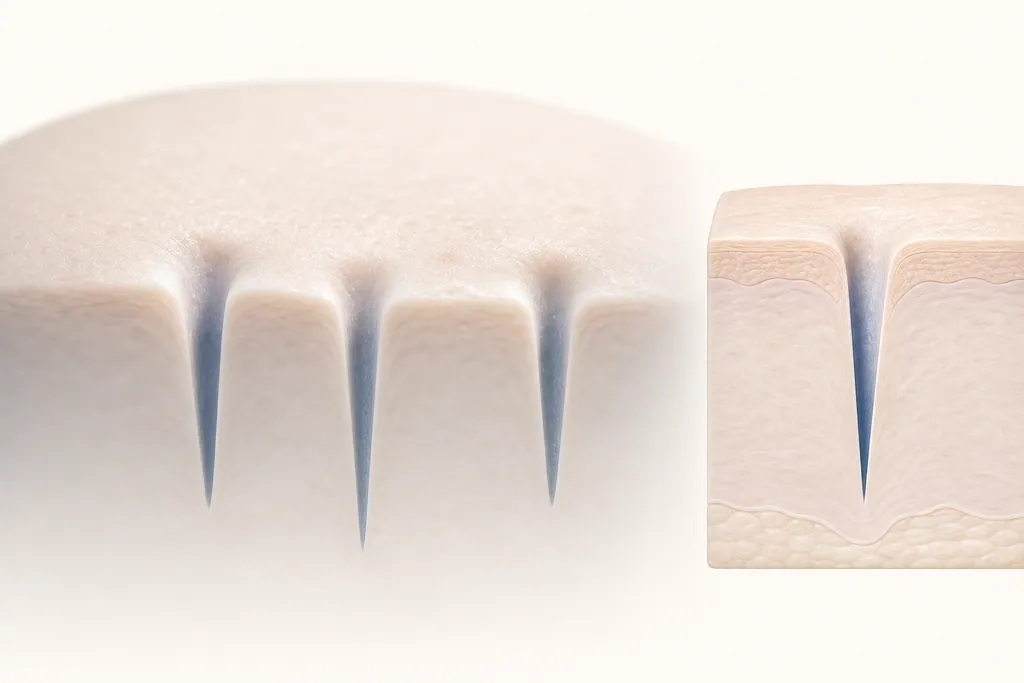 Acne Scars
Ice Pick Scars: Why They Are Difficult to Treat
Ice pick scars are narrow and deep — like tiny punctures. Their shape is exactly why broad resurfacing struggles to reach them.
 Acne Scars
Why Combination Treatment Is Often Needed for Acne Scars
Most people have more than one scar type, and each behaves differently. That is why a single treatment rarely does the whole job.