
DrPlus Skin Education · Acne Scars
Why Combination Treatment Is Often Needed for Acne Scars
Most people have more than one scar type, and each behaves differently. That is why a single treatment rarely does the whole job.
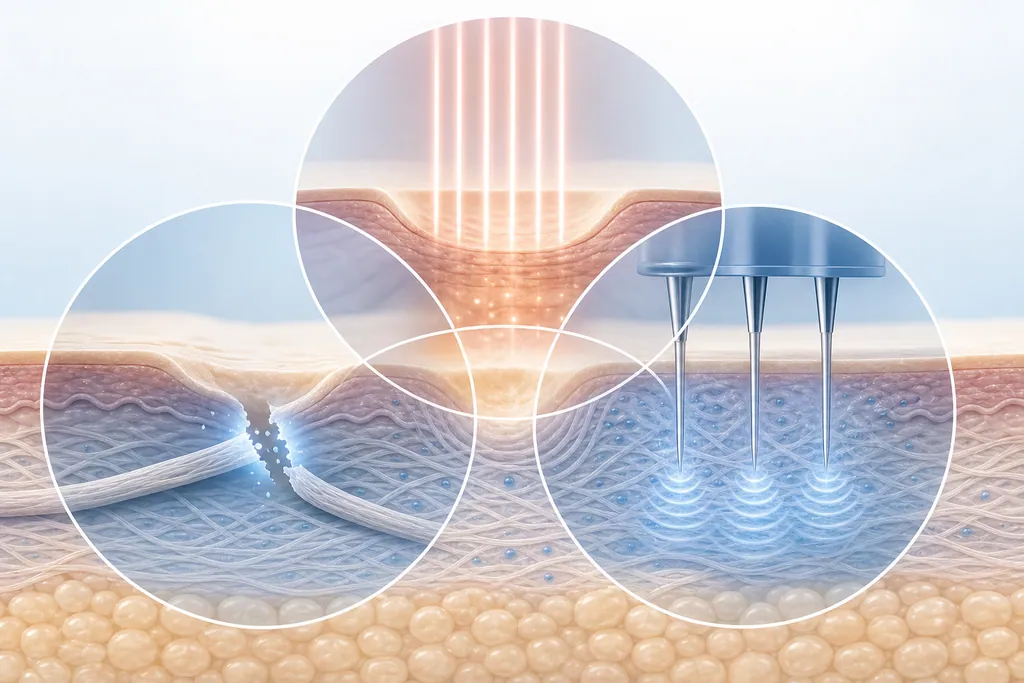
On this page
- Quick answer
- Why one acne scar treatment may not be enough
- Different scars have different causes
- Tethering vs texture vs depth
- Subcision for tethered scars
- CO₂ laser for surface texture
- RF microneedling for collagen remodeling
- Chemical peels for selected surface concerns
- Building a treatment plan
- Why consultation matters
Quick answer
Combination treatment is often needed because acne scars are not a single problem. Most people have a mix of scar types — tethered rolling scars, sharp-edged boxcar scars, deep ice pick scars — and each responds to a different treatment.
A good plan sequences treatments over months so each does its job: releasing tethering, rebuilding collagen at depth, and refining the surface. The right combination is decided by a doctor assessment, not a fixed package.
Why one acne scar treatment may not be enough
It is tempting to look for the single 'best' treatment for acne scars. But scars are the end result of different healing problems, and no single device addresses all of them well.
A laser that beautifully refines surface texture cannot release a scar tethered from below. A technique that releases tethering does not, by itself, resurface a sharp boxcar edge. Relying on one treatment for a mixed scar profile usually leaves part of the problem untouched.
This is not about selling more treatments — it is about matching the tool to the mechanism. When scars are mixed, a combination is simply the honest answer.
Different scars have different causes
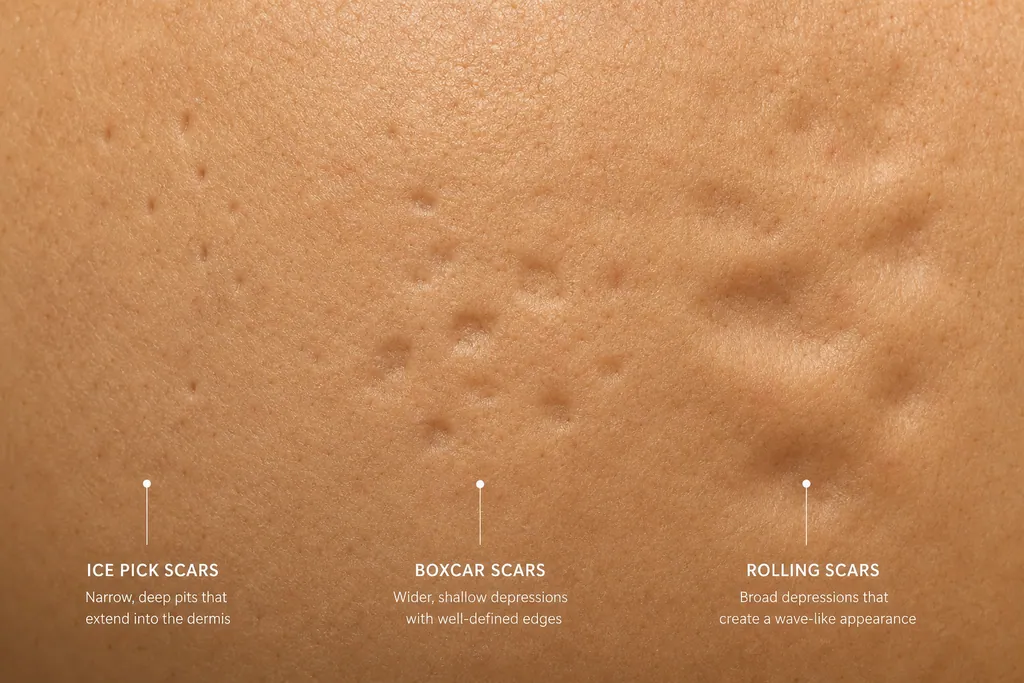
Atrophic acne scars are commonly grouped into four shapes — ice pick, boxcar, rolling and pitted/marks — and the shape reflects what happened during healing. Narrow deep channels, wide sharp-edged craters, and tethered waves are structurally different problems.
Because the cause differs, the solution differs too. Identifying the dominant pattern, and the mix, is what guides which treatments belong in the plan.
Ice pick
Narrow, deep channels that extend down into the dermis — like a small puncture wound.
Depth-first treatments usually needed
Boxcar
Wider, shallow-to-medium depressions with clearly defined, punched-out edges.
Often responsive to fractional resurfacing
Rolling
Wave-like undulations caused by fibrous bands tethering the skin downward.
Structural release commonly needed first
Pitted / marks
Includes deeper pits and flat post-inflammatory marks left after acne heals.
Pigment marks often respond to topicals + peels
Tethering vs texture vs depth
It helps to think in terms of three different problems a scar plan may need to solve: tethering (the surface pulled down from below), surface texture (sharp edges and irregularity), and depth (collagen lost deep in the dermis).
A single scar can involve more than one of these, and a face usually involves all three across different areas. Each calls for a different primary tool, which is the core reason combination treatment exists.
— Comparison
Three problems, three tools
| Problem | What it is | Common primary tool |
|---|---|---|
| Tethering | Fibrous bands pulling the surface down (rolling scars) | Subcision |
| Surface texture | Sharp edges and irregularity (boxcar, mixed) | CO₂ laser |
| Depth / collagen loss | Collagen lost deep in the dermis | RF microneedling |
| Surface tone / marks | Post-inflammatory marks and unevenness | Chemical peel (supportive) |
Tethering
- What it is
- Fibrous bands pulling the surface down (rolling scars)
- Common primary tool
- Subcision
Surface texture
- What it is
- Sharp edges and irregularity (boxcar, mixed)
- Common primary tool
- CO₂ laser
Depth / collagen loss
- What it is
- Collagen lost deep in the dermis
- Common primary tool
- RF microneedling
Surface tone / marks
- What it is
- Post-inflammatory marks and unevenness
- Common primary tool
- Chemical peel (supportive)
Subcision for tethered scars
When rolling scars are part of the picture, subcision is often the first step. Performed under local anaesthesia, it releases the fibrous bands tethering the skin down so the surface can lift toward its natural level.
Releasing the tether first matters: it means later surface treatments are working on skin that can actually respond, rather than skin being held down from beneath. This is a clear example of why sequence — not just selection — affects results.
CO₂ laser for surface texture
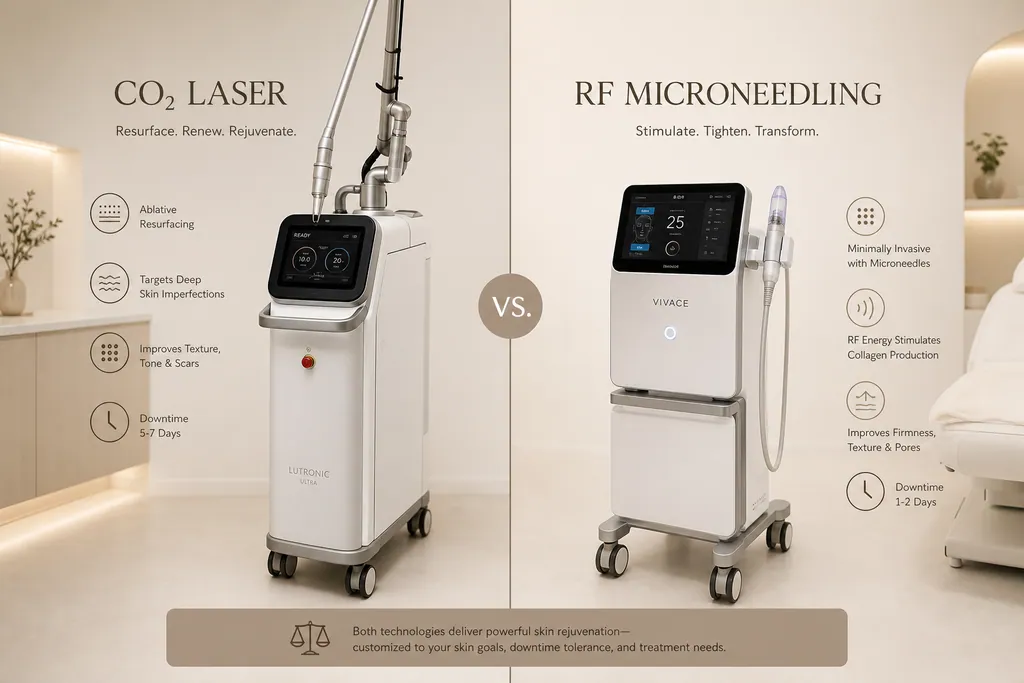
CO₂ laser is an ablative fractional resurfacing treatment. It creates microscopic columns of controlled injury that prompt collagen rebuilding and soften sharp edges — making it well suited to boxcar scars and broader textural irregularity.
Because it works on the surface and upper skin, it is frequently positioned later in a combination plan, after any structural release. It involves several days of redness and peeling, and careful settings for darker skin tones.
RF microneedling for collagen remodeling
RF microneedling delivers radiofrequency energy into the dermis through fine needles. Most of the energy lands at depth rather than across the surface, so it tends to be gentler on the upper skin and friendlier across a range of skin tones.
Its role in a combination plan is collagen support at depth — rebuilding the structural layer where atrophic scars are anchored. It is often used to maintain and build collagen between other treatments.
Chemical peels for selected surface concerns
Chemical peels use controlled exfoliation to address surface tone, post-inflammatory marks and mild surface irregularity. They are usually a supportive part of a scar plan rather than the main event.
For someone whose scars come with significant marks or uneven tone, peels can complement the structural treatments — improving how the overall result looks once collagen work is underway.
Building a treatment plan
A combination plan is sequenced over months, not stacked into one visit. Spacing lets each treatment do its job and allows the skin barrier to recover between sessions. A common pattern is structural release first, collagen support next, and surface refinement once the foundation is set.
The exact order and mix depend on your scar profile, skin tone and downtime tolerance. Progress is reviewed along the way so the plan can be adjusted as your skin responds.
— Pathway
How a combination plan is typically built
- 01
Assessment
Map the scar mix and identify tethering, texture and depth.
- 02
Release
Subcision for tethered rolling scars, where present.
- 03
Collagen support
RF microneedling to rebuild collagen at depth.
- 04
Surface refinement
CO₂ laser and peels for texture and tone.
- 05
Review & maintain
Assess response, adjust the plan, and plan touch-ups.
- 01
Assessment
Map the scar mix and identify tethering, texture and depth.
- 02
Release
Subcision for tethered rolling scars, where present.
- 03
Collagen support
RF microneedling to rebuild collagen at depth.
- 04
Surface refinement
CO₂ laser and peels for texture and tone.
- 05
Review & maintain
Assess response, adjust the plan, and plan touch-ups.
Why consultation matters
A combination plan only works when it is built around your specific skin. Choosing which treatments, in which order, at what intensity, is a clinical judgement that depends on seeing your scars in person.
At DrPlus in Johor Bahru, a consultation maps your scar mix, considers your skin tone, and explains a realistic, sequenced plan — including likely number of sessions and what improvement to expect. There is no pressure to proceed on the day.
— Frequently asked
Common questions
Different scar types are caused by different healing problems — tethering, surface texture and depth. No single treatment addresses all of them well, so a mix of scars usually needs a combination of treatments matched to each mechanism.
There is no universal best combination. A common pattern is subcision for tethered scars, RF microneedling for collagen at depth, and CO₂ laser for surface texture — but the right mix and order depend on your assessment.
Treatments are usually sequenced over time rather than stacked in one visit, so the skin can recover and each treatment can work. Your doctor will explain the spacing that suits your plan.
Combination plans typically run over several months because collagen remodels gradually and treatments are spaced apart. Your doctor will outline a realistic timeline at consultation.
A combination plan involves more than one treatment, so costs reflect that. The aim is to match treatments to your scar mix for a realistic result rather than to add treatments unnecessarily — your doctor will explain what is recommended and why.
The goal is meaningful, gradual improvement — softening and reducing the appearance of scars — rather than complete removal. Results vary between individuals and scar types.
By assessing your scar mix, skin tone, downtime tolerance and goals in person, then sequencing treatments to address tethering, depth and surface texture in a sensible order. The plan is reviewed and adjusted as your skin responds.
— Related treatments
Continue with the relevant DrPlus treatment pages
Each page goes deeper into mechanism, suitability and recovery — your final plan is confirmed at consultation.
Primary money page
Acne Scar Treatment Hub
Doctor-led category hub where combination plans are built around your scar mix.
acne scar treatment in Johor BahruSupporting
Subcision
Releases fibrous bands — often the first step in a combination plan.
subcision for tethered rolling scarsSupporting
CO₂ Laser
Fractional resurfacing for boxcar edges and broader texture.
CO₂ laser for surface textureSupporting
RF Microneedling
Energy at depth to rebuild collagen across a range of skin tones.
RF microneedling for collagen remodelingSupporting
Chemical Peel
Supportive exfoliation for marks and surface evenness.
chemical peel for surface tone— Continue reading
 Acne Scars
Types of Acne Scars: Ice Pick, Boxcar, Rolling and Pitted Scars
Atrophic acne scars come in distinct shapes — and the shape often determines what treatment may actually help.
 Acne Scars
CO₂ Laser vs RF Microneedling for Acne Scars
Two of the most common acne scar treatments — and they work in genuinely different ways. Here is how to think about them.
 Acne Scars
Acne Scar Treatment Recovery: What to Expect Week by Week
Recovery worries put many people off treatment. Here is an honest, practical timeline for what healing usually looks like.