
DrPlus Skin Education · Acne Scar Science
Why Lasers Alone May Not Fix Every Acne Scar
Lasers are superb at what they do — resurfacing the surface. But many acne scars are not surface problems. Understanding that mismatch explains why laser alone sometimes plateaus, and why combinations work better.
Quick answer
Lasers are excellent at resurfacing — removing and remodeling the surface and upper dermis to refine texture and stimulate collagen. The problem is that not every acne scar is a surface problem. Some scars are tethered down from beneath, some are too deep and narrow for a laser to reach, and some involve enough lost volume that resurfacing alone cannot lift them. When the scar's mechanism does not match what a laser does, laser alone plateaus.
This is not a criticism of lasers; it is about using the right tool for each mechanism. Tethered rolling scars need release (subcision); deep ice pick scars need focal techniques; and many faces need a combination, with laser doing the resurfacing it excels at while other tools address the parts it cannot. Understanding this is the difference between a result that stalls and one that keeps improving.
What lasers do well
It is worth being clear about the genuine strengths of laser, because the point is not that laser is weak. Fractional resurfacing lasers refine overall texture, soften the defined walls of boxcar scars, and stimulate collagen in the upper dermis. For surface irregularity and many shallow-to-moderate scars, they are among the most effective tools available, and they are a key resurfacing layer in almost every combination plan.
The limitation is one of reach and mechanism, not quality. A laser acts on the surface and upper dermis; when a scar's core problem lies deeper or is mechanical rather than textural, the laser's strengths simply do not apply to that part of the problem.
— Where treatments reach
Skin layers, in plain English
- Epidermis: Outer protective layer — pigmentation marks and surface texture live here.
- Dermis: Collagen and elastin layer — where atrophic scars are anchored and where most regenerative treatments work.
- Subcutis: Deeper fat / connective layer — beyond the reach of most aesthetic treatments.
A simplified illustration — actual skin layers are more nuanced. Your doctor will explain what is relevant to your case at consultation.
The tethered scar problem
Rolling scars are the clearest example of why laser alone can disappoint. A rolling scar is not merely missing tissue at the surface — it is actively pulled downward by fibrous bands that tether the skin to deeper layers. The wave-like depression you see is the surface being held down from beneath. A laser resurfaces the top of that depression, but it does nothing to the band doing the pulling, so the scar springs back.
The fix is mechanical: subcision passes a needle or cannula under the scar to sever the tethering bands, freeing the surface to rise. Only then does resurfacing or collagen stimulation have a level surface to refine. This is the textbook case of matching tool to mechanism — release first, then remodel.
— Mechanism
Tethered surface, before and after release
Tethered
Fibrous bands beneath the skin pull the surface downward, creating the rolling depression.
After release
Once the bands are released, the skin can sit closer to its natural level. Collagen support is often added in the following weeks.
Deep and narrow scars
Ice pick scars present a different reach problem. They are narrow channels that taper deep into the dermis, and a fractional laser cannot deliver enough energy to the base of such a tight, deep channel. Treating the surface may smooth the opening while leaving the deep channel essentially untouched, so the scar barely changes.
These scars usually need focal, depth-first techniques such as TCA CROSS, which rebuild the scar from its base, often alongside laser resurfacing of the surrounding skin. Again, the laser is not failing — it is being asked to do something its mechanism cannot, and the gap is filled by a tool designed for that geometry.
— Comparison
Where laser alone is and isn't enough
| Scar / problem | Laser alone | What's needed |
|---|---|---|
| Surface texture | Effective | Laser is a strong primary tool. |
| Boxcar walls | Often effective | Resurfacing softens defined edges. |
| Rolling (tethered) | Insufficient | Subcision to release, then collagen work. |
| Ice pick (deep, narrow) | Limited reach | Focal techniques such as TCA CROSS. |
Surface texture
- Laser alone
- Effective
- What's needed
- Laser is a strong primary tool.
Boxcar walls
- Laser alone
- Often effective
- What's needed
- Resurfacing softens defined edges.
Rolling (tethered)
- Laser alone
- Insufficient
- What's needed
- Subcision to release, then collagen work.
Ice pick (deep, narrow)
- Laser alone
- Limited reach
- What's needed
- Focal techniques such as TCA CROSS.
Volume loss and structural support
Some scarring involves enough loss of underlying tissue that the depression reflects missing volume, not just disrupted texture. Resurfacing refines the surface but does not replace lost structural support, so a deep, volume-related depression can remain even after good surface work. In these cases, support-oriented approaches and collagen-building over time matter more than surface resurfacing alone.
The practical lesson is that 'depth' is not one thing. A shallow textural scar and a deep volume-loss scar can look superficially similar but need very different strategies — which is one more reason accurate assessment, not just access to a laser, drives results.
Why combination therapy works better
Because most scarred faces carry more than one scar type and mechanism, the most reliable improvement comes from combining tools so each part of the problem is addressed by the right one. A representative sequence: release tethered rolling scars with subcision, treat deep ice pick scars with focal techniques, rebuild dermal collagen with RF microneedling, and resurface texture and boxcar walls with laser — all staged over time.
In this model the laser is a valued team member doing what it does best, not a lone solution carrying the whole burden. That is why combination therapy consistently outperforms any single modality for established, mixed scarring — and why a plan, rather than a single procedure, is what a good clinic offers.
— Pathway
Tools matched to mechanisms
- 1
Release
Subcision frees tethered rolling scars so the surface can rise.
- 2
Reach the deep ones
Focal techniques such as TCA CROSS treat deep, narrow ice pick scars.
- 3
Rebuild collagen
RF microneedling remodels the dermis across the area, gently in deeper skin.
- 4
Resurface
Laser refines texture and boxcar walls — the job it does best.
- 1
Release
Subcision frees tethered rolling scars so the surface can rise.
- 2
Reach the deep ones
Focal techniques such as TCA CROSS treat deep, narrow ice pick scars.
- 3
Rebuild collagen
RF microneedling remodels the dermis across the area, gently in deeper skin.
- 4
Resurface
Laser refines texture and boxcar walls — the job it does best.
When to consider a medical consultation
If laser treatment has improved your texture but left certain scars stubbornly unchanged, those remaining scars may have a mechanism laser cannot address alone. An assessment can identify which scars need release, focal treatment or support, and how to combine these with the resurfacing you have already had.
At DrPlus in Johor Bahru, a consultation maps each scar mechanism and explains how a combination plan would address what laser alone could not — with honest expectations and no pressure to proceed on the day.
Summary
Lasers excel at resurfacing the surface and upper dermis — refining texture, softening boxcar walls and stimulating collagen — but many acne scars involve mechanisms a surface treatment cannot reach. Tethered rolling scars are pulled from below and need release; deep, narrow ice pick scars sit beyond a laser's effective reach; and volume-loss depressions need structural support more than resurfacing.
This is why laser alone sometimes plateaus and why combination therapy, matching each tool to the mechanism it suits, usually delivers better, more complete results. The laser remains a key player — it simply works best as part of a plan rather than as a lone fix, which a proper assessment is designed to build.
— Frequently asked
Common questions
Lasers resurface the surface and upper dermis, but some scars involve mechanisms they cannot reach — tethered rolling scars pulled from below, deep narrow ice pick scars, or volume loss. Those parts often need subcision, focal techniques or structural support alongside laser.
Not at all — they are among the best tools for texture and boxcar walls and are a key part of most plans. The point is that they are not a complete solution for every scar mechanism, so they work best combined with other treatments.
Rolling scars are tethered down by fibrous bands beneath the surface. A laser resurfaces the top but does not release the band, so the scar stays pulled down. Subcision is needed to free the tether before resurfacing can help.
It means matching different tools to different scar mechanisms — for example subcision to release tethering, focal techniques for deep scars, RF microneedling for dermal collagen, and laser for texture — usually staged over time for more complete improvement.
If laser has improved texture but left certain scars unchanged, repeating it alone may not help those scars. A better step is an assessment to identify which scars need release, focal treatment or support in combination with laser.
No treatment removes scars completely. Combination therapy generally produces more complete improvement than laser alone by addressing more mechanisms, with the realistic goal of scars becoming meaningfully less noticeable.
— Related treatments
Continue with the relevant DrPlus treatment pages
Each page goes deeper into mechanism, suitability and recovery — your final plan is confirmed at consultation.
Primary money page
Acne Scar Treatment Hub
Doctor-led combination planning that matches each tool to the scar mechanism it suits.
acne scar treatment in Johor BahruSupporting
Subcision
Releases the tethering that surface laser cannot reach.
subcision for rolling scarsSupporting
RF Microneedling
Rebuilds dermal collagen as part of a combination plan.
RF microneedling for acne scarsSupporting
CO₂ Laser
The resurfacing layer that laser does best, within a wider plan.
fractional CO₂ laser for acne scars— Continue reading
Why Some Acne Scar Treatments Fail
When acne scar treatment disappoints, it is rarely because the technology failed. It is almost always one of five avoidable reasons — and understanding them is the best way to get a result that lasts.
 Acne Scars
Subcision for Acne Scars: How It Releases Rolling Scars
Rolling scars are tethered from below. Until that tethering is released, surface treatments often do less than expected — which is the job subcision does.
 Acne Scar Science
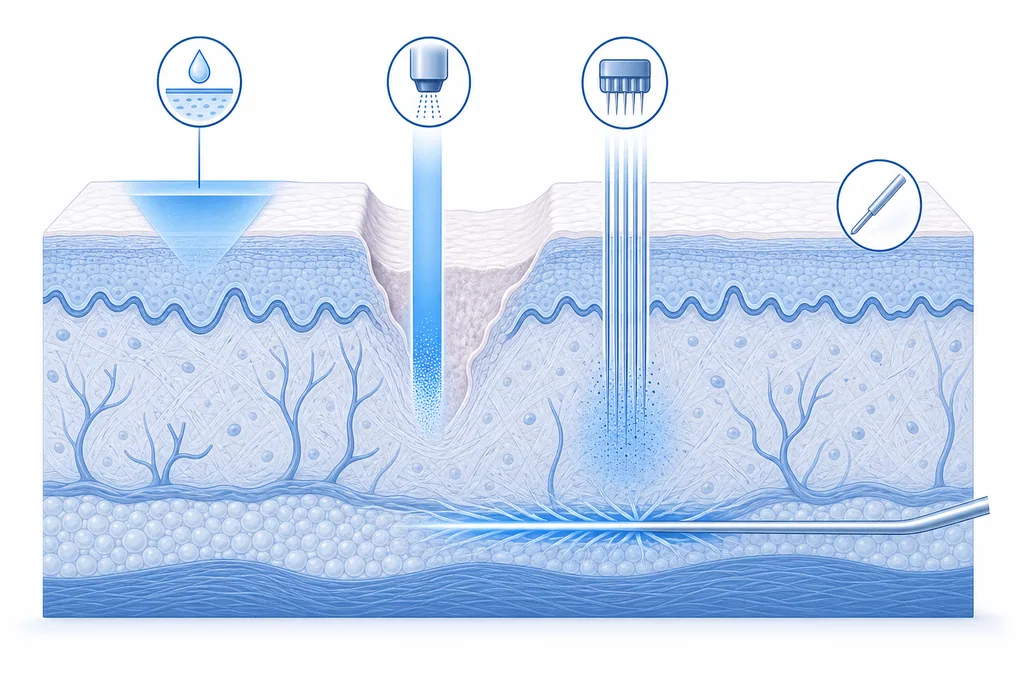
Acne Scar Treatment Comparison: CO₂ Laser, RF Microneedling, Subcision & Peels
There is no single 'best' acne scar treatment — only the right tool for a specific scar at a specific depth. This guide compares the four main options on the dimensions that actually decide outcomes.