
DrPlus Skin Education · Acne Scar Science
Why Some Acne Scar Treatments Fail
When acne scar treatment disappoints, it is rarely because the technology failed. It is almost always one of five avoidable reasons — and understanding them is the best way to get a result that lasts.
Quick answer
When someone says an acne scar treatment 'didn't work', the cause is rarely that the laser or device was ineffective. Far more often it is one of five avoidable reasons: the wrong treatment was chosen for the scar type, active acne was still creating new damage, the treatment was under-dosed or stopped too early, aftercare (especially sun protection) was neglected, or expectations were set at 'removal' when the realistic goal is improvement.
The encouraging implication is that most of these are within your and your doctor's control. A treatment matched to the scar, on calm skin, dosed adequately over enough sessions, with good aftercare and honest expectations, is what separates a satisfying result from a disappointing one. This guide walks through each failure mode so you can recognise and avoid it.
Reason 1: the wrong treatment for the scar
Atrophic scars come in distinct shapes — ice pick, boxcar, rolling — and each responds to a different mechanism. Broad resurfacing cannot reach the base of a deep, narrow ice pick scar. No surface treatment will lift a rolling scar that is tethered down from below. A single resurfacing pass will not address a face that actually needs subcision plus collagen stimulation. When the tool does not match the scar, even a flawlessly performed treatment underdelivers.
This is the most common and most fixable failure mode. It usually traces back to inadequate assessment — treating 'acne scars' as one thing rather than reading the specific mix of scar types and matching tools to each. A careful diagnosis is the foundation; everything else is downstream of getting this right.
— Comparison
Mismatch examples
| Scar | Wrong move | Better fit |
|---|---|---|
| Ice pick | Broad resurfacing only | Focal techniques (e.g. TCA CROSS) at depth |
| Rolling (tethered) | Laser alone | Subcision to release, then collagen stimulation |
| Mixed scarring | One treatment for everything | Combination plan matched to each type |
Ice pick
- Wrong move
- Broad resurfacing only
- Better fit
- Focal techniques (e.g. TCA CROSS) at depth
Rolling (tethered)
- Wrong move
- Laser alone
- Better fit
- Subcision to release, then collagen stimulation
Mixed scarring
- Wrong move
- One treatment for everything
- Better fit
- Combination plan matched to each type
Reason 2: treating scars while acne is still active
Scar treatment assumes you are repairing past damage. If acne is still active, you are repairing while fresh damage is being created — new inflammatory lesions form new scars and new post-inflammatory marks, often faster than treatment can improve the old ones. The result feels like running on a treadmill: effort and expense without net progress.
This is why responsible plans calm active acne first. It is not a delay tactic or an upsell; it is sequencing. Every active lesion is a potential new scar and a source of collagen-degrading inflammation, so settling the acne protects the investment you are about to make in scar treatment.
Reason 3: undertreatment
Scar improvement is cumulative — each session adds an increment of collagen that matures over months. Stopping after one or two sessions, or treating too conservatively for the scar's depth, simply does not deliver enough cumulative change. People then conclude the treatment 'doesn't work', when in reality it was never given the dose or duration it needed.
There is a balance here, especially in darker skin: too aggressive raises pigmentation risk, too timid wastes the opportunity. The right answer is an adequate, appropriately spaced course matched to the scar and skin — not a single hopeful session, and not reckless intensity. Completing the planned series is part of the treatment working.
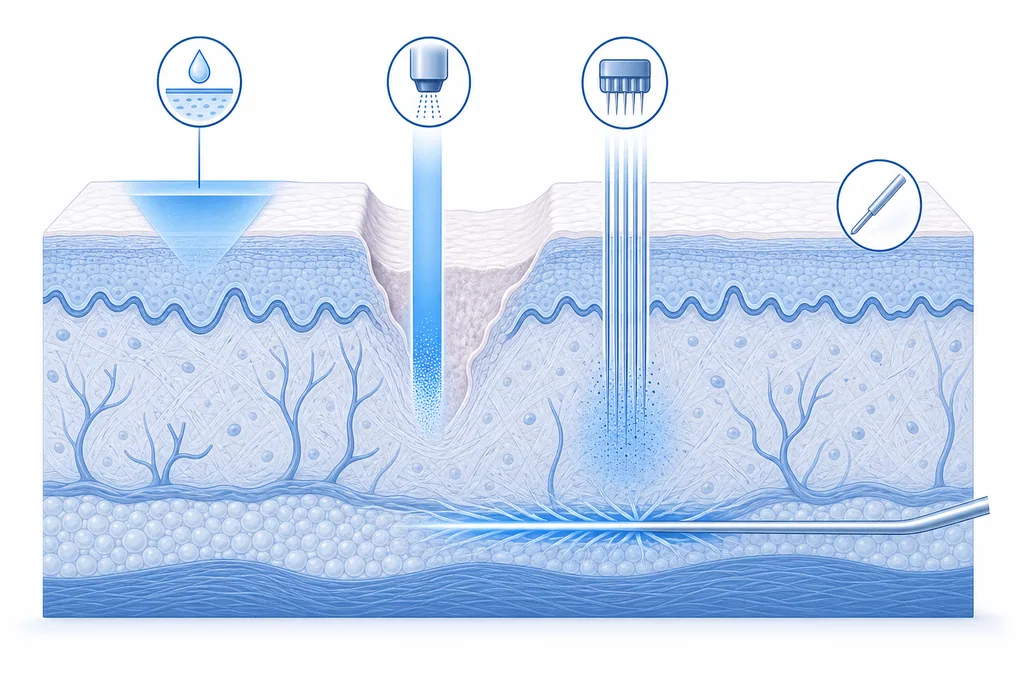
— Where treatments reach
Skin layers, in plain English
- Epidermis: Outer protective layer — pigmentation marks and surface texture live here.
- Dermis: Collagen and elastin layer — where atrophic scars are anchored and where most regenerative treatments work.
- Subcutis: Deeper fat / connective layer — beyond the reach of most aesthetic treatments.
A simplified illustration — actual skin layers are more nuanced. Your doctor will explain what is relevant to your case at consultation.
Reason 4: poor aftercare
What happens between sessions shapes the result. The two biggest culprits are neglected sun protection and disrupted healing. Unprotected UV exposure after treatment is a leading cause of post-inflammatory pigmentation — which can both mar the result and, in darker skin, masquerade as treatment failure. Picking at flaking or healing skin can cause new marks and even new scarring.
Good aftercare is unglamorous but decisive: gentle skin care, barrier support, not picking, and rigorous broad-spectrum sun protection — particularly under strong Malaysian sun. Treatments performed perfectly can still disappoint if the weeks afterward undo the work. Aftercare is genuinely part of the treatment, not an optional add-on.
Reason 5: unrealistic expectations
Sometimes the treatment objectively improved the scars — shallower, less shadowed, smoother texture — but it is perceived as a failure because the expectation was complete removal or fast change. No credible acne scar treatment removes scars entirely, and meaningful results take months to mature. When the bar is set at 'gone' or 'next week', genuine improvement reads as disappointment.
Honest expectation-setting is therefore part of good care, not a hedge. The realistic, worthwhile goal is making scars significantly less noticeable in everyday light, over a planned course. Clinics that promise removal or guaranteed results are setting patients up to feel let down — and that mismatch, not the treatment, is what 'fails'.
How to give treatment its best chance
Putting the five reasons in reverse gives a simple checklist for success: get a proper diagnosis of your scar types, settle active acne first, commit to an adequate and appropriately spaced course, follow aftercare and sun protection diligently, and hold realistic expectations measured at the right time. Most disappointments are prevented at the planning stage, not rescued afterward.
This is also why a considered, doctor-led plan tends to outperform a one-off procedure chosen on price or marketing. The plan is what aligns the tool, the timing, the dose and the expectations — the things that actually decide whether treatment succeeds.
— Pathway
Setting treatment up to succeed
- 1
Diagnose the scars
Map the specific scar types and skin tone so tools can be matched correctly.
- 2
Calm the acne
Settle active breakouts first so new scars are not forming during treatment.
- 3
Treat adequately
Complete an appropriately dosed, spaced course matched to scar and skin.
- 4
Aftercare & expectations
Protect from the sun, avoid picking, and judge results at three to six months.
- 1
Diagnose the scars
Map the specific scar types and skin tone so tools can be matched correctly.
- 2
Calm the acne
Settle active breakouts first so new scars are not forming during treatment.
- 3
Treat adequately
Complete an appropriately dosed, spaced course matched to scar and skin.
- 4
Aftercare & expectations
Protect from the sun, avoid picking, and judge results at three to six months.
When to consider a medical consultation
If a previous treatment disappointed you, that does not necessarily mean nothing can help — it often means one of these five factors was off. A fresh assessment can identify what went wrong: a mismatch, undertreatment, ongoing acne, aftercare gaps, or an expectation set too high.
At DrPlus in Johor Bahru, a consultation reviews your scar types, skin tone and history, explains honestly what is realistic, and builds a plan designed to avoid these failure modes — with no pressure to proceed on the day.
Summary
Acne scar treatments mostly 'fail' for reasons that have little to do with the technology: the treatment was mismatched to the scar type, active acne kept creating new damage, the course was under-dosed or cut short, aftercare was neglected, or expectations were set at removal rather than improvement. Each of these is avoidable with proper planning.
Give treatment its best chance by getting an accurate diagnosis, calming acne first, completing an adequate course, protecting the skin afterward, and judging results on biology's months-long clock. Done this way, well-matched treatment usually succeeds at its realistic goal — making scars meaningfully less noticeable — which is exactly what a careful assessment is designed to deliver.
— Frequently asked
Common questions
Most often because of treatment–scar mismatch, untreated active acne, too few sessions, poor aftercare, or expectations set at removal. These are planning and expectation issues rather than technology failures, and a fresh assessment can usually identify which applied.
A mismatched or over-aggressive treatment can fail to improve a scar and, particularly in darker skin, can trigger post-inflammatory pigmentation. Matching the right tool to the scar type and skin tone is what avoids this.
Because active acne keeps creating new scars and marks. Treating scars while breakouts continue means repairing old damage while new damage forms — calming the acne first lets scar treatment actually get ahead.
Usually several, spaced over months, because improvement is cumulative as collagen remodels. Stopping after one or two sessions is a common cause of underwhelming results. Your doctor will give a realistic range for your scars.
Often the situation can be improved with a better-matched plan, calmer skin, an adequate course and good aftercare. A fresh assessment identifies what went wrong and what realistic improvement is still achievable.
No. No credible treatment removes scars entirely. The realistic, worthwhile goal is making them significantly less noticeable over a planned course, with results judged at three to six months.
— Related treatments
Continue with the relevant DrPlus treatment pages
Each page goes deeper into mechanism, suitability and recovery — your final plan is confirmed at consultation.
Primary money page
Acne Scar Treatment Hub
Doctor-led assessment and combination planning designed to avoid common failure modes.
acne scar treatment in Johor BahruSupporting
Subcision
The right tool for tethered scars that laser alone cannot lift.
subcision for rolling scarsSupporting
RF Microneedling
Dermal collagen remodeling, often combined for a complete plan.
RF microneedling for acne scarsSupporting
CO₂ Laser
Resurfacing for texture and boxcar walls within a matched plan.
fractional CO₂ laser for acne scars— Continue reading
Why Lasers Alone May Not Fix Every Acne Scar
Lasers are superb at what they do — resurfacing the surface. But many acne scars are not surface problems. Understanding that mismatch explains why laser alone sometimes plateaus, and why combinations work better.
 Acne Scar Science
Acne Scar Treatment Comparison: CO₂ Laser, RF Microneedling, Subcision & Peels
There is no single 'best' acne scar treatment — only the right tool for a specific scar at a specific depth. This guide compares the four main options on the dimensions that actually decide outcomes.
Why Acne Scar Treatments Usually Need Multiple Sessions
Multiple sessions are not a sales tactic — they are how the biology of collagen actually works. Here is why staging treatment over time is the honest, effective way to improve scars.