
DrPlus Skin Education · Laser Resurfacing
Ablative vs Non-Ablative Lasers: What the Difference Really Means
Every skin laser falls into one of two families — those that vaporise tissue and those that work without removing the surface. Knowing which is which decodes almost every laser menu you will ever read.
The two families every laser belongs to
Strip away the brand names and every resurfacing-adjacent laser answers one question: does it remove tissue, or not? Ablative lasers — CO₂ at 10,600nm and erbium YAG at 2,940nm — are absorbed so strongly by water in the skin that they vaporise it, physically removing a controlled layer. Non-ablative lasers deliver their energy without breaking the surface: they heat the dermis, or in the case of pico lasers, shatter pigment particles photoacoustically, while the skin above stays intact.
'Fractional' is a separate concept that confuses people because it applies to both families. Fractional means the energy is delivered in a grid of tiny zones with untouched skin between them. There are fractional ablative lasers (fractional CO₂, fractional erbium) and fractional non-ablative lasers (most Fraxel modes). The grid controls how much skin is treated per pass; ablative-versus-non-ablative controls what happens inside each zone.
— Mechanism
Fractional vs fully ablative resurfacing
Fractional CO₂
Only narrow columns are treated. The untouched skin between them acts as a reservoir of healthy cells, so recovery is faster.
Fully ablative (older approach)
The whole surface is removed in one pass. Results can be strong, but downtime and risk are higher — a key reason fractional delivery became standard.
Simplified illustration. The depth, density and energy of treatment columns are set by your doctor based on scar depth and skin type.
Side by side: the practical differences
The physics translates into very practical differences in what a course of treatment feels like and delivers:
— Comparison
Ablative vs non-ablative at a glance
| Ablative (CO₂, erbium) | Non-ablative (Fraxel-type, pico) | |
|---|---|---|
| What it does | Vaporises columns of tissue and heats the surrounding dermis | Heats the dermis or targets pigment without removing the surface |
| Downtime | Roughly 5–7 days of visible recovery (redness, bronzing, peeling) | Hours to 2–3 days of redness or mild swelling; often none |
| Results per session | Larger change per session — fewer sessions overall | Smaller change per session — planned as a longer series |
| Strongest for | Texture, acne scars, etched lines, resurfacing | Pigment, tone, gentle collagen stimulation, maintenance |
| Discomfort | Needs topical numbing; sunburn feel for a day or two | Usually mild warmth or snapping; little to no numbing |
| PIH consideration | Higher stimulus — needs conservative settings in darker tones | Gentler on average, though no laser is zero-risk |
What it does
- Ablative (CO₂, erbium)
- Vaporises columns of tissue and heats the surrounding dermis
- Non-ablative (Fraxel-type, pico)
- Heats the dermis or targets pigment without removing the surface
Downtime
- Ablative (CO₂, erbium)
- Roughly 5–7 days of visible recovery (redness, bronzing, peeling)
- Non-ablative (Fraxel-type, pico)
- Hours to 2–3 days of redness or mild swelling; often none
Results per session
- Ablative (CO₂, erbium)
- Larger change per session — fewer sessions overall
- Non-ablative (Fraxel-type, pico)
- Smaller change per session — planned as a longer series
Strongest for
- Ablative (CO₂, erbium)
- Texture, acne scars, etched lines, resurfacing
- Non-ablative (Fraxel-type, pico)
- Pigment, tone, gentle collagen stimulation, maintenance
Discomfort
- Ablative (CO₂, erbium)
- Needs topical numbing; sunburn feel for a day or two
- Non-ablative (Fraxel-type, pico)
- Usually mild warmth or snapping; little to no numbing
PIH consideration
- Ablative (CO₂, erbium)
- Higher stimulus — needs conservative settings in darker tones
- Non-ablative (Fraxel-type, pico)
- Gentler on average, though no laser is zero-risk
The real trade: downtime for depth of change
There is no free lunch in resurfacing. The controlled injury that forces skin to rebuild is also what creates recovery time — so as a rule, the more a single session changes texture, the more visible the week after it. The honest way to compare options is total cost of the result: an ablative course might be two sessions with a week of recovery each, while a non-ablative course reaching a similar texture goal might be five or six easy sessions over more months.
Which trade is right depends on your life more than your skin: some patients would rather disappear for a week once; others cannot afford any visible downtime and prefer the slow lane. Both are legitimate — what matters is choosing deliberately rather than by marketing.
— Relative downtime
How they compare on recovery
Pico laser (non-ablative)
Minimal
Redness for hours; makeup usually next day. Pigment and tone work.
Non-ablative fractional (Fraxel-type)
Light
Pink and mildly swollen 1–3 days. Series of sessions.
Fractional erbium
Moderate
Lighter ablative — a few days of flaking, less residual heat than CO₂.
Fractional CO₂
Higher
About 5–7 days of visible recovery. Strongest per-session texture change.
Recovery profiles vary by skin, settings and aftercare. Your doctor will share what is realistic for your case.
Where the names you have heard actually sit
CO₂ (10,600nm) is the deepest-acting ablative wavelength, with significant residual heat — that heat is what drives strong collagen remodelling, and also what creates its downtime. Erbium YAG (2,940nm) is the other ablative: absorbed even more strongly by water, it removes tissue more superficially with less thermal effect — a gentler resurfacer with lighter recovery, at the cost of less deep collagen stimulus per pass.
Fraxel is a brand of fractional laser, and its most common modes (1,550nm and the 1,927nm thulium) are non-ablative — dermal heating in a grid without vaporising the surface. Pico lasers are non-ablative and work differently again: ultra-short pulses shatter pigment photoacoustically, which is why they excel at pigmentation and tone rather than deep texture. RF microneedling is not a laser at all, but it belongs in the conversation: needles deliver radiofrequency heat directly into the dermis while sparing the surface — a non-ablative-style downtime profile with meaningful texture results, and a common CO₂ alternative in PIH-prone skin.
How a doctor actually chooses between them
The decision is rarely 'which laser is best' and usually 'which injury does this skin need, and what recovery can this patient accept'. Deep textural problems — scarring, etched lines — favour ablative power or RF microneedling. Pigment and tone problems favour pico. Darker or PIH-prone skin shifts the calculus toward conservative or non-ablative approaches, or an ablative treatment with deliberately restrained settings.
Many real plans mix families: pico for pigment first, fractional CO₂ for texture later, or RF microneedling between CO₂ sessions. That is another reason to start from a diagnosis rather than a device name — the menu follows the assessment, not the other way around.
— Frequently asked
Common questions
Ablative lasers, like CO₂ and erbium YAG, vaporise a controlled layer of tissue — powerful resurfacing with several days of visible recovery. Non-ablative lasers, like pico and most Fraxel modes, deliver heat or target pigment without removing the surface — much lighter downtime, with smaller changes per session planned as a series.
Ablative. CO₂ at 10,600nm is absorbed strongly by water in skin and vaporises tissue on contact. Modern CO₂ treatment is almost always fractional — delivered in a grid of microscopic zones with intact skin between them — which keeps the ablative power while cutting recovery to roughly five to seven days.
Neither is universally better — they trade differently. Ablative gives larger per-session change with real downtime; non-ablative gives gradual change with minimal downtime over more sessions. The right choice depends on your concern (texture vs pigment), your skin tone, and how much recovery your life allows. A consultation settles it faster than comparison shopping.
On average, gentler energy means lower post-inflammatory hyperpigmentation risk — but no laser is zero-risk, and a badly set non-ablative laser can still cause PIH. Ablative CO₂ can also be used carefully in darker tones with conservative parameters. Safety lives in the settings and the operator more than the category.
Yes, within their lane. Non-ablative fractional lasers genuinely stimulate collagen and improve tone and mild texture over a series of sessions, and pico lasers are excellent for pigment. What they do not do is match a fractional CO₂ session for deep texture or scar change — expecting that leads to disappointment.
No — this is the most common mix-up. 'Fractional' describes the delivery pattern (a grid of treated zones with intact skin between), and it exists in both families: fractional CO₂ is ablative, while most Fraxel modes are fractional and non-ablative. Always ask which family a 'fractional laser' belongs to.
— Related treatments
Continue with the relevant DrPlus treatment pages
Each page goes deeper into mechanism, suitability and recovery — your final plan is confirmed at consultation.
Primary money page
Fractional CO₂ Laser at DrPlus
The ablative option — with settings personalised to your skin tone and goal.
doctor-led fractional CO₂ laser in Johor BahruSupporting
Pico Laser Sessions
The main non-ablative option for pigmentation-led concerns.
pico laser for pigment and toneSupporting
RF Microneedling
Dermal heating through needles — surface-sparing texture treatment.
RF microneedling as a lower-downtime alternativeSupporting
Acne Scar Treatment
Where each laser family fits in a full scar plan.
how scar treatments are combined— Continue reading
Fractional CO₂ Laser: The Complete Resurfacing Guide
Fractional CO₂ laser is the workhorse of skin resurfacing — one technology used for scars, texture, pores, fine lines and overall rejuvenation. Here is how it actually works, and who it suits.
 Acne Scars
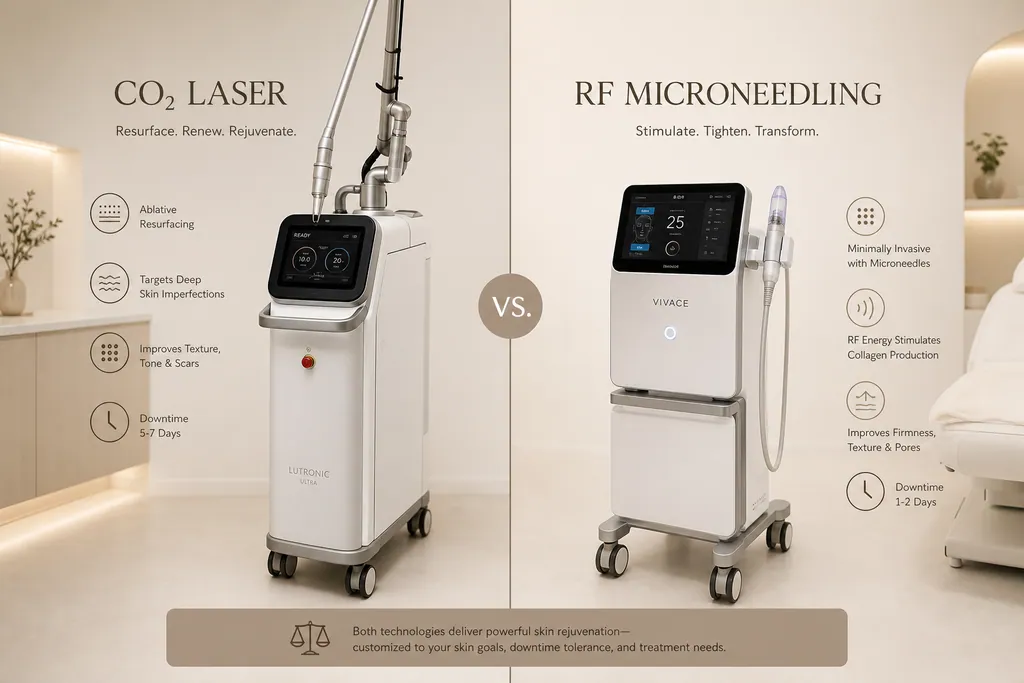
CO₂ Laser vs RF Microneedling for Acne Scars
Two of the most common acne scar treatments — and they work in genuinely different ways. Here is how to think about them.