
DrPlus Skin Education · Laser Resurfacing
Fractional CO₂ Laser: The Complete Resurfacing Guide
Fractional CO₂ laser is the workhorse of skin resurfacing — one technology used for scars, texture, pores, fine lines and overall rejuvenation. Here is how it actually works, and who it suits.
What fractional CO₂ laser actually is
A CO₂ laser produces light at 10,600 nanometres — a wavelength absorbed so strongly by the water in skin cells that it vaporises tissue on contact. That makes it an ablative laser: it physically removes a controlled layer of skin rather than merely heating it. Ablation is what gives CO₂ resurfacing its strength, and also what gives it real downtime.
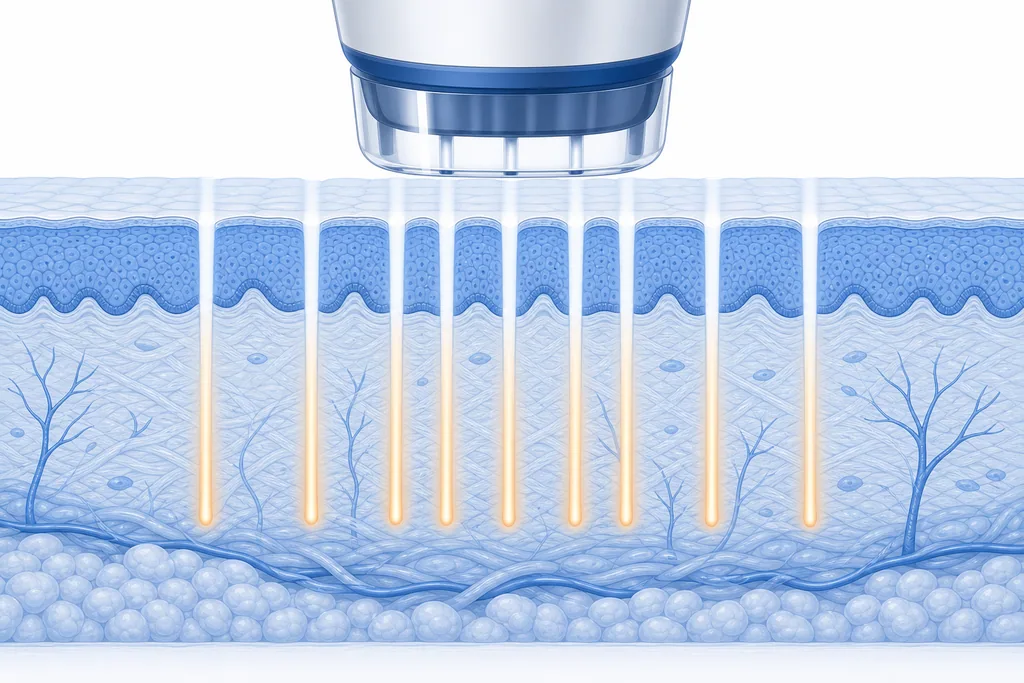
The 'fractional' part is the safety innovation. Instead of removing the entire surface in one pass — the old fully-ablative approach, with weeks of raw recovery — the beam is split into a fine grid of microscopic treatment columns called microthermal zones. Between every treated column sits a bridge of completely untouched skin, packed with healthy cells that migrate in and re-heal the treated zones within days.
That geometry is the whole trade: you keep most of the collagen-stimulating power of ablative resurfacing while cutting the visible recovery to roughly five to seven days for a typical face treatment.
— Mechanism
Fractional vs fully ablative resurfacing
Fractional CO₂
Only narrow columns are treated. The untouched skin between them acts as a reservoir of healthy cells, so recovery is faster.
Fully ablative (older approach)
The whole surface is removed in one pass. Results can be strong, but downtime and risk are higher — a key reason fractional delivery became standard.
Simplified illustration. The depth, density and energy of treatment columns are set by your doctor based on scar depth and skin type.
How it improves skin: three mechanisms at once
Each microthermal zone does more than remove tissue. The laser's effect works on three levels, which is why one session keeps producing change for months afterwards:
Mechanism
1 · Ablation
The column of damaged surface tissue — rough texture, scar edges, sun-worn skin — is vaporised and replaced by fresh skin as the zone re-heals.
Mechanism
2 · Thermal stimulation
A rim of controlled heat around each column signals fibroblasts — the skin's collagen factories — to switch into repair mode.
Mechanism
3 · Collagen remodelling
Over the following two to six months, new collagen is laid down and reorganised, gradually firming texture and softening scars and lines.
What fractional CO₂ is used for
Because the depth, density and energy of the microthermal zones are all adjustable, one machine covers a wide range of concerns. At DrPlus, fractional CO₂ is offered for full-face resurfacing and, with adjusted settings, for delicate areas like the under-eye region and neck. Stretch marks are treated within our dedicated stretch-mark programme.
— Comparison
One technology, many jobs
| Concern | How resurfacing helps |
|---|---|
| Acne scars | Softens boxcar walls and shallow scarring; often combined with subcision or RF microneedling for deeper scars. |
| Uneven texture | Replaces rough, irregular surface skin and stimulates smoother collagen underneath. |
| Enlarged pores | Tightens the collagen around pore openings so they appear finer — a refinement, not an erasure. |
| Fine lines | Fresh surface skin plus new dermal collagen soften etched-in fine lines, especially around the eyes and mouth. |
| General rejuvenation | Overall brightness and firmness from renewed surface skin and months of collagen remodelling. |
| Stretch marks | Fractional resurfacing within the stretch-mark programme — improvement, not disappearance, is the honest goal. |
Acne scars
- How resurfacing helps
- Softens boxcar walls and shallow scarring; often combined with subcision or RF microneedling for deeper scars.
Uneven texture
- How resurfacing helps
- Replaces rough, irregular surface skin and stimulates smoother collagen underneath.
Enlarged pores
- How resurfacing helps
- Tightens the collagen around pore openings so they appear finer — a refinement, not an erasure.
Fine lines
- How resurfacing helps
- Fresh surface skin plus new dermal collagen soften etched-in fine lines, especially around the eyes and mouth.
General rejuvenation
- How resurfacing helps
- Overall brightness and firmness from renewed surface skin and months of collagen remodelling.
Stretch marks
- How resurfacing helps
- Fractional resurfacing within the stretch-mark programme — improvement, not disappearance, is the honest goal.
What a session involves
A fractional CO₂ session is more structured than lighter lunchtime lasers, because it is a genuine resurfacing procedure with real (if short) recovery. Here is the typical arc at a doctor-led clinic:
— Pathway
A typical fractional CO₂ visit
- 1
Consultation & assessment
The doctor examines your skin, discusses goals, and confirms suitability — including PIH risk and any preparation needed. Private, no obligation to proceed.
- 2
Numbing
Topical anaesthetic sits on the skin for around 30–45 minutes. Most patients describe the treatment as hot pinpricks rather than sharp pain.
- 3
Laser passes
The handpiece treats the area in a grid, with depth and density set to your skin and goal. A face typically takes 15–30 minutes of laser time.
- 4
Aftercare & review
Soothing care is applied and you leave with written aftercare. Expect five to seven days of visible recovery, with follow-up available on WhatsApp.
- 1
Consultation & assessment
The doctor examines your skin, discusses goals, and confirms suitability — including PIH risk and any preparation needed. Private, no obligation to proceed.
- 2
Numbing
Topical anaesthetic sits on the skin for around 30–45 minutes. Most patients describe the treatment as hot pinpricks rather than sharp pain.
- 3
Laser passes
The handpiece treats the area in a grid, with depth and density set to your skin and goal. A face typically takes 15–30 minutes of laser time.
- 4
Aftercare & review
Soothing care is applied and you leave with written aftercare. Expect five to seven days of visible recovery, with follow-up available on WhatsApp.
Who suits it — and the honest caveats
Fractional CO₂ suits people with textural concerns — scarring, roughness, pores, fine lines — who can accept a planned week of visible recovery. It is not the right first tool for pigment problems like melasma or sun spots, where non-ablative options such as pico laser usually make more sense.
Skin tone matters. In Asian and darker skin tones, the healing inflammation itself can trigger post-inflammatory hyperpigmentation. That risk is manageable — conservative settings, sometimes pre-treatment skin preparation, and strict sun protection afterwards — but it is exactly why parameters should be chosen by a doctor who treats these skin tones routinely, not copied from a fair-skin protocol.
Results are gradual and individual. Improvement builds over months, most plans involve more than one session, and complete removal of scars or lines is not a realistic promise from any laser.
Key terms in laser resurfacing
Resurfacing research gets confusing fast because brand names and physics terms are mixed freely. These are the terms worth knowing:
— Frequently asked
Common questions
It resurfaces the skin: a 10,600nm ablative laser vaporises a grid of microscopic columns of skin, and the healing response replaces them with fresh tissue while stimulating months of new collagen. It is used for acne scars, uneven texture, enlarged pores, fine lines and general rejuvenation, with settings adjusted to each goal.
It depends on the concern and how aggressively each session is set. Lighter rejuvenation goals may be planned as one or two sessions; scar and texture work commonly involves a series spaced a couple of months apart, because collagen remodelling from each session continues for months. A doctor sets a realistic range at consultation.
With topical numbing applied for 30–45 minutes beforehand, most patients describe it as tolerable — hot pinpricks and warmth rather than sharp pain. The treated skin feels like a sunburn for the first day or so, which settles quickly with the aftercare provided.
Plan around five to seven days of visible recovery for a typical face treatment: redness first, then a bronzed, sandpaper-like texture, then peeling around days three to seven revealing pink new skin. The pinkness fades over the following weeks. Lighter settings shorten this; deeper scar settings lengthen it.
Yes, when the parameters respect the skin. Asian and darker skin tones carry a real risk of post-inflammatory hyperpigmentation after ablative treatment, so conservative settings, appropriate preparation and strict sun protection are essential. This is a treatment where the doctor's experience with your skin tone matters as much as the machine.
Fully ablative CO₂ removes the entire skin surface in the treated area — powerful, but with weeks of raw recovery and higher risk. Fractional CO₂ treats only a grid of microscopic zones, leaving intact skin between them, so healing takes days instead of weeks. Fractional is the modern standard for almost all resurfacing.
Today, almost always yes. “CO₂ laser”, “fractional CO₂” and “laser fractional CO₂” nearly always refer to the same modern device: a 10,600 nm carbon-dioxide laser delivered in a fractional grid pattern. The older fully-ablative mode still exists for specific indications, but when a clinic advertises CO₂ resurfacing for scars, pores or texture, fractional delivery is what is meant.
It contributes a genuine but moderate tightening effect. The controlled thermal injury stimulates new collagen as the microscopic zones heal, which firms skin texture and can soften fine crepiness — most visibly in thinner-skinned areas. It is not a substitute for a lifting treatment: significant laxity is usually better addressed with HIFU or other modalities, sometimes combined with CO₂ for surface quality. A doctor separates the two problems at assessment.
— Related treatments
Continue with the relevant DrPlus treatment pages
Each page goes deeper into mechanism, suitability and recovery — your final plan is confirmed at consultation.
Primary money page
Fractional CO₂ Laser at DrPlus
Doctor-led resurfacing in Iskandar Puteri — settings personalised at consultation.
fractional CO₂ laser resurfacing at DrPlusSupporting
Acne Scar Treatment
The full scar programme — CO₂ is one tool among several.
acne scar treatment optionsSupporting
RF Microneedling
A lower-downtime collagen stimulator often compared with CO₂.
RF microneedling for texture and scarsSupporting
Book a Consultation
Suitability, settings and PIH risk are all assessed by a doctor first.
book a private skin assessment— Continue reading
 CO₂ Laser
Fractional CO₂ Laser for Acne Scars: Complete Scientific Guide
Fractional CO₂ laser is one of the most powerful resurfacing tools for acne scars — but only when the right scar, the right settings and the right skin meet. Here is the science behind how it actually works.
Ablative vs Non-Ablative Lasers: What the Difference Really Means
Every skin laser falls into one of two families — those that vaporise tissue and those that work without removing the surface. Knowing which is which decodes almost every laser menu you will ever read.