
DrPlus Men's Wellness · Circumcision
Circumcision in Singapore & Johor Bahru: An Adult's Guide
Adult circumcision is a common, straightforward procedure done for medical or personal reasons. Here is a clear, judgement-free overview.

Quick answer
Circumcision is the surgical removal of the foreskin. In adults it is considered for two broad reasons: medical (for example a tight foreskin that cannot retract, recurrent inflammation or infections) and personal — religious, cultural or hygiene preferences. Both are entirely legitimate, and a good clinic treats the decision without judgement.
As an adult procedure it is done in a clinical setting, usually under local anaesthesia, and most men return to desk-based work within a few days while full healing takes a few weeks. The main decisions are why you are considering it and which method best suits you — both worth discussing with a doctor.
Why adults consider circumcision
Medically, the most common drivers are phimosis (a foreskin too tight to retract comfortably), recurrent balanitis (inflammation), or related hygiene difficulties. In these cases circumcision can resolve a recurring problem rather than being purely elective.
Personally, many men choose it for religious or cultural reasons, perceived hygiene benefits, or preference. There is no requirement to justify a personal choice — the consultation simply ensures it is safe and appropriate for you.
Mechanism
Tight foreskin (phimosis)
A foreskin that cannot retract comfortably is a common medical reason.
Mechanism
Recurrent inflammation
Repeated infections or irritation may be helped by circumcision.
Mechanism
Personal preference
Religious, cultural or hygiene reasons — all entirely valid.
The main methods
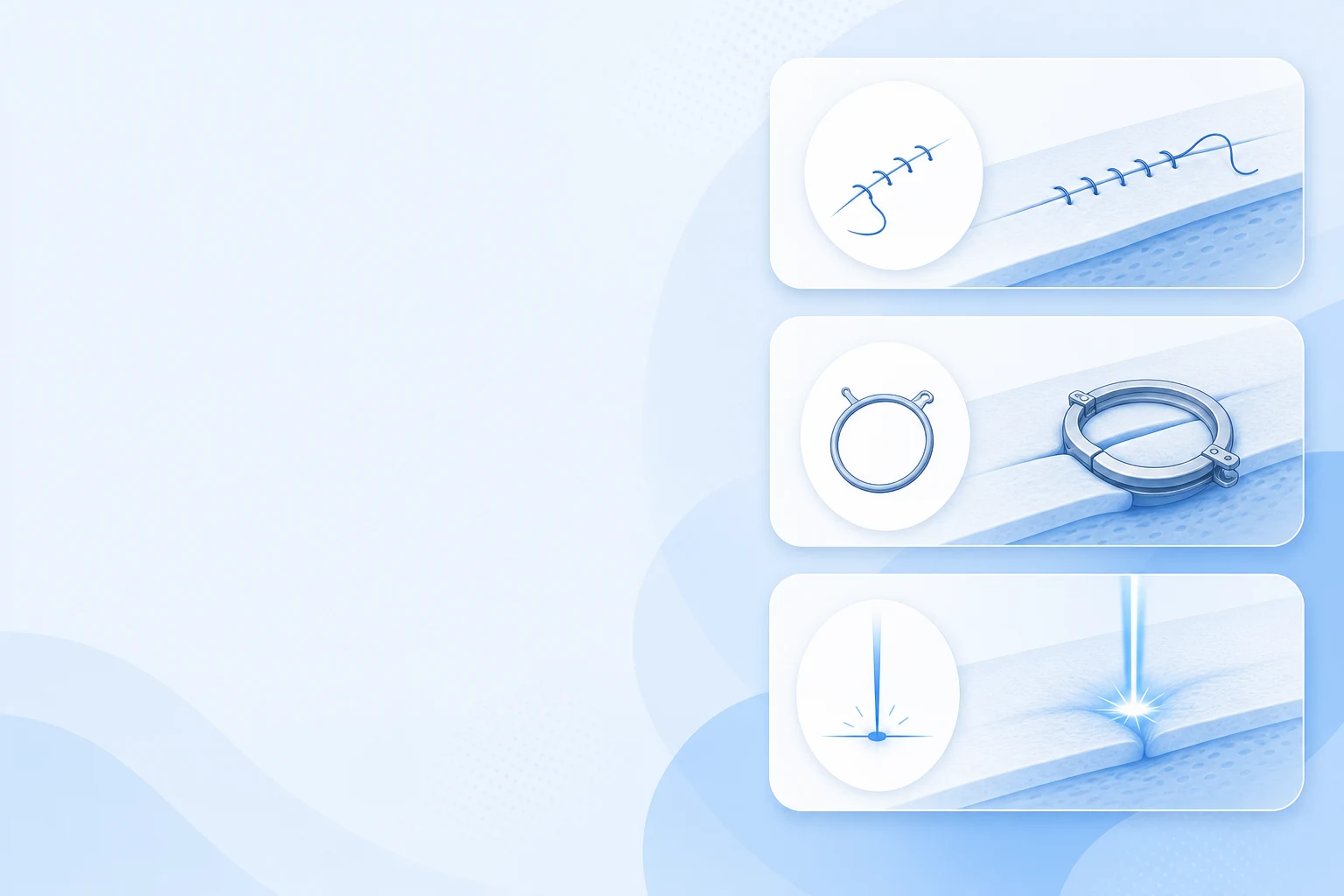
There are three broad approaches. Conventional surgical circumcision removes the foreskin and closes the area with dissolvable stitches — the long-established standard. Device or clamp methods use a tool to guide removal, often with less bleeding and fewer stitches. Laser-assisted circumcision uses laser energy to cut and seal, which can reduce bleeding — though it is still a surgical procedure, not a 'no-cut' shortcut.
No method is universally best. The right choice depends on your anatomy, any medical reasons, and your healing preferences, which is exactly what the consultation works through.
— Method comparison
Three common approaches to adult circumcision
Conventional
Surgical removal with stitches
Time-tested; stitches dissolve over time.
Device / Clamp
A device guides removal, often stitch-light
Aims for a tidy result with reduced bleeding.
Laser
Laser-assisted cutting and sealing
Sealing can mean less bleeding; still a surgical procedure.
No single method is universally best — the right choice depends on your anatomy, any medical reasons, healing preferences and a doctor’s assessment. All are surgical procedures done in a clinical setting.
What recovery is like
Expect some swelling and tenderness for the first days, managed with simple pain relief and care instructions. Most men resume light daily activity and desk work within a few days. Strenuous activity and sexual activity are typically paused for a few weeks until healing is complete.
Clear written aftercare — keeping the area clean, recognising normal versus concerning signs, and knowing when to follow up — is part of good care. Healing timelines vary between individuals.
— Healing timeline
A typical recovery arc
Days 1–3
Early healing
Swelling and tenderness; managed with pain relief and gentle care.
Week 1
Settling
Most men back to desk work; keep the area clean and protected.
Weeks 2–4
Healing
Swelling subsides; stitches dissolve where used.
~4–6 weeks
Full recovery
Strenuous and sexual activity resumed once healed, as advised.
A general guide only. Individual healing speed varies with skin type, scar depth, aftercare and the treatment used.
A private, doctor-led process
Circumcision is a personal matter, and the process should feel calm and confidential — private rooms, discreet booking, and a doctor who explains everything clearly. Examination is done only as clinically needed and with your consent.
At DrPlus in Johor Bahru, the consultation focuses on your reasons, the right method, and honest expectations — never pressure.
— Privacy first
How private men's wellness consultations work at DrPlus
Private consultation
Private rooms, discreet booking, and confidential records — your appointment is private from the moment you book.
Doctor-led assessment
Every conversation is with a qualified physician — not a sales consultant.
Discreet care
Calm, judgement-free, clinical — no pressure to proceed and no public exposure.
When to see a doctor
Book a consultation if you have a medical issue like a tight foreskin or recurrent infections, or simply want to discuss circumcision as a personal choice. The doctor confirms suitability, explains the methods, and answers your questions without rush.
Any sudden pain, a foreskin stuck in a retracted position, or signs of infection should be assessed promptly rather than left.
— Frequently asked
Common questions
The procedure is done under local anaesthesia, so it is not painful at the time. Afterwards there is some tenderness and swelling for a few days, managed with simple pain relief and aftercare.
Most men return to desk work within a few days. Full healing usually takes a few weeks, with strenuous and sexual activity paused for around four to six weeks until healed, as advised by your doctor.
There is no universally best method. Conventional, device/clamp and laser-assisted approaches each have trade-offs. The right choice depends on your anatomy, medical reasons and healing preferences, decided with a doctor.
No. Circumcision is considered for medical reasons or for personal, religious and hygiene preferences. A consultation is judgement-free and simply ensures it is safe and appropriate for you.
Yes. Consultations take place in private rooms, with discreet booking and confidential handling of records. Examination is performed only when clinically necessary and with your consent.
— Related treatments
Continue with the relevant DrPlus treatment pages
Each page goes deeper into mechanism, suitability and recovery — your final plan is confirmed at consultation.
— Continue reading
 Circumcision
Circumcision Methods Compared: Stapler, Laser, Glue and More
'Stapler', 'laser', 'glue' or 'conventional'? Here is what each circumcision method actually means — without the marketing spin.
 Men's Wellness
Phimosis (Tight Foreskin): Treatment in Singapore & Johor Bahru
A foreskin that will not retract is common and treatable. Here is what causes it, what not to do, and the options that actually help.
 Men's Wellness
Private STD Testing in Singapore & Johor Bahru: What to Expect
Testing should not be a stressful or exposed experience. Here is what a private, doctor-led consultation looks like.