
DrPlus Men's Wellness · Circumcision
Circumcision Methods Compared: Stapler, Laser, Glue and More
'Stapler', 'laser', 'glue' or 'conventional'? Here is what each circumcision method actually means — without the marketing spin.
Quick answer
When clinics advertise 'laser' or 'clamp' circumcision, they are describing how the foreskin is removed, not whether surgery happens. All circumcision is a surgical procedure. The differences lie in the technique, how bleeding is managed, the use of stitches, and the healing experience.
The honest summary: each method has trade-offs, and none is a magic painless or scar-free shortcut. The best method for you depends on your anatomy, any medical reasons, and your preferences — which is a conversation for a doctor, not an advertisement.
The methods at a glance
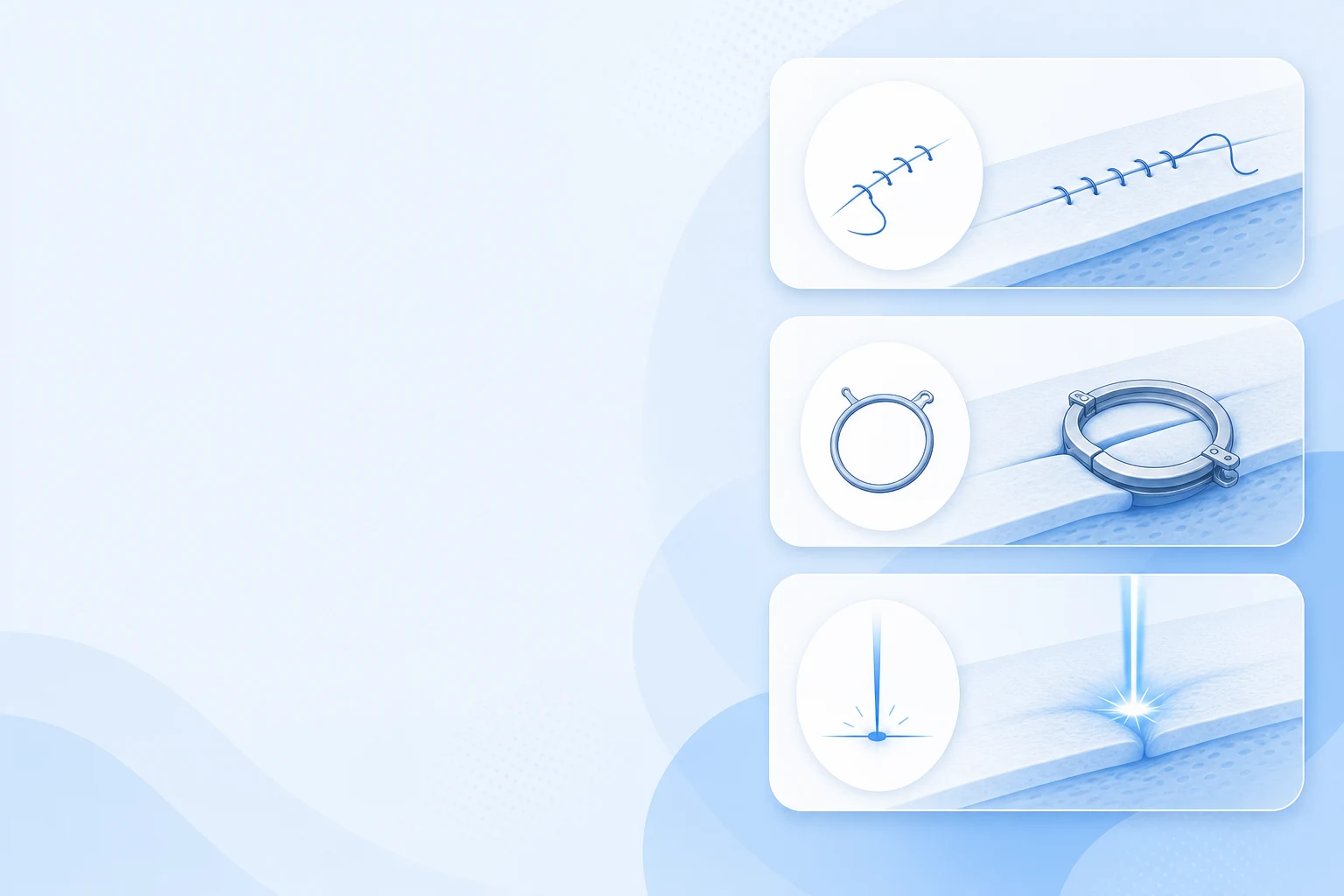
Conventional surgical circumcision is the long-established approach: the foreskin is removed and the area closed with dissolvable stitches. Stapler and device methods — including ZSR-type circular staplers and the Shang ring — use a tool that removes the foreskin and seals the edge in one step, often reducing bleeding and the number of stitches. Glue-assisted circumcision closes the wound with medical-grade tissue adhesive in place of some or all stitches. Laser-assisted circumcision uses focused laser energy to cut and seal tissue, which can reduce bleeding.
Each is performed under local anaesthesia in a clinical setting. The visual below summarises the conceptual differences.
— Method comparison
Three common approaches to adult circumcision
Conventional
Surgical removal with stitches
Time-tested; stitches dissolve over time.
Device / Clamp
A device guides removal, often stitch-light
Aims for a tidy result with reduced bleeding.
Laser
Laser-assisted cutting and sealing
Sealing can mean less bleeding; still a surgical procedure.
No single method is universally best — the right choice depends on your anatomy, any medical reasons, healing preferences and a doctor’s assessment. All are surgical procedures done in a clinical setting.
How they compare
The practical trade-offs are summarised below. Remember these are general tendencies — individual results depend on technique, anatomy and healing, not the device label alone.
— Comparison
Circumcision methods — general comparison
| Aspect | Conventional | Stapler / Ring | Glue-assisted | Laser |
|---|---|---|---|---|
| How it works | Surgical removal + stitches | Device removes and seals in one step | Removal + adhesive closure | Laser cuts and seals |
| Bleeding | Standard | Often reduced | Standard | Often reduced |
| Closure | Dissolvable stitches | Staples/ring separate over weeks | Adhesive film peels away | Variable |
| Still surgery? | Yes | Yes | Yes | Yes |
How it works
- Conventional
- Surgical removal + stitches
- Stapler / Ring
- Device removes and seals in one step
- Glue-assisted
- Removal + adhesive closure
- Laser
- Laser cuts and seals
Bleeding
- Conventional
- Standard
- Stapler / Ring
- Often reduced
- Glue-assisted
- Standard
- Laser
- Often reduced
Closure
- Conventional
- Dissolvable stitches
- Stapler / Ring
- Staples/ring separate over weeks
- Glue-assisted
- Adhesive film peels away
- Laser
- Variable
Still surgery?
- Conventional
- Yes
- Stapler / Ring
- Yes
- Glue-assisted
- Yes
- Laser
- Yes
Laser vs stapler circumcision
These two get compared most often, so it is worth being precise. A stapler (such as a ZSR-type device) changes how the foreskin is removed and closed: the circular device excises and seals the edge in one action, which is why stapler procedures are often quick with limited bleeding. The small staples then separate on their own over two to three weeks. A laser changes only the cutting instrument: the foreskin is removed by laser energy instead of a blade, with sealing as it cuts — closure still needs stitches, glue or both.
Neither is universally better. Staplers standardise the cut and closure, which suits straightforward anatomy; laser offers the surgeon fine control and reduced bleeding but leaves closure as a separate step. Recovery arcs are comparable, and the deciding factors are your anatomy and the doctor's assessment — not the device's marketing.
Recovery differences
Across methods, recovery is broadly similar: some swelling and tenderness early on, desk work within days, and a few weeks to full healing. Methods that reduce bleeding may feel a little tidier early on, but the overall arc is comparable.
What matters most for a smooth recovery is good technique and clear aftercare — not the marketing name of the method.
— Relative downtime
How they compare on recovery
Conventional
Light
Tenderness and swelling; desk work in days.
Stapler / Ring
Light
Often less bleeding; staples separate over 2–3 weeks.
Glue-assisted
Light
No knots; adhesive film peels away as skin heals.
Laser
Light
Sealing can reduce bleeding; still a few weeks to heal.
Recovery profiles vary by skin, settings and aftercare. Your doctor will share what is realistic for your case.
Choosing with a doctor, privately
The right method is best chosen in a private consultation where a doctor assesses your anatomy and reasons and explains the realistic trade-offs. Beware any provider promising a discomfort-free, scar-free, instant result — that is marketing, not medicine.
At DrPlus, method selection is doctor-led and honest, in a discreet setting — at our clinics in Singapore and across the border.
— Privacy first
How private men's wellness consultations work at DrPlus
Private consultation
Private rooms, discreet booking, and confidential records — your appointment is private from the moment you book.
Doctor-led assessment
Every conversation is with a qualified physician — not a sales consultant.
Discreet care
Calm, judgement-free, clinical — no pressure to proceed and no public exposure.
— Frequently asked
Common questions
A device method: a circular stapler removes the foreskin and seals the wound edge in one step, often with less bleeding and a quick procedure time. The small staples then separate on their own over two to three weeks. The Shang ring works on a related ring-compression principle.
Neither universally. Staplers standardise removal and closure in one action; laser gives fine cutting control with reduced bleeding but still needs stitches or glue to close. Recovery is comparable — the right choice depends on your anatomy and the doctor's assessment.
Yes. The laser performs the cutting and seals tissue as it goes. It is not a no-cut method — it simply uses laser energy instead of a conventional blade.
A closure technique: after the foreskin is removed surgically, medical-grade tissue adhesive seals the skin edges in place of some or all stitches. The film peels away on its own over one to two weeks as the skin heals beneath it.
Stapler/ring and laser methods often reduce bleeding compared with conventional surgery, but individual results depend on technique and anatomy. A doctor can advise what suits you.
Through a private consultation where a doctor assesses your anatomy and reasons and explains the realistic trade-offs. Be cautious of providers promising discomfort-free or scar-free results.
— Related treatments
Continue with the relevant DrPlus treatment pages
Each page goes deeper into mechanism, suitability and recovery — your final plan is confirmed at consultation.
Primary money page
Circumcision at DrPlus
Doctor-led method selection in a discreet setting.
adult circumcision in Johor BahruSupporting
Circumcision in Singapore
Method selection at the Tanjong Pagar and East Coast clinics.
circumcision clinic services in SingaporeSupporting
Stapler Circumcision: Deep Dive
Our detailed guide to the stapler method specifically.
how stapler circumcision works step by stepSupporting
Men's Wellness Overview
How DrPlus approaches private men's health.
doctor-led men's wellness in Johor Bahru— Continue reading
Glue Circumcision in Singapore: How Tissue Adhesive Closure Works
'Glue circumcision' does not mean no surgery — it means the wound is closed with medical tissue adhesive instead of stitches. Here is how it works, who suits it, and how healing differs.
 Circumcision
Circumcision in Singapore & Johor Bahru: An Adult's Guide
Adult circumcision is a common, straightforward procedure done for medical or personal reasons. Here is a clear, judgement-free overview.
Circumcision Recovery: Healing Timeline and Aftercare Guide
Knowing what normal healing looks like makes circumcision recovery far less stressful. Here is the week-by-week timeline, the aftercare that matters, and the warning signs to act on.