
DrPlus Men's Wellness · Circumcision
Circumcision Recovery: Healing Timeline and Aftercare Guide
Knowing what normal healing looks like makes circumcision recovery far less stressful. Here is the week-by-week timeline, the aftercare that matters, and the warning signs to act on.
Quick answer
Adult circumcision healing follows a predictable arc: the first few days bring swelling and tenderness, week one settles enough for desk work, weeks two to four see stitches dissolve or device components separate as the wound knits, and by around four to six weeks most men are cleared to resume all activity. Individual timelines vary with age, health and method.
Aftercare is straightforward but matters: keep the area clean and dry, manage discomfort with the pain relief your doctor recommends, wear snug supportive underwear to limit movement and swelling, and attend your review so healing is checked rather than guessed at.
— Healing timeline
The typical healing arc
Days 1–3
Peak swelling
Tenderness, swelling and mild bruising peak — rest, pain relief and gentle care.
Days 4–7
Settling
Discomfort eases; most men resume desk work and light daily activity.
Weeks 2–3
Closure
Dissolvable stitches soften and fall away; stapler components separate naturally.
Weeks 4–6
Cleared
Wound matured; strenuous exercise and sexual activity resumed as advised.
A general guide only. Individual healing speed varies with skin type, scar depth, aftercare and the treatment used.
Wound care basics
Follow your clinic's written instructions first — they are personalised to your method. In general: keep the initial dressing on for as long as instructed, then keep the area clean with gentle washing and thorough, careful drying. Avoid soaking (baths, pools) until cleared; quick showers are usually fine after the first day or two.
Snug, supportive underwear reduces movement, friction and swelling — it makes a noticeable difference to comfort in the first two weeks. Apply any prescribed ointment as directed, and resist the urge to pick at stitches, glue film or device components; they detach on their own schedule.
How the method changes recovery
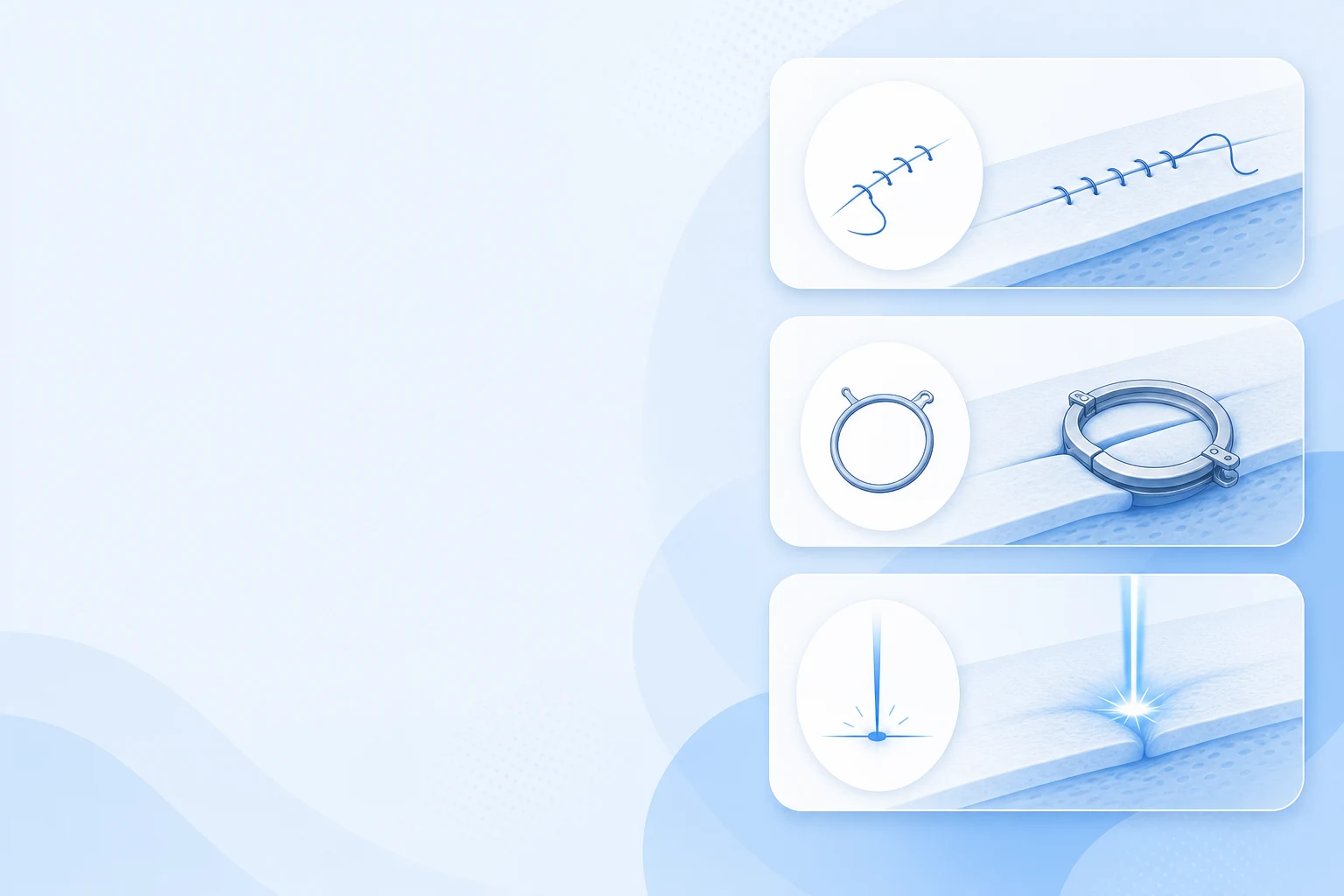
The overall healing arc is broadly similar across methods, but the details differ. With conventional circumcision, dissolvable stitches soften and fall away over two to three weeks. With stapler (device) circumcision, the small staples or ring components separate gradually over a similar window — finding a few on your underwear is normal, and stragglers are removed at review if needed. With glue-assisted closure, the adhesive film peels away as the skin heals beneath it.
None of these should be pulled, peeled or trimmed at home. If a component is causing genuine discomfort rather than just being noticeable, that is a review question — not a bathroom project.
— Comparison
Closure types — what to expect while healing
| Closure | What happens | Typical window |
|---|---|---|
| Dissolvable stitches | Soften and fall away on their own | Roughly 2–3 weeks |
| Stapler / device | Staples or ring components separate gradually | Roughly 2–3 weeks; stragglers removed at review |
| Tissue glue | Adhesive film peels as skin heals beneath | Roughly 1–2 weeks |
Dissolvable stitches
- What happens
- Soften and fall away on their own
- Typical window
- Roughly 2–3 weeks
Stapler / device
- What happens
- Staples or ring components separate gradually
- Typical window
- Roughly 2–3 weeks; stragglers removed at review
Tissue glue
- What happens
- Adhesive film peels as skin heals beneath
- Typical window
- Roughly 1–2 weeks
Work, exercise and sexual activity
Desk-based work is usually realistic within a few days. Physically demanding jobs need longer — often one to two weeks — because straining and friction aggravate swelling. Walking is encouraged early; gym sessions, cycling, swimming and contact sport wait until your doctor clears them, typically around the four-to-six-week mark.
Sexual activity, including masturbation, is paused until the wound has fully healed — usually four to six weeks. Resuming early is one of the most common causes of wound breakdown, which sets healing back significantly. Night-time erections can be briefly uncomfortable in the early weeks; emptying your bladder before sleep and simple pain relief help.
Warning signs that need review
Most recoveries are uneventful, but you should know what is not normal. Bleeding that does not settle with ten minutes of gentle pressure, spreading redness or warmth, thick discharge, fever, worsening pain after day three, or difficulty passing urine all warrant prompt contact with your clinic rather than waiting for the scheduled review.
A good clinic gives you a direct line for exactly these questions — use it. An early phone call resolves most concerns; a late one turns small issues into bigger ones.
— Frequently asked
Common questions
Most adults are back at desk work within a few days, the wound closes over two to three weeks, and full healing — including clearance for exercise and sexual activity — typically takes around four to six weeks. Individual timelines vary.
Dissolvable stitches soften and fall away over roughly two to three weeks. Stapler ring components separate gradually over a similar window, and any stragglers are removed at your review. Neither should be pulled off at home.
Quick showers are usually fine after the first day or two — follow your clinic's specific instructions. Avoid soaking in baths or pools until cleared, keep washing gentle, and dry the area carefully afterwards.
Walking is encouraged early. Gym sessions, cycling, swimming and sport typically wait around four to six weeks, until your doctor confirms the wound has healed enough to handle friction and exertion.
Yes — swelling, tenderness and mild bruising are expected in the first week and ease gradually. What is not normal is swelling that keeps worsening, spreading redness, fever or discharge; those warrant prompt review.
— Related treatments
Continue with the relevant DrPlus treatment pages
Each page goes deeper into mechanism, suitability and recovery — your final plan is confirmed at consultation.
— Continue reading
Adult Circumcision: What to Expect From Consultation to Recovery
Considering circumcision as an adult raises practical questions: what happens at consultation, what procedure day feels like, and how much time off you really need. Here are the answers.
Circumcision in Singapore: Procedure, Recovery and What to Expect
Circumcision is one of the most common minor surgical procedures in Singapore, performed on infants, boys and adults alike. Here is a clear, judgement-free overview of how it works.
 Circumcision
Circumcision Methods Compared: Stapler, Laser, Glue and More
'Stapler', 'laser', 'glue' or 'conventional'? Here is what each circumcision method actually means — without the marketing spin.