
DrPlus Skin Education · Laser Resurfacing
CO₂ Laser Healing Day by Day: What to Expect
The week after fractional CO₂ follows a predictable script — redness, bronzing, peeling, pink new skin. Knowing the script in advance is what makes recovery calm instead of alarming.
The shape of CO₂ recovery: front-loaded, then quiet
Fractional CO₂ downtime is front-loaded. Almost everything visible happens in the first week — the redness, the bronzed rough texture, the peeling — and then the drama is over. What continues afterwards is invisible: months of collagen remodelling that delivers the actual result long after your face looks normal again.
This matters for expectations in both directions. The first days can look worse than people expect (especially day two, when the skin is bronzed and sandpapery), and the result arrives later than people expect, because new collagen takes months to build. Neither is a sign anything went wrong — both are the treatment working as designed.
Day 0 to week 4+: the honest timeline
Here is the typical arc for a standard fractional CO₂ face treatment. Individual timelines vary — the sequence is what stays consistent:
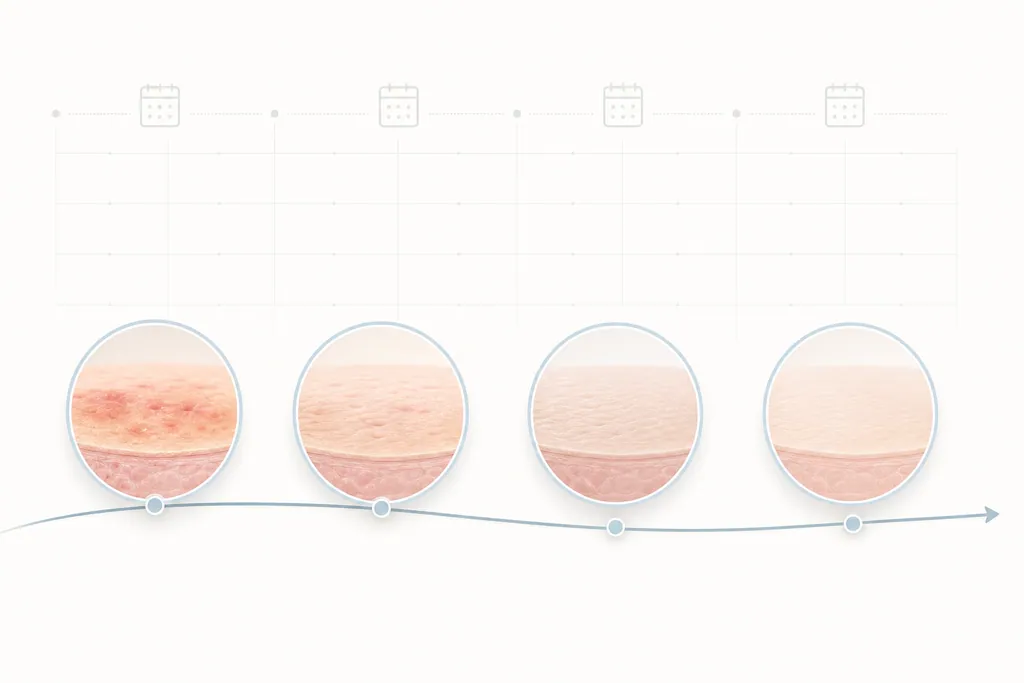
— Healing timeline
Fractional CO₂ healing, stage by stage
Day 0
Treatment day
Skin is red and feels like a strong sunburn, with mild swelling. The grid pattern of treated zones may be faintly visible. Cool compresses and the prescribed balm are your tools tonight.
Day 1–2
Bronzing & sandpaper
Redness settles into a bronzed, tanned look and the surface feels rough — the treated microzones are drying into tiny crusts. Swelling peaks around day one or two, often worse around the eyes in the morning.
Day 3–7
Peeling
The bronzed layer flakes away, usually starting around the mouth and nose. Do not pick or exfoliate — let it release on its own. Underneath is fresh, pink new skin.
Week 2
Pink, smooth, presentable
Peeling is done and skin looks smooth but pink, like mild windburn. Makeup is usually fine again once the surface is fully closed — most people are comfortably back to normal life.
Week 3–4+
Pinkness fades, collagen builds
The pink tone fades over weeks. Meanwhile fibroblasts keep laying down new collagen for two to six months — texture and scar improvement keeps building quietly during this time.
A general guide only. Individual healing speed varies with skin type, scar depth, aftercare and the treatment used.
Skincare staging: what goes back on, and when
Aftercare is staged to match what the skin can tolerate. The theme of week one is 'bland and protective' — everything active, fragranced or exfoliating stays in the drawer. Your clinic's written protocol overrides any general guide, but the typical staging looks like this:
— Pathway
Typical post-CO₂ skincare staging
- 1
Days 0–3 · Protect
Gentle cleanser, the prescribed healing balm or ointment, and nothing else. No makeup, no actives, no exfoliation. Avoid direct sun entirely.
- 2
Days 4–7 · Rebuild the basics
As peeling completes, switch to a bland moisturiser and start (or restart) a high-SPF sunscreen once the surface has closed.
- 3
Week 2–3 · Reintroduce gently
Makeup and a simple routine return. Actives like retinoids and vitamin C wait for your doctor's go-ahead — typically two to four weeks post-treatment.
- 4
Ongoing · Defend the result
Daily sunscreen for at least the next two to three months. Healing skin plus sun exposure is the classic recipe for pigmentation.
- 1
Days 0–3 · Protect
Gentle cleanser, the prescribed healing balm or ointment, and nothing else. No makeup, no actives, no exfoliation. Avoid direct sun entirely.
- 2
Days 4–7 · Rebuild the basics
As peeling completes, switch to a bland moisturiser and start (or restart) a high-SPF sunscreen once the surface has closed.
- 3
Week 2–3 · Reintroduce gently
Makeup and a simple routine return. Actives like retinoids and vitamin C wait for your doctor's go-ahead — typically two to four weeks post-treatment.
- 4
Ongoing · Defend the result
Daily sunscreen for at least the next two to three months. Healing skin plus sun exposure is the classic recipe for pigmentation.
Pinkness vs PIH: two different things
Two pigment-related worries dominate CO₂ recovery, and they are worth separating. Post-treatment pinkness (erythema) is normal new skin with a rich blood supply — it fades on its own over weeks. Post-inflammatory hyperpigmentation (PIH) is different: brown patches that develop when healing inflammation over-stimulates melanocytes, and it is far more likely in Asian and darker skin tones, or after sun exposure during recovery.
PIH risk is managed, not eliminated: conservative settings at treatment, strict sun protection afterwards, and no picking during the peeling phase. If brown patches do appear in the weeks after treatment, tell your clinic — early PIH usually responds well to management, and your doctor can adjust the plan for future sessions.
— Mechanism
How a dark mark forms after inflammation
Inflammation
Acne, heat or a treatment irritates the skin, releasing signalling molecules.
Melanocytes activate
Those signals switch pigment cells into overdrive, over-producing melanin.
Pigment deposited
Excess melanin settles in the skin as a flat dark mark — and in deeper skin can drop into the dermis, where it fades slowly.
PIH is a pigment response, not a structural scar. It often fades over months — but the right care, and avoiding fresh inflammation, speeds recovery and prevents new marks.
When to call the clinic
The overwhelming majority of CO₂ recoveries are uneventful — the timeline above, then done. But healing skin deserves a low threshold for asking. Contact your clinic the same day if you notice any of the following:
— Frequently asked
Common questions
Expect redness settling into a bronzed, tanned appearance with a rough, sandpaper-like feel, plus mild swelling that often peaks on day one or two — sometimes worse around the eyes in the morning. This is the treated microzones drying at the surface, and it is a normal stage, not a complication.
Typically between days three and seven, often starting around the mouth and nose where skin moves most. Let it release on its own — picking or scrubbing the flakes off early can disrupt healing and raises the risk of marks and pigmentation, especially in Asian skin tones.
Most people are comfortably presentable within five to seven days, once peeling completes. The new skin stays pink for a while — usually fading over two to four weeks, sometimes longer after deeper settings. Makeup can generally cover the pinkness once the surface has fully closed.
Usually once peeling has finished and the skin surface is fully closed — commonly around day five to seven. Putting makeup on open or still-peeling skin risks irritation and infection. Your clinic will confirm timing for your skin at review, and mineral formulas are often the gentlest restart.
Prolonged pinkness (erythema) is common and usually harmless — new skin has a rich blood supply, and deeper settings produce longer-lasting pinkness. It fades gradually over weeks. It is different from PIH, which appears as brown patches; if you are unsure which you are seeing, send your clinic a photo.
You cannot rush the biology, but you can avoid slowing it: follow the staged aftercare, keep the skin moisturised with the products provided, do not pick at peeling skin, and be strict about sun protection. Sleeping slightly elevated for the first nights also helps swelling settle faster.
— Related treatments
Continue with the relevant DrPlus treatment pages
Each page goes deeper into mechanism, suitability and recovery — your final plan is confirmed at consultation.
— Continue reading
 Acne Scars
Acne Scar Treatment Recovery: What to Expect Week by Week
Recovery worries put many people off treatment. Here is an honest, practical timeline for what healing usually looks like.
Fractional CO₂ Laser: The Complete Resurfacing Guide
Fractional CO₂ laser is the workhorse of skin resurfacing — one technology used for scars, texture, pores, fine lines and overall rejuvenation. Here is how it actually works, and who it suits.