
DrPlus Skin Education · Asian Skin & PIH
Post-Inflammatory Hyperpigmentation After Acne Scar Treatment
The most common disappointment after scar treatment in darker skin is not a scar that didn't improve — it's a new dark mark. Here's why PIH happens, who is at risk, and how it is prevented and managed.
Quick answer
Post-inflammatory hyperpigmentation (PIH) is a flat, darker patch of skin that can appear after any inflammation — including the deliberate, controlled injury of a scar treatment. It is not a new scar and not a sign the treatment damaged the skin's structure; it is the pigment cells reacting to inflammation by over-producing melanin, which then settles in the skin as a mark.
PIH is most relevant in deeper Asian skin tones, where pigment cells are naturally more reactive. The good news is that it is usually temporary and very manageable, and its risk can be substantially reduced before treatment ever starts — through conservative settings, surface-sparing techniques, skin preparation and, above all, diligent sun protection. This guide explains why it happens, who is at risk, and how it is prevented and treated.
What PIH actually is
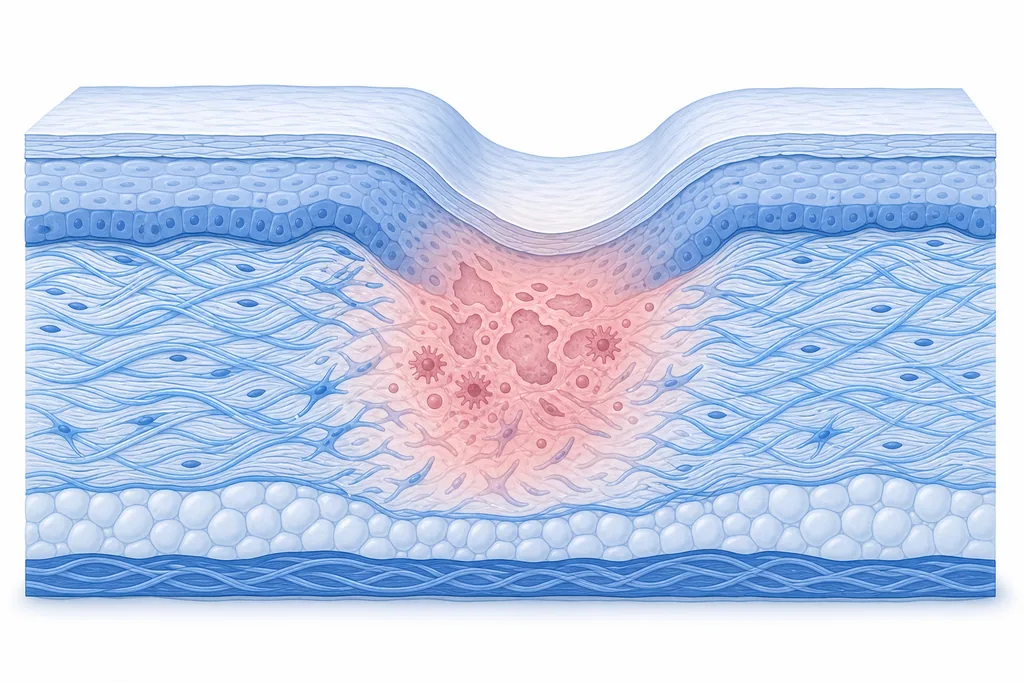
The skin's pigment is made by melanocytes, cells that sit mainly at the base of the epidermis and produce melanin. When the skin is inflamed, signalling molecules released during that inflammation tell melanocytes to ramp up melanin production. The excess pigment is deposited in the surrounding skin, producing a flat brown, grey or sometimes reddish-brown mark where the inflammation occurred.
Where that pigment ends up matters for how long it lasts. Epidermal PIH (pigment held in the surface layer) tends to fade faster. In deeper skin, some pigment can drop into the dermis (dermal PIH), where it is harder for the body to clear and fades more slowly. This is part of why PIH can feel stubborn in skin of colour.
— Mechanism
How a dark mark forms after inflammation
Inflammation
Acne, heat or a treatment irritates the skin, releasing signalling molecules.
Melanocytes activate
Those signals switch pigment cells into overdrive, over-producing melanin.
Pigment deposited
Excess melanin settles in the skin as a flat dark mark — and in deeper skin can drop into the dermis, where it fades slowly.
PIH is a pigment response, not a structural scar. It often fades over months — but the right care, and avoiding fresh inflammation, speeds recovery and prevents new marks.
Key terms in this guide
Why scar treatments can trigger PIH
Scar treatments work by creating controlled injury to trigger collagen rebuilding — but inflammation is an unavoidable part of that injury. In skin with reactive melanocytes, that same inflammation can switch on excess pigment production. So the very mechanism that improves the scar can, if not carefully managed, also provoke a pigment response. This is the central tension of treating scars in darker skin.
The amount of inflammation matters. Treatments that heat or remove the surface more aggressively — fully ablative laser, deep peels — provoke more pigment response than gentler, surface-sparing options. This is exactly why treatment choice and settings are tailored to skin tone: the goal is enough controlled injury to remodel collagen, but not so much that it triggers lasting pigmentation.
— Comparison
Relative PIH risk by approach
| Approach | Relative PIH risk | Why |
|---|---|---|
| Superficial peel | Lower | Acts at the surface with limited inflammation when done conservatively. |
| RF microneedling | Lower–moderate | Heats the dermis while largely sparing the surface pigment cells. |
| Fractional CO₂ laser | Higher | Ablative surface injury provokes melanocytes more strongly. |
| Deep peel | Higher | Greater depth and inflammation; used cautiously or avoided in darker skin. |
Superficial peel
- Relative PIH risk
- Lower
- Why
- Acts at the surface with limited inflammation when done conservatively.
RF microneedling
- Relative PIH risk
- Lower–moderate
- Why
- Heats the dermis while largely sparing the surface pigment cells.
Fractional CO₂ laser
- Relative PIH risk
- Higher
- Why
- Ablative surface injury provokes melanocytes more strongly.
Deep peel
- Relative PIH risk
- Higher
- Why
- Greater depth and inflammation; used cautiously or avoided in darker skin.
Who is most at risk
PIH risk rises with skin tone: the more melanin and the more reactive the melanocytes, the higher the chance of a pigment response after inflammation. Fitzpatrick III–V skin — common across Johor Bahru and Malaysia — therefore carries more risk than fair skin. A personal or family history of pigmenting easily after spots, cuts or previous treatments is also a strong predictor.
Other contributors include ongoing active acne (a continuous source of inflammation), sun exposure without protection, and picking at healing skin. None of these mean treatment is off the table — they mean the plan should be built to minimise inflammation and protect pigment at every step.
How doctors reduce the risk
Most PIH prevention happens before and around the treatment, not after a mark appears. Strategies include choosing surface-sparing treatments (such as RF microneedling) where appropriate, using conservative energy and density, sometimes performing a test area, preparing the skin beforehand, spacing sessions to limit cumulative inflammation, and treating any active acne first so the skin is calm.
Then there is sun protection, which deserves its own emphasis. UV exposure is a powerful trigger for melanin production, so unprotected skin after treatment is far more likely to pigment. Rigorous, consistent broad-spectrum sun protection in the days and weeks afterward — essential under strong Malaysian sun — is one of the highest-impact things you can do to prevent PIH.
If PIH does appear: management
The first reassurance is that most PIH is temporary. Epidermal pigment usually fades over weeks to months as the skin renews; dermal pigment takes longer but generally improves with time and care. The single most important step is to stop adding inflammation — avoid picking, harsh products or further aggressive treatment until the skin settles — and to protect rigorously from the sun, which otherwise keeps the pigment switched on.
Beyond that, a doctor may guide pigment-focused care to help marks fade more quickly and evenly, and will time any further scar treatment around the resolving pigmentation. Patience is again part of the process: chasing PIH with aggressive treatment often makes it worse, while calm skin plus sun protection lets the body clear it.
— Healing timeline
How PIH typically resolves
Weeks 0–4
Settle the skin
Stop all sources of fresh inflammation — no picking, harsh actives or aggressive treatment. Protect strictly from the sun.
Months 1–3
Epidermal pigment fades
Surface pigment lightens as the skin renews, helped by pigment-focused care if advised.
Months 3+
Deeper pigment improves
Dermal pigment fades more slowly but generally improves with time, consistent sun protection and patience.
A general guide only. Individual healing speed varies with skin type, scar depth, aftercare and the treatment used.
A common misconception
A dark mark after treatment is often mistaken for permanent damage or 'the treatment going wrong'. In most cases it is neither — it is a temporary pigment response that fades with the right care. Reacting to it with stronger treatment, in panic, is exactly the wrong move and tends to prolong it.
When to consider a medical consultation
Because PIH risk is so tied to skin tone and personal history, a consultation before treatment is the best way to keep it low — and if a mark does appear, professional guidance helps it fade faster and safely. An assessment grades your skin, reviews your pigment history, and builds a plan that protects your tone while treating your scars.
At DrPlus in Johor Bahru, treating skin of colour is routine, and pigment protection is built into every step — with honest expectations and no pressure to proceed on the day.
Summary
Post-inflammatory hyperpigmentation is the pigment cells' reaction to inflammation — including the controlled injury of a scar treatment — and it is the most relevant risk when treating scars in deeper Asian skin. It is a flat dark mark, not a structural scar, and it usually fades over months, though dermal pigment is slower to clear.
Most of the risk is managed before and around treatment: surface-sparing techniques, conservative settings, calming active acne, and above all rigorous sun protection. If PIH does appear, settling the skin and protecting from the sun — not escalating treatment — is the path back. Built into a thoughtful, skin-tone-aware plan, the risk is low and the outcome usually temporary.
— Frequently asked
Common questions
PIH is a flat darkening of the skin caused by excess melanin after inflammation. It can follow acne or a scar treatment, and is a pigment response rather than a structural scar. It usually fades over time with the right care.
Scar treatments create controlled injury to trigger collagen rebuilding, and the accompanying inflammation can switch reactive pigment cells into over-producing melanin — especially in deeper skin. Gentler, surface-sparing treatments provoke less of this response.
Usually not. Surface (epidermal) pigment typically fades over weeks to months, and deeper (dermal) pigment improves more slowly. Avoiding fresh inflammation and protecting from the sun helps it clear; aggressive treatment tends to prolong it.
Choose surface-sparing treatments and conservative settings where appropriate, treat active acne first, avoid picking, and above all protect rigorously from the sun afterward. A skin-tone-aware plan from a doctor keeps the risk low.
More aggressive, surface-disrupting treatments like fully ablative CO₂ laser and deep peels carry higher PIH risk in darker skin, while surface-sparing options such as RF microneedling and conservative superficial peels generally carry less.
Stop adding inflammation — no picking, harsh products or further aggressive treatment — and protect strictly from the sun. See your doctor for pigment-focused guidance. Most PIH fades with calm skin, sun protection and time.
— Related treatments
Continue with the relevant DrPlus treatment pages
Each page goes deeper into mechanism, suitability and recovery — your final plan is confirmed at consultation.
Primary money page
Acne Scar Treatment Hub
Doctor-led scar plans with pigment protection built in for deeper skin tones.
acne scar treatment in Johor BahruSupporting
Pigmentation Treatment
For existing dark marks and post-inflammatory pigmentation that need addressing.
pigmentation treatment in Johor BahruSupporting
RF Microneedling
A surface-sparing, lower-PIH-risk option for scar treatment in darker skin.
RF microneedling for acne scarsSupporting
Chemical Peel
Conservative peels can support pigment evenness when chosen carefully.
chemical peel for surface tone— Continue reading
Why RF Microneedling Is Popular for Asian Skin Types
For deeper skin tones, the biggest treatment risk is not the scar — it is the dark mark a treatment can leave behind. Understanding that risk explains why RF microneedling has become a go-to for Asian skin.
 Acne Scar Science
The Complete Science of Acne Scarring
Acne scars are not a surface problem. They are the visible record of how inflammation reshaped the collagen scaffold beneath your skin. Understand that, and every treatment decision starts to make sense.
Chemical Peels for Acne Scars: A Medical Education Guide
Chemical peels are often misunderstood as a scar 'cure'. In reality they are precise surface-renewal tools — powerful for tone and texture, limited for deep structure. Here is exactly what they can and cannot do.