
DrPlus Skin Education · Hair Loss
PRP vs Minoxidil for Hair Loss: What a Doctor Considers
One is a daily topical, the other an in-clinic injection series. They are not rivals so much as different tools — here is how a doctor actually chooses.
Two different tools, not two versions of one thing
Minoxidil is a topical medication applied daily. It works by prolonging the anagen (growth) phase of the hair cycle and improving blood flow around the follicle. It is well studied, widely available, and its main limitation is commitment: results fade if you stop.
PRP (platelet-rich plasma) is an in-clinic procedure. A small volume of your blood is drawn and spun to concentrate the platelets, and the platelet-rich layer is injected into the scalp where hair is thinning. The growth factors released by platelets are used to stimulate weakened follicles over a planned series of sessions.
— Mechanism
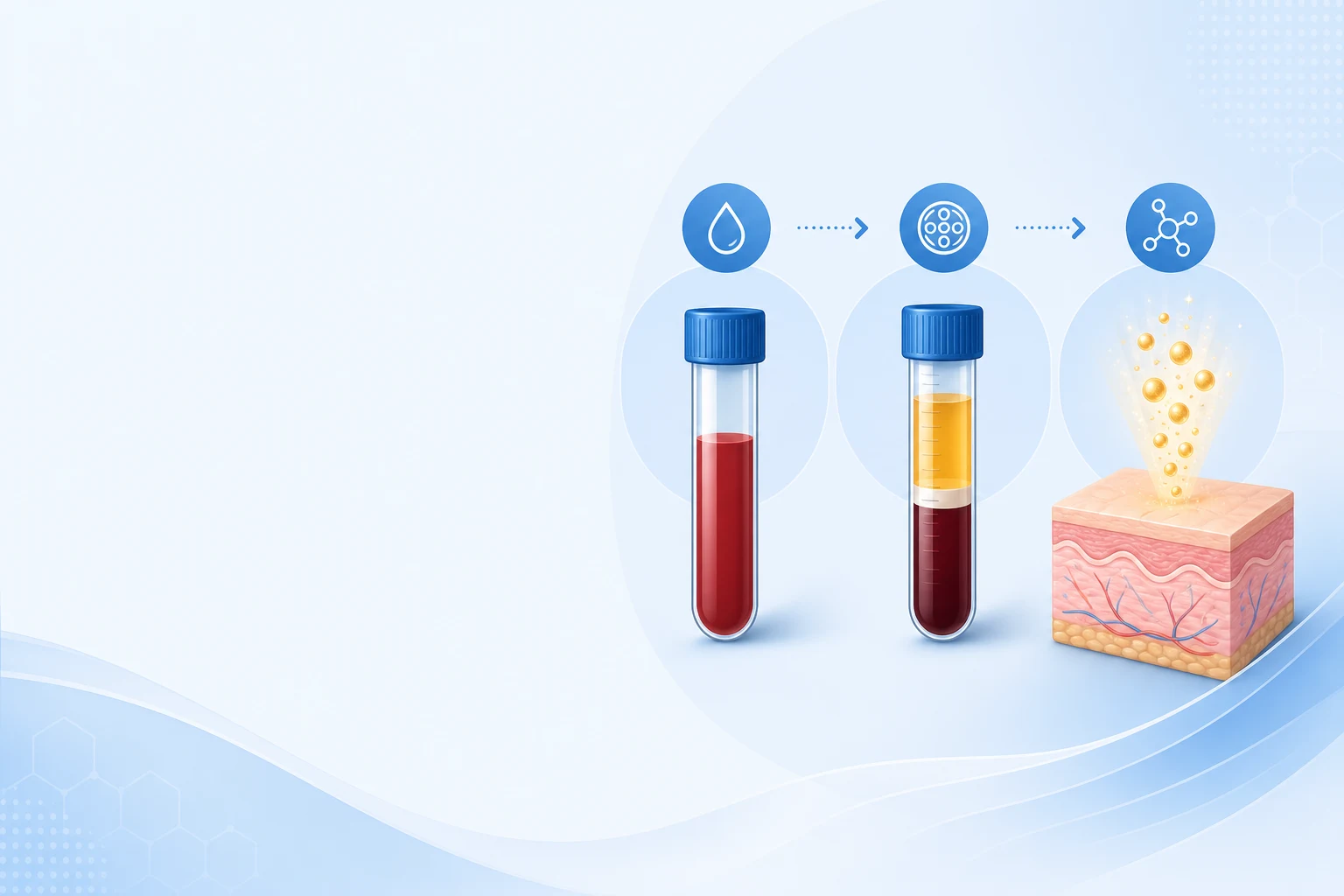
From your own blood to concentrated growth factors
1 · Draw
A small sample of your own blood is taken.
2 · Spin
A centrifuge separates the platelet-rich plasma.
3 · Apply
Growth factors support repair after micro-injury.
PRP does not resurface or release scars by itself. It is used as a supporting layer — the concentrated growth factors are intended to help the skin recover and build collagen after treatments such as microneedling or subcision. Evidence is mixed and results vary between individuals.
Side by side
The practical differences matter more than the theoretical ones:
— Comparison
PRP vs minoxidil at a glance
| Minoxidil | PRP | |
|---|---|---|
| What it is | Daily topical medication | In-clinic injection series using your own platelets |
| Commitment | Every day, indefinitely — results fade on stopping | A planned series, then maintenance sessions |
| Best for | Early, diffuse thinning; maintaining density | Thinning with live follicles; patients who struggle with daily topicals |
| Common drawbacks | Scalp irritation, initial shedding, daily discipline | Needle-based, cost per session, response varies by individual |
| Evidence | Extensively studied over decades | Growing evidence base; protocols vary between clinics |
What it is
- Minoxidil
- Daily topical medication
- PRP
- In-clinic injection series using your own platelets
Commitment
- Minoxidil
- Every day, indefinitely — results fade on stopping
- PRP
- A planned series, then maintenance sessions
Best for
- Minoxidil
- Early, diffuse thinning; maintaining density
- PRP
- Thinning with live follicles; patients who struggle with daily topicals
Common drawbacks
- Minoxidil
- Scalp irritation, initial shedding, daily discipline
- PRP
- Needle-based, cost per session, response varies by individual
Evidence
- Minoxidil
- Extensively studied over decades
- PRP
- Growing evidence base; protocols vary between clinics
Who suits which — and when to combine
The single most important factor is whether the follicles are still alive. Both minoxidil and PRP stimulate weakened follicles; neither reliably revives skin that has been smooth and bald for years. This is why early treatment consistently outperforms late treatment, whatever the method.
In practice, many treatment plans combine both: minoxidil (or other prescribed medication) as the daily foundation, with PRP as a periodic in-clinic stimulus. For patients who cannot tolerate minoxidil — irritation, or the daily routine simply doesn't stick — PRP offers a clinic-led alternative.
For female pattern hair loss, the calculus shifts slightly: fewer licensed medication options exist, which is one reason PRP is often discussed for women with diffuse thinning. Suitability still depends on diagnosis.
What a realistic timeline looks like
Hair grows slowly, so no honest treatment shows results in weeks. With either approach, the first signs — reduced shedding, then early regrowth of finer hairs — typically appear around the three-month mark, with visible density change closer to six months.
PRP is usually delivered as an initial series of monthly sessions, then spaced maintenance. Minoxidil is daily from day one. Judging either before three months is judging it too early.
— Pathway
A typical doctor-led hair loss pathway
- 1
Diagnosis
Scalp examination and history — pattern loss, telogen effluvium, or a medical cause needing referral.
- 2
Plan
Daily foundation (topicals/medication where appropriate) plus in-clinic options like PRP, matched to your follicle status.
- 3
Series & review
PRP sessions spaced roughly monthly at first; progress reviewed with photos at three and six months.
- 1
Diagnosis
Scalp examination and history — pattern loss, telogen effluvium, or a medical cause needing referral.
- 2
Plan
Daily foundation (topicals/medication where appropriate) plus in-clinic options like PRP, matched to your follicle status.
- 3
Series & review
PRP sessions spaced roughly monthly at first; progress reviewed with photos at three and six months.
— Frequently asked
Common questions
Neither is universally better — they work differently. Minoxidil is a well-studied daily topical; PRP is an in-clinic injection series using your own platelet growth factors. Many plans combine both. The right choice depends on your diagnosis, how early your loss is, and whether a daily topical realistically fits your routine.
Possibly — but the first step is understanding why minoxidil underperformed. If the follicles in the area are no longer alive, no stimulant will work. If the issue was irritation or inconsistent use, PRP's clinic-led format may suit you better. A scalp assessment answers this before you spend on either.
Most protocols start with a series of sessions spaced about a month apart, followed by maintenance sessions at longer intervals. The exact count depends on your degree of thinning and how your scalp responds — your doctor will set expectations at consultation.
PRP is commonly discussed for female diffuse thinning, partly because fewer licensed medication options exist for women. Response varies by individual and diagnosis matters — female hair loss has a wider range of medical causes that should be checked first.
The scalp is numbed before injections, and most patients describe the sensation as pressure with brief stings rather than significant pain. The area can feel tender for a day or so afterwards.
— Related treatments
Continue with the relevant DrPlus treatment pages
Each page goes deeper into mechanism, suitability and recovery — your final plan is confirmed at consultation.
— Continue reading
 PRP & Regenerative
PRP and Exosomes for Acne Scars: A Supporting Role
PRP and exosomes are often marketed as scar cures. The honest picture is more useful: they are supporting players that help skin heal after the real work.
Aesthetic Treatment Costs in Johor Bahru: What Determines Your Quote
Searching for a price list? Here is what actually determines what you pay for aesthetic treatment in Johor Bahru — and how to get an exact, personalised quote.