
DrPlus Skin Education · Subcision
Subcision with Filler, RF Microneedling or CO₂ Laser: What Follows the Release
Subcision is the structural first step — but what you add afterwards, and when, often decides how much of the lift you keep. A doctor explains the spacer and resurfacing logic.
Why subcision comes first — and why it is rarely the whole plan
Rolling scars are held down from beneath: fibrous bands anchor the skin's underside to deeper tissue, and no amount of surface work lifts skin that is still pinned. That is the case for subcision as the structural first step — a needle or blunt cannula passed under local anaesthetic cuts the bands, the skin rises, and the released space fills with a small pocket of blood that acts as a natural spacer supporting new collagen.
But release alone has a known weakness: cut bands can partially reform as the area heals, pulling some of the lift back down. And subcision does nothing for the surface itself — the skin over a released scar keeps whatever texture, edges and tone it had before. This is why most well-designed plans treat subcision as step one of a sequence: something to preserve the space that was released, and something to remodel the surface once the structure is free.
— Mechanism
Tethered surface, before and after release
Tethered
Fibrous bands beneath the skin pull the surface downward, creating the rolling depression.
After release
Once the bands are released, the skin can sit closer to its natural level. Collagen support is often added in the following weeks.
The spacer logic: blood, saline and filler after release
The moment the bands are cut, a race begins between two healing outcomes: new collagen building in the freed space and holding the skin up, versus the fibrous tethering re-forming and pulling it back down. A spacer tips that race in the right direction by physically keeping the released surfaces apart while collagen establishes.
The default spacer is the one subcision creates itself — the controlled blood pocket beneath the released scar, which is why doctors do not aggressively compress the area afterwards. In some cases the doctor augments this: saline can be infiltrated to hydrodissect and hold the plane open, or a small amount of dermal filler can be placed into the released space, supporting the lifted skin directly while longer-term collagen builds. Filler after subcision is a targeted structural aid for suitable scars — a different job from the volumising most people associate fillers with, and a case-by-case decision based on scar depth, location and how the release behaves.
Mechanism
Blood spacer (default)
The controlled pocket of blood formed during subcision holds the released skin away from deeper tissue and becomes scaffolding for new collagen — no added product required.
Mechanism
Saline assist
Sterile saline infiltrated during or after release helps separate the tissue plane and discourage early reattachment — a simple, temporary mechanical aid.
Mechanism
Filler as structural support
A small volume of dermal filler placed into the released space directly props the lifted skin while collagen matures — considered case-by-case for deeper or re-tethering-prone scars.
RF microneedling vs fractional CO₂ after release
Once the structure is free, the surface becomes worth treating — and the two main remodelling tools are RF microneedling and fractional CO₂ laser. Both work by triggering controlled collagen remodelling; they differ in how they deliver the stimulus and what that costs you in downtime.
RF microneedling drives fine needles into the dermis and releases radiofrequency heat at depth, largely sparing the surface — recovery is typically shorter, and the surface-sparing delivery is a meaningful advantage in Asian skin tones where post-inflammatory hyperpigmentation is the complication to avoid. Fractional CO₂ ablates microscopic columns of skin from the surface down, giving strong texture remodelling — often the stronger choice for sharp boxcar edges — at the cost of several days of visible redness and micro-crusting. Neither is universally superior; the choice follows your scar mix, skin tone and downtime tolerance, and some plans stage both across a course.
— Comparison
The two main resurfacing follow-ons
| RF microneedling | Fractional CO₂ laser | |
|---|---|---|
| How it remodels | Needles deliver radiofrequency heat into the dermis, sparing most of the surface | Laser ablates microscopic columns from the surface down, triggering renewal |
| Typical downtime | Redness for roughly 1–3 days | Visible redness and micro-crusting, commonly around 5–7 days |
| Strengths after subcision | Dermal collagen stimulation with modest downtime; well suited to Asian skin tones | Stronger surface remodelling — often preferred for sharp boxcar edges and etched texture |
| Usual timing after release | Around 4–6 weeks after subcision | Around 4–6 weeks after subcision |
How it remodels
- RF microneedling
- Needles deliver radiofrequency heat into the dermis, sparing most of the surface
- Fractional CO₂ laser
- Laser ablates microscopic columns from the surface down, triggering renewal
Typical downtime
- RF microneedling
- Redness for roughly 1–3 days
- Fractional CO₂ laser
- Visible redness and micro-crusting, commonly around 5–7 days
Strengths after subcision
- RF microneedling
- Dermal collagen stimulation with modest downtime; well suited to Asian skin tones
- Fractional CO₂ laser
- Stronger surface remodelling — often preferred for sharp boxcar edges and etched texture
Usual timing after release
- RF microneedling
- Around 4–6 weeks after subcision
- Fractional CO₂ laser
- Around 4–6 weeks after subcision
Sequencing windows: why the ~4–6 week gap exists
The interval between subcision and resurfacing is not arbitrary. In the first weeks after release, the treated area is swollen, bruised and structurally busy — the spacer is organising, early collagen is forming, and the skin's true post-release level has not yet emerged. Resurfacing into that environment means treating a moving target and stacking inflammation on inflammation.
By around four to six weeks, swelling has resolved, the surface has settled, and the doctor can see which scars held their lift and which partially re-tethered — information that shapes exactly where the resurfacing energy should go. The same logic spaces repeat subcision sessions four to eight weeks apart. Good sequencing is mostly the discipline of letting each step finish its work before judging it and starting the next.
— Pathway
A typical subcision-led combination sequence
- 01
Release
Subcision frees the tethered scars; the blood spacer — sometimes with saline or filler support — holds the released space.
- 02
Settle (weeks 1–4)
Bruising and swelling resolve; collagen begins building. The skin's true post-release level emerges.
- 03
Remodel (~4–6 weeks)
RF microneedling or fractional CO₂ treats the now-free surface — texture, edges and tone.
- 04
Review & repeat
Progress reviewed at two to three months; further release or resurfacing rounds are planned only where the response justifies them.
- 01
Release
Subcision frees the tethered scars; the blood spacer — sometimes with saline or filler support — holds the released space.
- 02
Settle (weeks 1–4)
Bruising and swelling resolve; collagen begins building. The skin's true post-release level emerges.
- 03
Remodel (~4–6 weeks)
RF microneedling or fractional CO₂ treats the now-free surface — texture, edges and tone.
- 04
Review & repeat
Progress reviewed at two to three months; further release or resurfacing rounds are planned only where the response justifies them.
Rejuran S and other adjuncts — assessed, not assumed
Patients researching subcision increasingly ask about adjuncts — most often Rejuran S, a thicker, scar-focused formulation of polynucleotide injectable, discussed as a way to support skin quality and collagen in treated scars. There are also questions about subcision for concerns beyond acne scars, such as cellulite dimples or nasolabial folds, where the technique has been described.
Our position on both is the same and deliberately boring: assessed case-by-case at consultation. DrPlus offers subcision for facial acne scarring — tethered rolling scars — and adjuncts like Rejuran S are considered where an individual plan genuinely benefits, not added by default. Other described uses of the technique are discussed honestly at consultation if you raise them, but the clinic's focus, and this article set's, is acne scars. If an add-on cannot be justified to you in one plain sentence at consultation, it does not belong in your plan.
— Frequently asked
Common questions
As a structural spacer, not for volumising. Released bands can partially reform and pull the lifted skin back down; a small amount of filler placed into the freed space props the skin up while new collagen matures. It is considered case-by-case — many plans rely on the natural blood spacer alone, with filler reserved for deeper or re-tethering-prone scars.
Neither universally. RF microneedling heats the dermis through fine needles while sparing most of the surface — shorter downtime and well suited to Asian skin tones. Fractional CO₂ gives stronger surface remodelling, often preferred for sharp boxcar edges, at the cost of several days of visible recovery. Scar mix, skin tone and downtime tolerance decide it at consultation.
Typically around four to six weeks. By then swelling has resolved, the released skin has settled at its true level, and the doctor can see which scars held their lift — which tells them exactly where resurfacing energy should go. Treating earlier means stacking inflammation on a still-healing area and judging a result that has not formed yet.
Rejuran S is a thicker, scar-focused polynucleotide injectable discussed as a support for skin quality and collagen in treated scars. It can be a reasonable adjunct in some plans, but it is assessed case-by-case at consultation rather than added by default — a good clinic explains in one sentence why your plan does or does not benefit from it.
Sometimes — softer, recent tethering can respond meaningfully to release alone, especially over one to three sessions. But subcision does not treat the skin's surface, and cut bands can partially reform, so many plans add a spacer strategy and a resurfacing step to protect and finish the result. What your plan needs is a consultation question, not a default.
The technique has been described for other tethered depressions, including cellulite dimples and some fold-related concerns. DrPlus focuses subcision on facial acne scarring; other described uses are assessed case-by-case at consultation if you raise them, with honest advice about whether the evidence and your anatomy support it.
— Related treatments
Continue with the relevant DrPlus treatment pages
Each page goes deeper into mechanism, suitability and recovery — your final plan is confirmed at consultation.
Primary money page
Subcision Treatment at DrPlus
Structural release first, with spacer and resurfacing steps sequenced at a doctor-led consultation.
subcision as the first step of a sequenced planSupporting
RF Microneedling
The surface-sparing remodelling option, typically four to six weeks after release.
RF microneedling at DrPlusSupporting
Fractional CO₂ Laser
The stronger resurfacing option for boxcar edges and etched texture.
fractional CO₂ laser resurfacingSupporting
Dermal Fillers
How filler is used as a spacer after scar release — a different job from volumising.
dermal fillers used as structural support— Continue reading
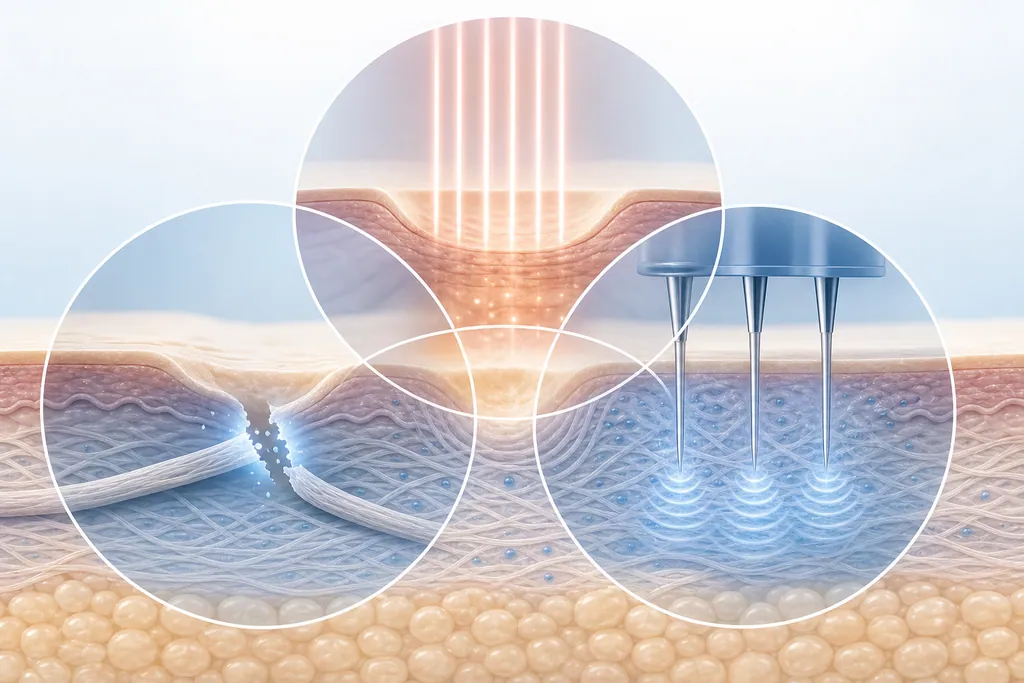 Acne Scars
Why Combination Treatment Is Often Needed for Acne Scars
Most people have more than one scar type, and each behaves differently. That is why a single treatment rarely does the whole job.
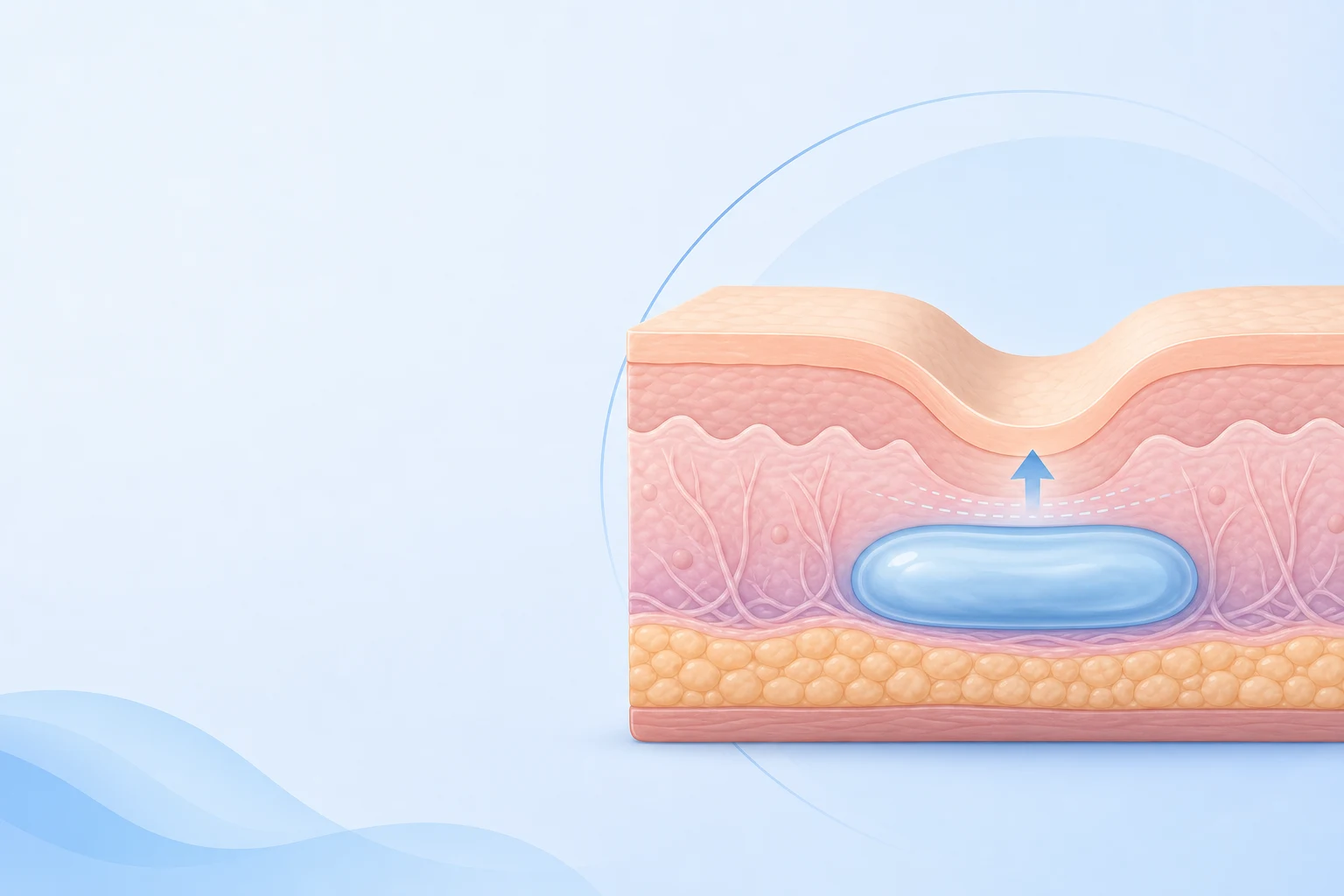 Dermal Fillers
Dermal Fillers for Pitted Acne Scars: How They Help
Filler can lift a depressed scar almost immediately — but that is only half the story. Here is what fillers do for pitted scars, and what they do not.