
DrPlus Skin Education · Laser Resurfacing
CO₂ Laser for Pores & Skin Rejuvenation: An Honest Guide
Pores cannot be closed and no laser deletes them — but resurfacing can genuinely refine how they look. Here is the honest version of what CO₂ rejuvenation does.
Why pores look bigger over time
A pore is the opening of a hair follicle and its oil gland — functional anatomy, not a flaw. What changes over the years is how visible that opening is. Three forces do most of the enlarging: oil production (a busy gland stretches its opening and keeps it dilated), collagen loss (the firm scaffolding that holds each opening taut slackens with age and sun damage, letting pores sag into an oval, more visible shape), and the debris-and-shadow effect, where oxidised oil and rough surrounding texture make each pore read darker and deeper than it is.
This is why pore size is really a skin-firmness and surface-quality story. It is also why the concern clusters on the nose, inner cheeks and forehead — the zones with the densest oil glands — and why pores often look worse in photos taken in harsh light: shadows exaggerate every opening.
The honest part: what no treatment can do
Before what works, the disclaimer that should be on every pore treatment page: pores do not open and close, and they cannot be removed. You need them — they are how oil reaches and protects the skin surface. Any clinic promising to 'erase' or 'close' pores is selling vocabulary, not physiology.
The realistic goal is refinement: making pores visibly finer, skin smoother and light reflect more evenly. That is a genuine, worthwhile change — most people who say they want smaller pores actually want exactly this — but it is an improvement in appearance, maintained over time, not a structural deletion.
How fractional CO₂ refines pores and revives glow
Fractional CO₂ helps pore appearance from two directions at once. The collagen remodelling triggered by each session re-firms the dermal scaffolding around every pore opening, pulling slack, oval openings back toward taut and small. Meanwhile the resurfacing itself replaces rough, dull surface skin with a fresh layer — and smoother skin scatters light more evenly, which is most of what we perceive as 'glow'.
For pore and rejuvenation goals, the laser is typically run at lighter settings than scar work: shallower depth, lower density. That means a gentler session — often three to five days of visible recovery rather than a full week — repeated as a short series. As always, the improvement builds over the months of collagen remodelling that follow each session, varies between individuals, and depends on suitability assessed at consultation.
Mechanism
Firmer scaffolding
New collagen around each pore opening restores the tension that holds it small and round — the main lever on visible pore size.
Mechanism
Smoother surface
Resurfacing replaces rough, uneven surface skin, removing the shadow-and-texture effect that exaggerates every pore.
Mechanism
Even light reflection
Fresh, smoother skin reflects light uniformly — the renewed brightness patients describe as glow after resurfacing.
Lighter settings, lighter recovery
One machine, different dials. A scar-focused CO₂ session drives deep, dense treatment columns and earns its five-to-seven-day recovery. A pore-and-rejuvenation session uses shallower, sparser zones: enough controlled injury to trigger remodelling and refresh the surface, without the downtime of deep scar work. In Asian and darker skin tones this lighter approach has a second advantage — a gentler inflammatory load means lower PIH risk, though preparation and sun protection still matter.
The trade-off is honest too: lighter sessions produce smaller per-session change, so pore and glow programmes are usually planned as a short series with maintenance considered later, rather than one dramatic session.
— Relative downtime
How they compare on recovery
Light rejuvenation setting
Light
Shallow, sparse zones — roughly 3–5 days of flaking and pinkness.
Standard pore/texture setting
Moderate
Moderate depth and density — around 5 days of visible recovery.
Deep scar-focused setting
Higher
The full resurfacing experience — about 5–7 days, planned deliberately.
Recovery profiles vary by skin, settings and aftercare. Your doctor will share what is realistic for your case.
Alternatives and companions: RF microneedling and peels
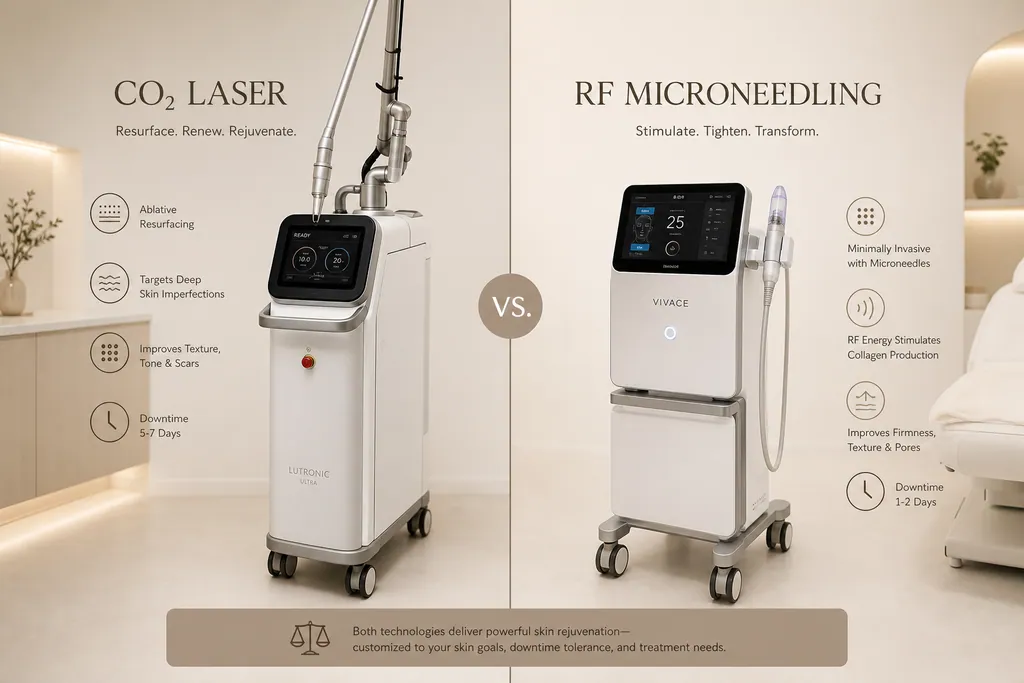
Fractional CO₂ is not the only route to finer-looking pores. RF microneedling delivers collagen-stimulating heat through fine needles while sparing the surface — a strong option when downtime must stay minimal or when PIH risk argues for a surface-sparing approach. Chemical peels work at the other end of the problem: regular superficial peels keep pores clear of the oxidised oil and dead-cell buildup that darkens them, and improve surface smoothness over a series.
In practice these are often companions rather than competitors — a peel-maintained surface, an RF microneedling or CO₂ course for firmness, chosen and sequenced by a doctor after looking at your actual skin: how oily it is, how much slack the pores show, your skin tone and how much recovery your calendar allows.
— Frequently asked
Common questions
It makes them look smaller — genuinely and visibly, in suitable skin. The collagen remodelling firms the skin around each pore opening and the resurfacing smooths surrounding texture, so pores read as finer. What it cannot do is delete or close pores, which are permanent, necessary anatomy. Refinement over a short series is the honest expectation.
Pore and rejuvenation goals typically use lighter settings over a short series — commonly two to four sessions spaced one to two months apart, refined at consultation. Because each session triggers months of collagen remodelling, the appearance keeps improving between and after sessions rather than arriving all at once.
Yes — resurfacing was never scar-only. Light fractional CO₂ settings refresh dull, rough, sun-tired skin: smoother surface, more even light reflection, and gradual firming from new collagen. Recovery at these settings is shorter than scar work, usually a few days of flaking and pinkness.
Both refine pore appearance through collagen stimulation; they differ in trade-offs. CO₂ adds surface resurfacing for extra smoothness and glow but needs several days of recovery. RF microneedling spares the surface — less downtime and lower PIH risk in darker tones — with results building over more sessions. A doctor chooses based on your skin tone, oiliness and schedule.
The refinement is real but not frozen in time — skin keeps ageing, oil keeps flowing and sun exposure keeps degrading collagen. Improvements from a course typically hold well for a long time, supported by sunscreen and sensible skincare, with occasional maintenance sessions if you want to keep the effect topped up.
— Related treatments
Continue with the relevant DrPlus treatment pages
Each page goes deeper into mechanism, suitability and recovery — your final plan is confirmed at consultation.
Primary money page
Fractional CO₂ Laser at DrPlus
Gentler protocols for pore refinement and rejuvenation, set per skin tone.
light-setting CO₂ resurfacing for pores and glowSupporting
RF Microneedling
The lower-downtime alternative for pore refinement.
surface-sparing collagen stimulationSupporting
Chemical Peel
Maintains surface clarity between or after laser sessions.
peels for pore-clogging buildupSupporting
Book a Consultation
Find out what refinement is realistic for your skin before committing.
have your pores assessed honestly— Continue reading
Fractional CO₂ Laser: The Complete Resurfacing Guide
Fractional CO₂ laser is the workhorse of skin resurfacing — one technology used for scars, texture, pores, fine lines and overall rejuvenation. Here is how it actually works, and who it suits.
 Acne Scars
CO₂ Laser vs RF Microneedling for Acne Scars
Two of the most common acne scar treatments — and they work in genuinely different ways. Here is how to think about them.