
DrPlus Skin Education · Active Acne
Cystic and Nodular Acne: Why It Scars and How to Treat It
Deep, painful lumps that never come to a head are the acne type most likely to scar — and the type that most needs a doctor, not a squeeze.
Quick answer
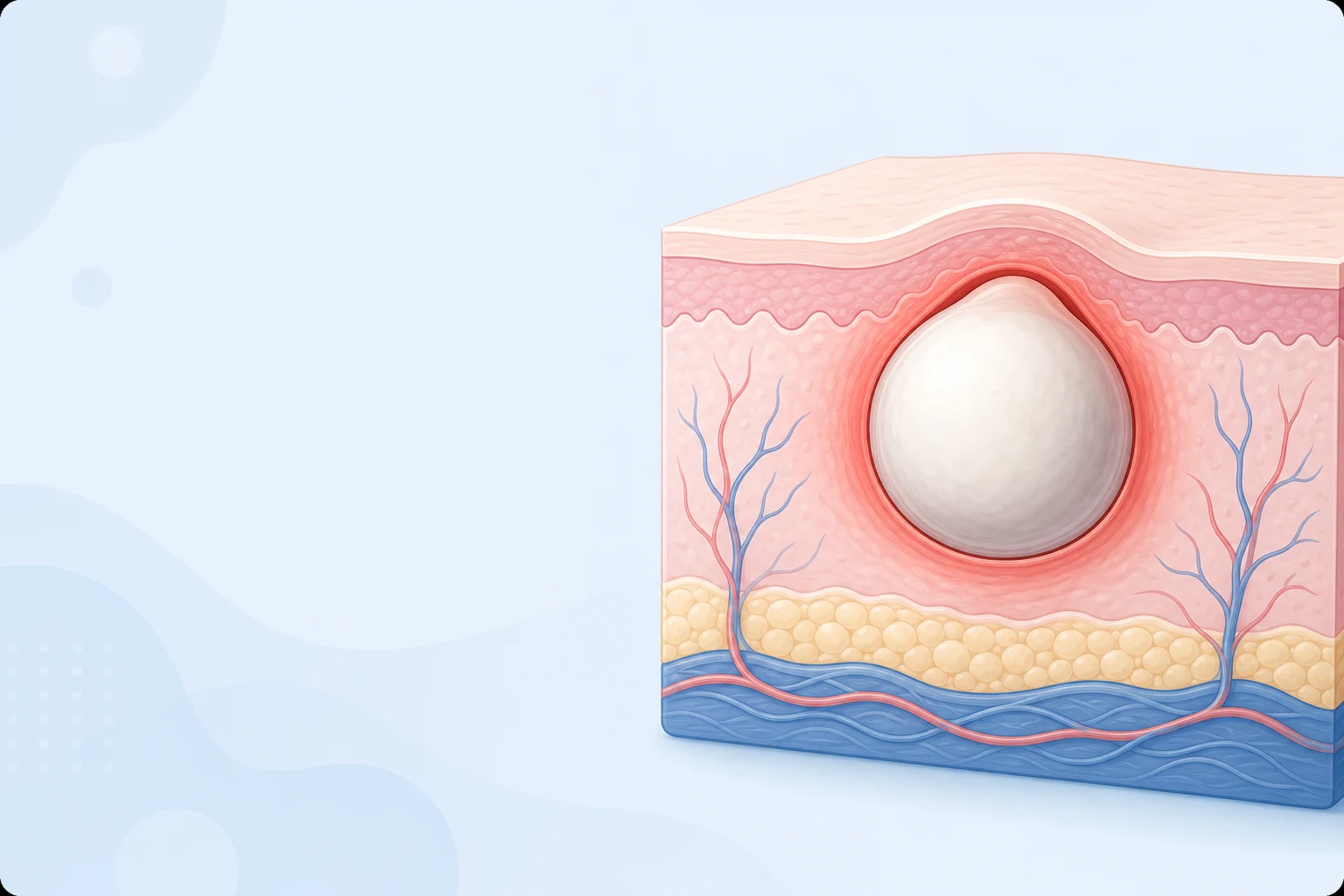
Cystic and nodular acne are the deepest, most inflamed forms of acne. Instead of a surface whitehead, the lesion forms as a painful lump beneath the skin — a nodule when firm, a cyst when filled with fluid. Both can last for weeks and tend to recur in the same spots.
This is the form that most needs a doctor, for two reasons: it rarely responds adequately to over-the-counter products, and it is the type most likely to scar. Treating it promptly and properly is the difference between calming the acne and living with permanent scars.
Why it forms so deep
In cystic and nodular acne, the blockage and inflammation occur deep within the pore and surrounding tissue. The wall of the pore can rupture below the surface, spilling its contents into the dermis and triggering a strong inflammatory response across a wider area — which is why these lesions are large, painful and slow to settle.
Because the damage reaches into the collagen-rich dermis, the skin often cannot heal perfectly, and a depression or mark can remain. The depth of the lesion is exactly why the scarring risk is so high.
— Where treatments reach
Skin layers, in plain English
- Epidermis: Outer protective layer — pigmentation marks and surface texture live here.
- Dermis: Collagen and elastin layer — where atrophic scars are anchored and where most regenerative treatments work.
- Subcutis: Deeper fat / connective layer — beyond the reach of most aesthetic treatments.
A simplified illustration — actual skin layers are more nuanced. Your doctor will explain what is relevant to your case at consultation.
Why it scars so readily
Scarring is a collagen problem, and cystic acne attacks collagen directly. The intense, deep inflammation can destroy collagen as it spreads, and when the skin repairs the gap it frequently does so imperfectly — leaving an atrophic (depressed) scar. The longer and more often a cyst inflames the same area, the greater the cumulative damage.
This is the core argument for early treatment: every untreated cyst is another opportunity to scar. With cystic acne, waiting it out is the most expensive option in the long run.
Mechanism
Deep inflammation
The lesion inflames the dermis, where collagen lives.
Mechanism
Collagen damage
Intense inflammation can destroy collagen across a wide area.
Mechanism
Imperfect repair
The skin often heals with a depression or mark — a scar.
How it is treated
Because cystic and nodular acne is deep and resistant, treatment is usually medical and, for more severe cases, systemic — under close supervision. The priority is to bring the deep inflammation under control quickly to relieve pain and, just as importantly, to stop the scarring process.
In a clinic, an individual lesion may sometimes be settled with a targeted treatment to reduce a painful flare, while the overall plan addresses the underlying tendency. The exact approach depends on severity and history, which is why assessment comes first.
— Comparison
Cystic acne — approach by situation
| Situation | Typical approach | Why |
|---|---|---|
| A single painful flare | In-clinic settling of the lesion | Fast relief and lower scarring risk for that lesion. |
| Recurrent cysts | Medical, often systemic treatment | Controls the underlying tendency. |
| Already scarring | Control acne first, then scar plan | Stop new damage before repairing old. |
A single painful flare
- Typical approach
- In-clinic settling of the lesion
- Why
- Fast relief and lower scarring risk for that lesion.
Recurrent cysts
- Typical approach
- Medical, often systemic treatment
- Why
- Controls the underlying tendency.
Already scarring
- Typical approach
- Control acne first, then scar plan
- Why
- Stop new damage before repairing old.
Why to act early
If you have deep, painful lumps that recur, do not wait for them to settle on their own or work through more over-the-counter products. The scarring clock is running, and this is the acne type where prompt medical treatment changes the long-term outcome most.
At DrPlus in Johor Bahru, cystic and nodular acne is assessed and treated medically, with a focus on controlling deep inflammation early to protect against scarring.
— Frequently asked
Common questions
Cystic acne is a deep, inflamed form of acne where painful, fluid-filled lumps form beneath the skin rather than at the surface. Nodular acne is similar but firmer. Both are slow to resolve and the most likely to scar.
Because the inflammation is deep, it damages collagen in the dermis, and the skin often heals imperfectly with a depression or mark. The deeper and more recurrent the lesions, the higher the scarring risk.
No. Deep cysts have nothing to extract at the surface, and squeezing pushes inflammation deeper, prolongs healing and increases scarring. A doctor can settle a painful lesion safely.
It usually needs medical and, in more severe cases, systemic treatment under supervision, because it resists over-the-counter products. The goal is to control deep inflammation quickly to relieve pain and prevent scarring.
Yes — and that is the point of acting early. Bringing the inflammation under control promptly is the most effective way to prevent the permanent scars cystic acne can leave.
— Related treatments
Continue with the relevant DrPlus treatment pages
Each page goes deeper into mechanism, suitability and recovery — your final plan is confirmed at consultation.
— Continue reading
 Active Acne
How to Treat Acne in Singapore & Johor Bahru: A Doctor's Guide
Most acne advice online is noise. Here is how acne actually forms and how it is treated medically — and why getting it under control early protects your skin from scars.
 Active Acne
Hormonal Acne: Causes and How to Treat It
Breakouts along your jaw that flare on a monthly cycle? That pattern points to hormonal acne — and it responds to a different approach than teenage acne.
 Acne Scar Science
The Complete Science of Acne Scarring
Acne scars are not a surface problem. They are the visible record of how inflammation reshaped the collagen scaffold beneath your skin. Understand that, and every treatment decision starts to make sense.