
DrPlus Skin Education · Tattoo Removal
How Many Sessions Does Laser Tattoo Removal Take?
The honest answer is a range, not a number — and the factors that decide it are knowable upfront. A doctor explains what drives your session count.
Why tattoo removal is never one session
A laser does not erase ink — it shatters it. Each session fragments a layer of ink particles into pieces small enough for your immune system to carry away. The clearing happens between sessions, not during them, which is why removal is a series with rest periods rather than a single long appointment.
Picosecond lasers fragment ink into finer particles than older nanosecond (Q-switched) lasers, which is why they are often preferred for stubborn or previously treated tattoos. But even with pico technology, the biology of ink clearance sets the pace.
— Mechanism
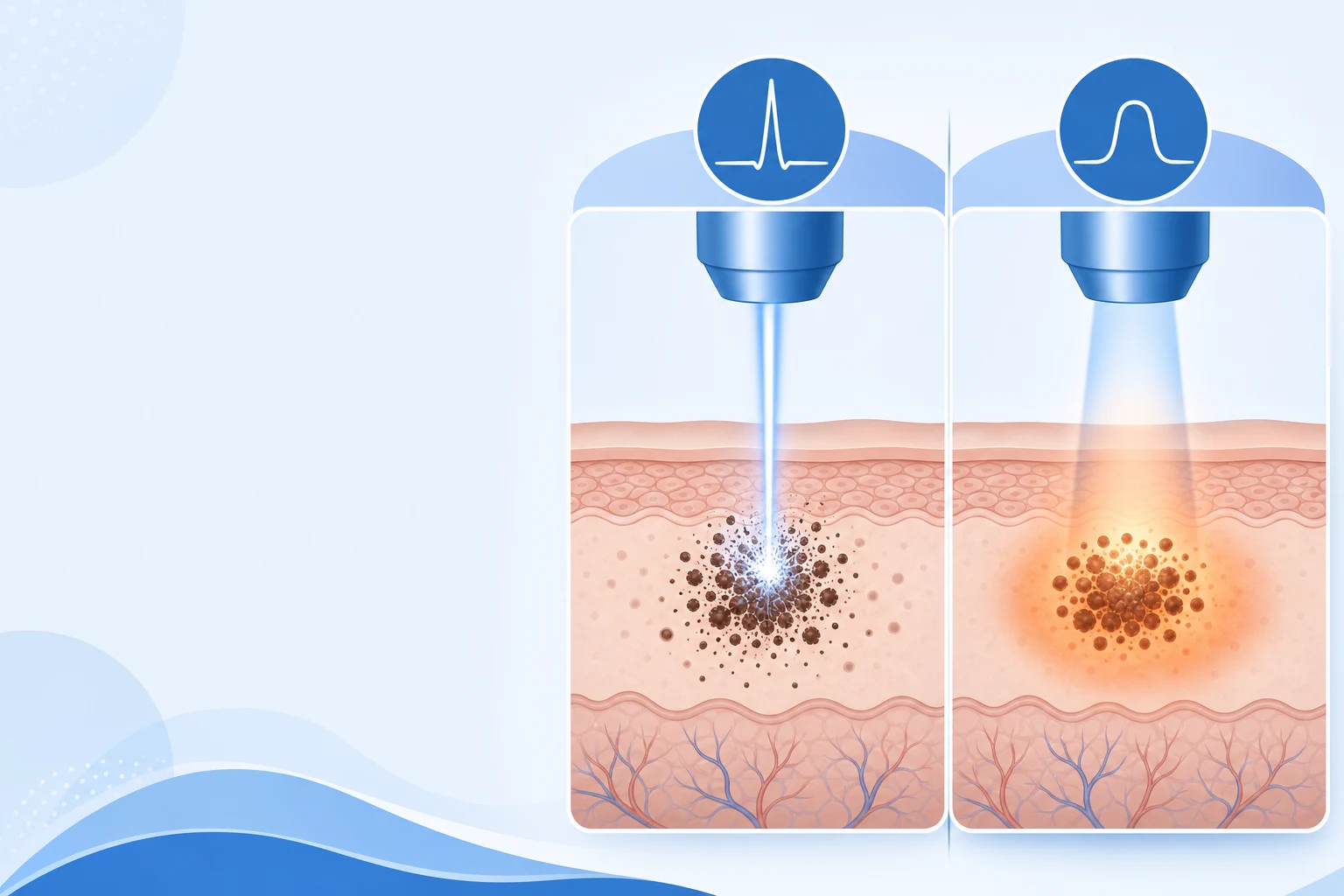
Ultra-short pulses shatter pigment, not skin
Before
Excess pigment sits in clumps that are too large for the body to clear on its own.
After pico pulses
A photoacoustic pressure wave breaks the pigment into dust-fine particles your immune system gradually flushes away.
Because pico pulses are measured in trillionths of a second, they rely more on this shattering effect than on heat — which helps lower the pigmentation risk that older heat-based lasers carry in deeper skin tones.
What decides your session count
Two tattoos of the same size can need very different plans. These are the factors a doctor weighs at assessment:
— Comparison
Session-count factors
| Factor | How it changes the plan |
|---|---|
| Ink colour | Black and dark blue respond best. Green, teal and some bright colours absorb laser energy less efficiently and need more sessions or specific wavelengths. |
| Ink density & layering | Dense professional ink, cover-ups and layered tattoos hold more pigment per square centimetre — more material to clear. |
| Tattoo age | Older tattoos have often already faded and may clear faster than fresh, saturated ink. |
| Depth & who applied it | Professional machines deposit ink at consistent depth; amateur tattoos vary — sometimes shallower and faster to clear. |
| Your skin tone | Darker skin needs more conservative settings to protect surrounding melanin, which can extend the series. |
| Location on the body | Areas with better circulation (closer to the heart) tend to clear ink faster than hands, feet and ankles. |
Ink colour
- How it changes the plan
- Black and dark blue respond best. Green, teal and some bright colours absorb laser energy less efficiently and need more sessions or specific wavelengths.
Ink density & layering
- How it changes the plan
- Dense professional ink, cover-ups and layered tattoos hold more pigment per square centimetre — more material to clear.
Tattoo age
- How it changes the plan
- Older tattoos have often already faded and may clear faster than fresh, saturated ink.
Depth & who applied it
- How it changes the plan
- Professional machines deposit ink at consistent depth; amateur tattoos vary — sometimes shallower and faster to clear.
Your skin tone
- How it changes the plan
- Darker skin needs more conservative settings to protect surrounding melanin, which can extend the series.
Location on the body
- How it changes the plan
- Areas with better circulation (closer to the heart) tend to clear ink faster than hands, feet and ankles.
What happens between sessions
After each session the treated area typically shows frosting (a temporary white appearance), then mild redness and swelling that settle over days. Over the following weeks the fragmented ink is gradually carried away and the tattoo visibly lightens.
Sessions are usually spaced around six to eight weeks apart. Rushing the interval does not speed up removal — the limiting step is your body's clearance, not the laser.
— Healing timeline
A typical between-session cycle
Day 0
Treatment
Frosting immediately after, then redness and mild swelling. Aftercare instructions provided.
Week 1–2
Surface settles
Any crusting or blistering heals. Sun protection and gentle care matter most here.
Week 3–8
Ink clearance
The lymphatic system carries fragmented ink away. Fading becomes visible gradually.
Week 6–8+
Next session
The doctor reassesses fading and adjusts settings before the next pass.
A general guide only. Individual healing speed varies with skin type, scar depth, aftercare and the treatment used.
Realistic expectations — and when removal is partial
Many tattoos can be cleared to the point where they are no longer noticeable, but 'complete invisibility' is not guaranteed for every tattoo. Some colours resist clearance, and some skin holds a faint ghost or textural change.
An honest assessment before you start matters more than optimistic promises. A doctor who examines your tattoo — colour, density, age, your skin type — can give you a realistic range and flag any colours likely to linger before you commit.
— Frequently asked
Common questions
Most professional tattoos need a planned series of sessions spaced 6–8 weeks apart — commonly somewhere between six and twelve, though small, old or amateur tattoos can need fewer. The honest answer is a range set at assessment, because ink colour, density, depth and your skin tone all change the count.
Picosecond lasers fragment ink into finer particles than nanosecond (Q-switched) lasers, which can mean more efficient clearance per session, especially for stubborn or previously treated tattoos. It does not make removal instant — the body still needs weeks to clear fragmented ink between sessions.
Black and dark blue respond best because they absorb laser energy across wavelengths. Green, teal, and some bright or pastel colours are more resistant and may need specific wavelengths or additional sessions. A doctor will flag resistant colours at assessment.
With appropriate settings and good aftercare, scarring is uncommon — most visible marks after healing reflect the original tattoo (some tattoos scar the skin when applied). Aggressive settings, picking at crusts, or sun exposure during healing raise the risk, which is why doctor-led treatment and aftercare matter.
Cost depends on the tattoo's size, colours, ink density and how many sessions your plan needs — which is why we quote after an assessment rather than publishing a flat price. WhatsApp us a photo of your tattoo and we can give you a realistic estimate quickly.
— Related treatments
Continue with the relevant DrPlus treatment pages
Each page goes deeper into mechanism, suitability and recovery — your final plan is confirmed at consultation.
— Continue reading
 Laser
LaserPico Laser vs Q-Switch Laser for Pigmentation
Two pigment lasers, one common question. Here is the real difference between pico and Q-switched lasers — and why neither is simply 'better'.
 Pico & Laser
Pico Laser Treatment: A Doctor's Complete Guide
Pico laser is one of the most searched skin treatments — and one of the most misunderstood. Start here for a clear, doctor-led overview.