
DrPlus Skin Education · Pigmentation
Sun Spots and Age Spots: Treatment in Singapore & Johor Bahru
Sun spots are among the most treatable pigmentation — but only if you also stop new ones forming. Here is how they are cleared and kept away.

Quick answer
Sun spots — medically solar lentigines, and often called age spots — are flat, well-defined brown marks that develop where the skin has had the most cumulative sun: the face, hands, chest and shoulders. They are essentially a record of past UV exposure, which is why they become more common with age.
The good news is they are among the most treatable pigmentation. Because the pigment is relatively shallow and well-defined, pigment lasers clear them predictably. The catch is prevention: without sun protection, new spots keep forming.
Where sun spots fit among pigmentation
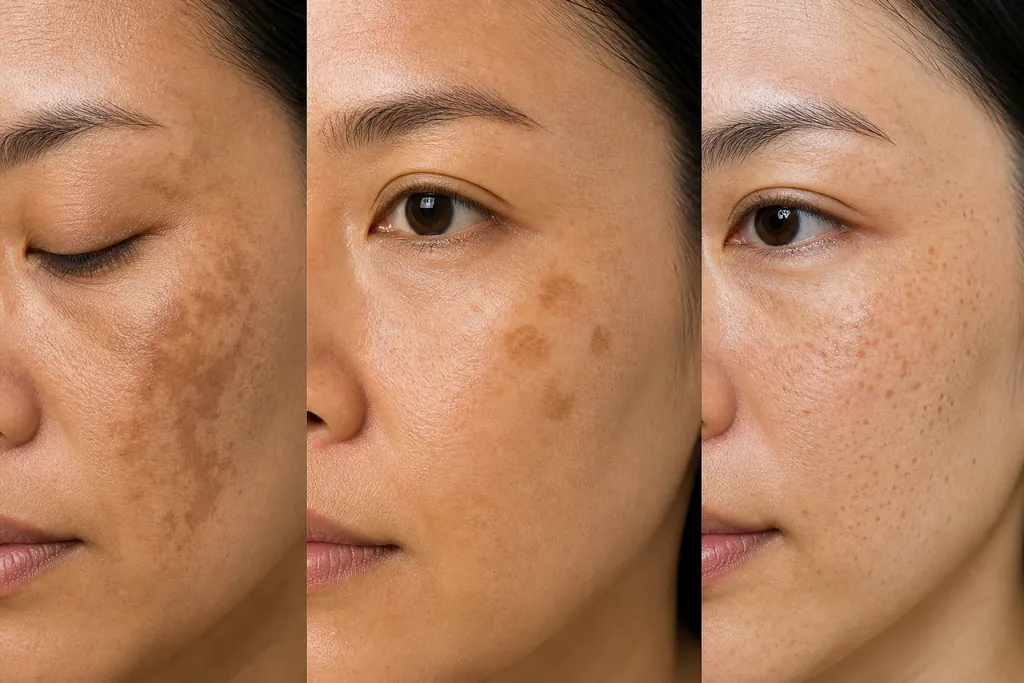
Sun spots are one of three common pigmentation patterns, alongside melasma and freckles, and they behave the most predictably of the three. Telling them apart matters because they are treated differently — sun spots tolerate pigment laser well, whereas melasma does not.
Melasma
Symmetrical patches, often on the cheeks, forehead or upper lip. Strongly hormone- and sun-influenced.
Cautious, lower-intensity protocols are the norm
Sun spots
Flat, well-defined dark marks caused by cumulative sun exposure — most common on face, hands and chest.
Often responsive to pigment lasers with sun discipline
Freckles
Small, lighter brown spots — often genetic. Tend to darken with sun and fade with consistent sun protection.
Gentle approaches when treatment is wanted
How they form
UV exposure stimulates pigment cells to produce melanin as a protective response. Over years, repeated exposure leads to localised clusters of excess pigment that show up as discrete dark spots. Unlike melasma, they are not strongly hormone-driven, and unlike PIH they do not require prior inflammation — sun alone is enough.
Because they are a cumulative-sun phenomenon, they tend to keep appearing unless sun exposure is managed, which is why prevention is part of the treatment.
Mechanism
Cumulative UV
Years of sun stimulate localised excess pigment.
Mechanism
Discrete spots
Pigment clusters into well-defined, flat brown marks.
Mechanism
Keeps recurring
New spots form over time without sun protection.
How they are treated
Pigment laser is the workhorse for sun spots: it targets the excess pigment, which the body then clears, often with good results in relatively few sessions because the pigment is shallow and defined. Supportive topicals and gentle peels can help with overall tone and milder spots.
Treatment without prevention is a short-term win, though. Daily broad-spectrum sun protection is what stops the next crop of spots, and it is the difference between a one-off clearance and lasting clear skin.
— Comparison
Sun spots — treatment at a glance
| Option | Role | Note |
|---|---|---|
| Pigment laser | Primary treatment | Clears defined spots, often in few sessions. |
| Supportive topicals | Tone & mild spots | Help overall evenness. |
| Gentle peels | Surface refinement | Adjunct for texture and mild pigment. |
| Sun protection | Prevention | Stops new spots — essential long-term. |
Pigment laser
- Role
- Primary treatment
- Note
- Clears defined spots, often in few sessions.
Supportive topicals
- Role
- Tone & mild spots
- Note
- Help overall evenness.
Gentle peels
- Role
- Surface refinement
- Note
- Adjunct for texture and mild pigment.
Sun protection
- Role
- Prevention
- Note
- Stops new spots — essential long-term.
When a spot needs checking
Most sun spots are harmless cosmetic pigmentation. But any spot that changes — growing, darkening unevenly, developing irregular borders, itching or bleeding — should be assessed promptly, because skin cancers can occasionally masquerade as a 'spot'. A doctor confirms a lesion is benign before treating it cosmetically.
This is one reason laser spot treatment is best done after a medical look rather than at a walk-in counter: you want the diagnosis confirmed first.
When to see a doctor
See a doctor to confirm your marks are sun spots (not melasma or something requiring medical attention) and to plan laser treatment plus a prevention routine. The combination of clearing existing spots and preventing new ones is what delivers a lasting result.
At DrPlus in Johor Bahru, sun spots are assessed before treatment and paired with a realistic prevention plan.
— Frequently asked
Common questions
Cumulative UV exposure over years stimulates localised excess pigment, forming flat, well-defined brown marks on sun-exposed areas like the face, hands and chest. They are not strongly hormone-driven, unlike melasma.
Yes — 'age spots' is a common name for solar lentigines, but they are driven by cumulative sun rather than age itself. They are treatable, and sun protection prevents new ones at any age.
Pigment laser is the main treatment, clearing defined spots often in relatively few sessions because the pigment is shallow. Supportive topicals and gentle peels help tone, and sun protection prevents new spots.
Treated spots are cleared, but new ones can form with continued sun exposure. Daily broad-spectrum sun protection is essential to keep results lasting.
If a spot grows, changes colour unevenly, develops irregular borders, itches or bleeds, see a doctor promptly. These changes need medical assessment to rule out skin cancer before any cosmetic treatment.
— Related treatments
Continue with the relevant DrPlus treatment pages
Each page goes deeper into mechanism, suitability and recovery — your final plan is confirmed at consultation.
— Continue reading
 Pigmentation
Melasma vs Freckles: Photos & How to Tell Them Apart
Three of the most common pigmentation patterns — and they behave very differently in treatment.
 Pigmentation
Freckles Treatment in Singapore & Johor Bahru: Options Explained
Freckles are harmless and often loved — but if you want them lighter, here is what works, and why they come back without sun protection.
 Pigmentation
Pigmentation Aftercare: Keeping Your Results
Clearing pigment is only half the job. Keeping it clear is the other half — and it comes down to a few disciplined habits.