
DrPlus Skin Education · Acne Scars
TCA CROSS for Ice Pick Acne Scars: How It Works
Deep, narrow ice pick scars defeat broad resurfacing because the energy cannot reach the bottom of the channel. TCA CROSS solves this with a completely different idea: rebuild from the base, one scar at a time.
Quick answer
TCA CROSS stands for Chemical Reconstruction Of Skin Scars. It is a focal technique in which a high-strength trichloroacetic acid is applied with a fine tip directly into the base of an individual ice pick scar — and nowhere else. The acid causes a controlled, contained injury at the scar floor, and as that point heals the body lays down new collagen that gradually fills the channel from the bottom up.
The reason it exists is geometry. Ice pick scars are narrow and deep, so broad resurfacing lasers struggle to deliver enough energy to the base of the channel. TCA CROSS sidesteps that problem entirely by treating one scar at a time, at depth. It softens scars over several sessions rather than erasing them, and because it uses a strong acid in precise spots, it is firmly a doctor-led procedure.
Why ice pick scars need a different approach
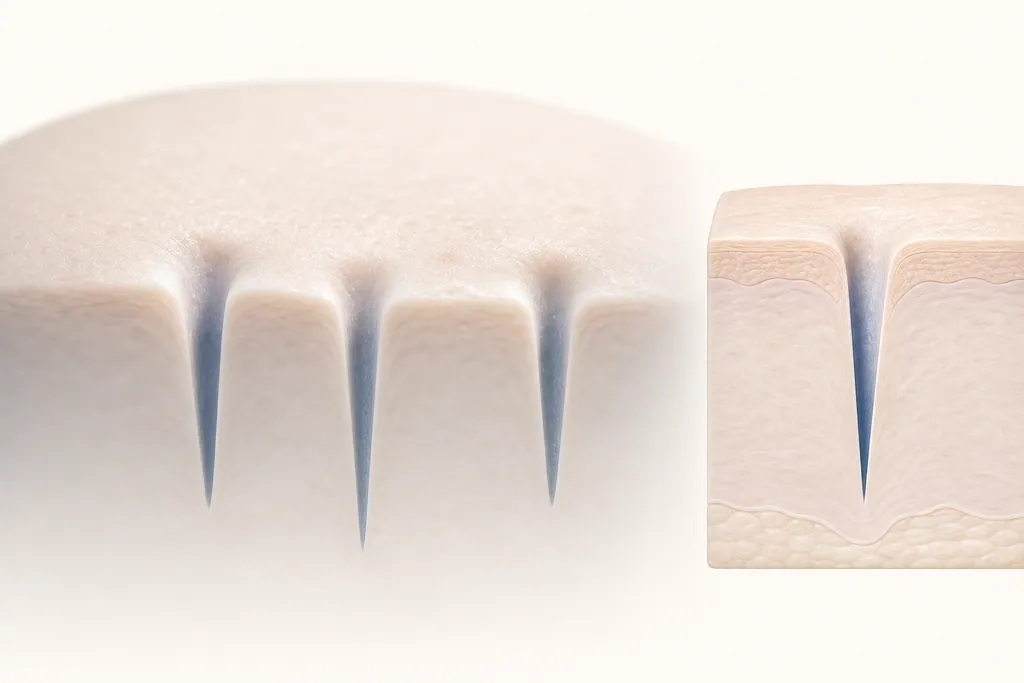
Ice pick scars are the narrow, deep members of the atrophic scar family — small surface openings that taper to a point well down in the dermis, like tiny punctures. Their shape is precisely what makes them stubborn: a treatment that works across the surface, such as a fractional laser, cannot easily push enough energy down a tight, deep channel to remodel its base.
Treating only the surface can smooth the opening while leaving the deep channel intact, so the scar barely changes. Effective treatment has to address the depth of the scar — which is the gap that focal techniques like TCA CROSS are designed to fill.
— Where treatments reach
Skin layers, in plain English
- Epidermis: Outer protective layer — pigmentation marks and surface texture live here.
- Dermis: Collagen and elastin layer — where atrophic scars are anchored and where most regenerative treatments work.
- Subcutis: Deeper fat / connective layer — beyond the reach of most aesthetic treatments.
A simplified illustration — actual skin layers are more nuanced. Your doctor will explain what is relevant to your case at consultation.
Key terms in this guide
How TCA CROSS rebuilds a scar
The principle is controlled, contained injury followed by guided repair. A fine applicator places a small amount of high-strength TCA precisely at the base of the ice pick scar. The acid denatures protein at that spot, producing a contained zone of injury at the scar floor — and a visible white 'frost' that tells the clinician the acid has acted where intended.
As that focal point heals, the body runs its standard wound-repair cascade locally: fibroblasts move in and lay down fresh collagen, which slowly fills the channel from the base toward the surface. Over repeated sessions, the cumulative collagen narrows and shallows the scar, so the opening becomes less deep and casts less shadow. The surrounding skin, untouched by the acid, is left to heal the small treated point.
Mechanism
1 · Precise application
A fine tip places high-strength TCA into the base of a single ice pick scar — and only there.
Mechanism
2 · Controlled frost
A contained white frost confirms the acid has acted at the scar floor without spreading to healthy skin.
Mechanism
3 · Collagen fills in
As the point heals, new collagen builds from the base, gradually narrowing and shallowing the channel over sessions.
Which scars suit TCA CROSS — and which do not
TCA CROSS is purpose-built for ice pick scars and some narrow, deep boxcar scars — exactly the geometry that resists resurfacing. It is not the tool for broad rolling scars (which are tethered and need release) or for wide, shallow texture (which suits area-based resurfacing or RF microneedling). It is a precision instrument for a specific problem, not an all-rounder.
Because most faces carry a mix of scar types, TCA CROSS is usually one component of a combination plan: it handles the deep narrow scars while resurfacing or RF microneedling refines the surrounding texture and subcision addresses any tethered scars. Sequencing these is part of what a consultation decides.
— Comparison
TCA CROSS suitability
| Scar type | Fit | Why |
|---|---|---|
| Ice pick | Strong | Treats the deep, narrow base that resurfacing cannot reach. |
| Narrow boxcar | Sometimes | Can help small, deep boxcar scars; assessed case by case. |
| Rolling | Not suitable | Tethered scars need release (subcision), not focal acid. |
| Broad texture | Not suitable | Area-based resurfacing or RF microneedling is the better fit. |
Ice pick
- Fit
- Strong
- Why
- Treats the deep, narrow base that resurfacing cannot reach.
Narrow boxcar
- Fit
- Sometimes
- Why
- Can help small, deep boxcar scars; assessed case by case.
Rolling
- Fit
- Not suitable
- Why
- Tethered scars need release (subcision), not focal acid.
Broad texture
- Fit
- Not suitable
- Why
- Area-based resurfacing or RF microneedling is the better fit.
Safety, frosting and why technique matters
TCA CROSS uses a strong acid, so precision is everything. Applied correctly, the acid stays contained within the scar and the frost is small and well-defined. Applied carelessly — too much acid, or spread onto healthy skin — it can injure surrounding tissue, widen the treated area, or in darker skin trigger pigmentation. This operator-dependence is exactly why it should be performed by a trained clinician, not attempted at home with internet-purchased acids.
In deeper Asian skin tones, the main risk to manage is post-inflammatory hyperpigmentation around the treated points. Careful concentration, contained application, conservative session spacing and rigorous sun protection all reduce that risk. A clinician may also start conservatively and review response before treating more scars.
What recovery looks like
Because only tiny points are treated, downtime is localised rather than face-wide. The treated spots frost white, then over the following days form small crusts or dark dots that shed as the points heal. The surrounding skin is largely unaffected, so most people continue normal activities, taking care not to pick at the healing spots.
The deeper change — collagen filling the channel — unfolds over weeks to months and across several sessions, typically spaced some weeks apart. As with all scar work, improvement is gradual and cumulative, and the realistic goal is softening: shallower, less shadowed scars rather than disappearance.
— Healing timeline
After a TCA CROSS session
Minutes
Frosting
Treated points turn white as the acid acts — the marker of contained, correct application.
Days 1–7
Crust & shed
Small crusts or dark dots form at the treated points and shed as they heal. Avoid picking to prevent marks.
Weeks to months
Collagen fills the channel
New collagen gradually narrows and shallows each scar across repeated sessions.
A general guide only. Individual healing speed varies with skin type, scar depth, aftercare and the treatment used.
Honest limitations
TCA CROSS softens ice pick scars; it does not erase them, and results vary between individuals and scars. Several sessions are usually needed, and progress is measured in 'less deep, less noticeable' rather than 'gone'. It treats the deep narrow scars only — surrounding texture and other scar types still need their own tools.
It also asks for patience and realistic expectations, which is part of good care. Any clinic promising to remove ice pick scars completely, in one session, with any single technique is overselling — ice pick scars are among the most challenging atrophic scars precisely because of their shape.
When to consider a medical consultation
If you have small, deep pits that look like enlarged or punctured pores and have not changed with surface treatments, TCA CROSS may be relevant — but only an in-person assessment can confirm the scar type and whether the technique suits your skin tone and scar pattern.
At DrPlus in Johor Bahru, a consultation maps your scar mix, explains how TCA CROSS would fit alongside other treatments, and sets honest expectations on sessions and likely improvement — with no pressure to proceed on the day.
Summary
TCA CROSS treats ice pick scars by doing the opposite of broad resurfacing: instead of working across the surface, it places a high-strength acid precisely into the base of a single deep scar, prompting the body to rebuild collagen from the bottom up. That focal, depth-first logic is what makes it one of the few effective options for the narrow, deep geometry of ice pick scars.
It is precise, operator-dependent and not a DIY treatment; it softens rather than erases, needs several sessions, and carries a pigmentation risk that must be managed in darker skin. Used by a trained clinician as part of a combination plan, it fills a genuine gap that lasers alone cannot — which is exactly why a proper assessment matters.
— Frequently asked
Common questions
Chemical Reconstruction Of Skin Scars. It is a focal technique that applies high-strength trichloroacetic acid precisely into the base of an individual ice pick scar to prompt collagen rebuilding from the bottom up.
Ice pick scars are narrow and deep, so broad resurfacing lasers cannot deliver enough energy to the base of the channel. TCA CROSS treats one scar at a time at depth, which suits that geometry far better.
No. It softens and shallows scars over several sessions, with the realistic goal being less deep, less noticeable scars rather than complete removal. Results vary between individuals.
It can be, but the main risk is post-inflammatory hyperpigmentation around the treated points. Careful application, conservative spacing and strict sun protection reduce that risk, which is why it must be performed by a trained clinician.
Frosting is the white discolouration that appears where the acid has acted. A small, contained frost confirms the acid has been applied correctly to the scar base without spreading to healthy skin.
No. High-strength TCA applied imprecisely can injure or pigment healthy skin. TCA CROSS depends on contained, expert application and should only be performed by a trained medical professional.
— Related treatments
Continue with the relevant DrPlus treatment pages
Each page goes deeper into mechanism, suitability and recovery — your final plan is confirmed at consultation.
Primary money page
Acne Scar Treatment Hub
Doctor-led hub where focal techniques like TCA CROSS are sequenced within a full plan.
acne scar treatment in Johor BahruSupporting
Chemical Peel
Surface refinement alongside focal scar treatment for overall evenness.
chemical peel for surface toneSupporting
CO₂ Laser
Resurfaces surrounding texture while focal techniques treat the deep channels.
fractional CO₂ laser for acne scarsSupporting
RF Microneedling
Rebuilds dermal collagen across the surrounding skin in a combination plan.
RF microneedling for acne scars— Continue reading
 Acne Scars
Ice Pick Scars: Why They Are Difficult to Treat
Ice pick scars are narrow and deep — like tiny punctures. Their shape is exactly why broad resurfacing struggles to reach them.
Chemical Peels for Acne Scars: A Medical Education Guide
Chemical peels are often misunderstood as a scar 'cure'. In reality they are precise surface-renewal tools — powerful for tone and texture, limited for deep structure. Here is exactly what they can and cannot do.
Why Lasers Alone May Not Fix Every Acne Scar
Lasers are superb at what they do — resurfacing the surface. But many acne scars are not surface problems. Understanding that mismatch explains why laser alone sometimes plateaus, and why combinations work better.