
DrPlus Men's Wellness · Circumcision
Glue Circumcision in Singapore: How Tissue Adhesive Closure Works
'Glue circumcision' does not mean no surgery — it means the wound is closed with medical tissue adhesive instead of stitches. Here is how it works, who suits it, and how healing differs.
Quick answer
Glue circumcision is a closure technique, not a different operation. The foreskin is removed surgically under local anaesthesia exactly as in conventional circumcision — then, instead of closing the wound with a full ring of dissolvable stitches, the doctor seals the skin edges with medical-grade tissue adhesive (a cyanoacrylate skin glue used widely in surgery).
The appeal is comfort and convenience during healing: no suture knots to catch on clothing, no stitch marks, and a film that simply peels away as the skin knits beneath it. It is a legitimate, established option — but it is still surgery, and whether it suits you depends on your anatomy and the doctor's assessment.
How tissue adhesive closure works
Medical tissue adhesives polymerise within seconds of contact with skin, bonding the wound edges while the body's own healing seals the deeper layers. In circumcision, the adhesive is applied along the cut edge after the foreskin is removed and bleeding is controlled — sometimes on its own, sometimes over a small number of anchoring stitches.
The glue film is waterproof enough for careful showering, flexible enough for normal movement, and sloughs off gradually over one to two weeks as the outer skin layer renews — by which point the wound edges have knitted.
Mechanism
Seal
Adhesive bonds the wound edges within seconds, replacing some or all stitches.
Mechanism
Protect
The film shields the healing edge from friction and moisture in the early days.
Mechanism
Peel away
As skin renews over one to two weeks, the film sloughs off on its own — nothing to remove.
Glue vs stitches vs stapler
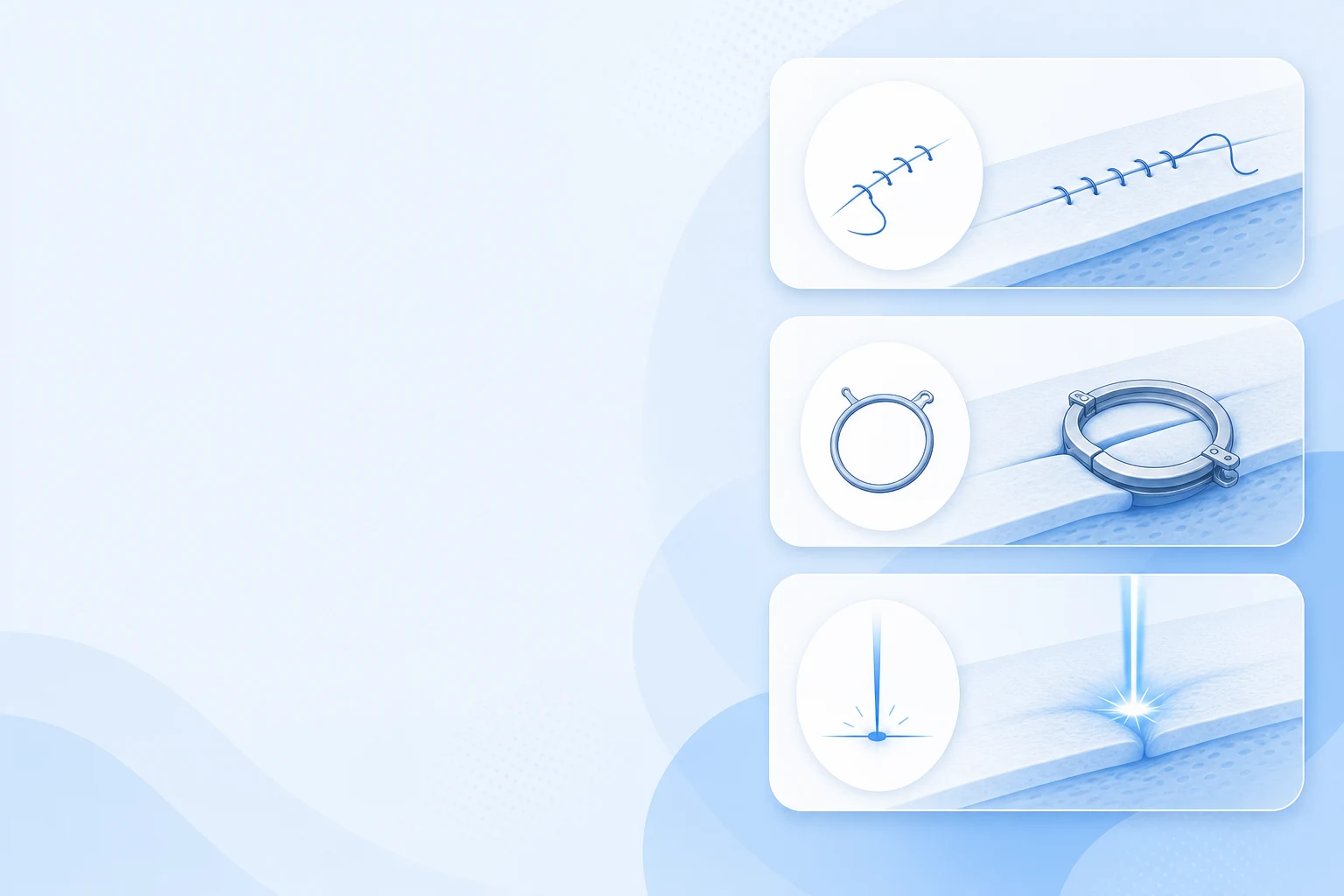
All three approaches remove the foreskin the same way; they differ at the closure stage. Stitched closure is the long-established standard and copes with any anatomy. Stapler devices remove and seal in one step, often with less bleeding, and their components separate over two to three weeks. Glued closure avoids knots and stitch marks and tends to feel tidier early on — but it relies on a clean, dry, well-matched wound edge, so it is not automatic for every case.
In practice, doctors also combine approaches — a few anchoring stitches plus adhesive is common. The comparison below summarises general tendencies; your anatomy and the doctor's technique decide what is right for you.
— Comparison
Closure approaches — general comparison
| Aspect | Stitches | Stapler | Glue |
|---|---|---|---|
| Closure | Dissolvable sutures | Device seals the edge | Tissue adhesive film |
| What detaches | Stitches dissolve, 2–3 weeks | Components separate, 2–3 weeks | Film peels, 1–2 weeks |
| Early comfort | Knots can catch slightly | Ring noticeable early on | Often feels tidier |
| Still surgery? | Yes | Yes | Yes |
Closure
- Stitches
- Dissolvable sutures
- Stapler
- Device seals the edge
- Glue
- Tissue adhesive film
What detaches
- Stitches
- Stitches dissolve, 2–3 weeks
- Stapler
- Components separate, 2–3 weeks
- Glue
- Film peels, 1–2 weeks
Early comfort
- Stitches
- Knots can catch slightly
- Stapler
- Ring noticeable early on
- Glue
- Often feels tidier
Still surgery?
- Stitches
- Yes
- Stapler
- Yes
- Glue
- Yes
Who suits glue circumcision
Good candidates are adults and older teenagers with straightforward anatomy, no active infection, and no bleeding tendency — the situations where a clean, dry wound edge can be reliably achieved. Heavier bleeding risk, significant scarring from previous infections, or revision surgery tilt the choice back toward stitched closure, where the doctor has more control.
This is why 'do you do glue circumcision?' is really a consultation question. A doctor who examines you can say whether adhesive closure — alone or combined with stitches — is a sensible plan for your case, rather than promising a technique before seeing the anatomy it has to work on.
Healing after glued closure
The overall recovery arc matches other methods: a few days of swelling and tenderness, desk work within a few days, and around four to six weeks before strenuous exercise and sexual activity resume. The glue-specific differences are small but pleasant — careful showering is usually possible early, and there are no stitches to feel or wait on.
Two rules specific to adhesive: do not pick or peel the film, even when the edges lift — it detaches on its own schedule — and avoid ointments or creams directly on the glue unless your doctor says otherwise, because they soften the film prematurely.
— Frequently asked
Common questions
Yes — tissue-adhesive closure is an established option offered by doctor-led clinics, sometimes combined with a small number of stitches. Suitability is confirmed at examination. DrPlus discusses closure options during circumcision consultations at Tanjong Pagar and East Coast.
The procedure feels the same either way — it is done under local anaesthesia. During healing, many patients find glued closure more comfortable because there are no suture knots to catch, but overall discomfort and recovery time are broadly similar.
The adhesive film peels away gradually over one to two weeks as the outer skin renews, by which time the wound edges have knitted. It should never be picked or peeled off early.
Sometimes fully, sometimes not — doctors often place a few anchoring stitches and seal the rest with adhesive. What matters is a secure closure for your anatomy, which the doctor decides during the procedure.
Slightly tidier early healing is common, but the deeper wound heals on the same biological timeline — so activity restrictions (around four to six weeks for strenuous exercise and sexual activity) still apply.
— Related treatments
Continue with the relevant DrPlus treatment pages
Each page goes deeper into mechanism, suitability and recovery — your final plan is confirmed at consultation.
— Continue reading
 Circumcision
Circumcision Methods Compared: Stapler, Laser, Glue and More
'Stapler', 'laser', 'glue' or 'conventional'? Here is what each circumcision method actually means — without the marketing spin.
Circumcision Recovery: Healing Timeline and Aftercare Guide
Knowing what normal healing looks like makes circumcision recovery far less stressful. Here is the week-by-week timeline, the aftercare that matters, and the warning signs to act on.
Circumcision Cost in Singapore: What Determines the Fee
Circumcision quotes in Singapore can differ several-fold. This guide explains the factors behind the spread — and when Medisave or insurance may apply — so you can compare like with like.