
DrPlus Skin Education · Singapore
PRP in Singapore: What It's Used For and What's Realistic
PRP uses your own blood's growth factors to support healing and regeneration. Here is what the evidence supports it for — and where the marketing outruns the science.
What PRP actually is
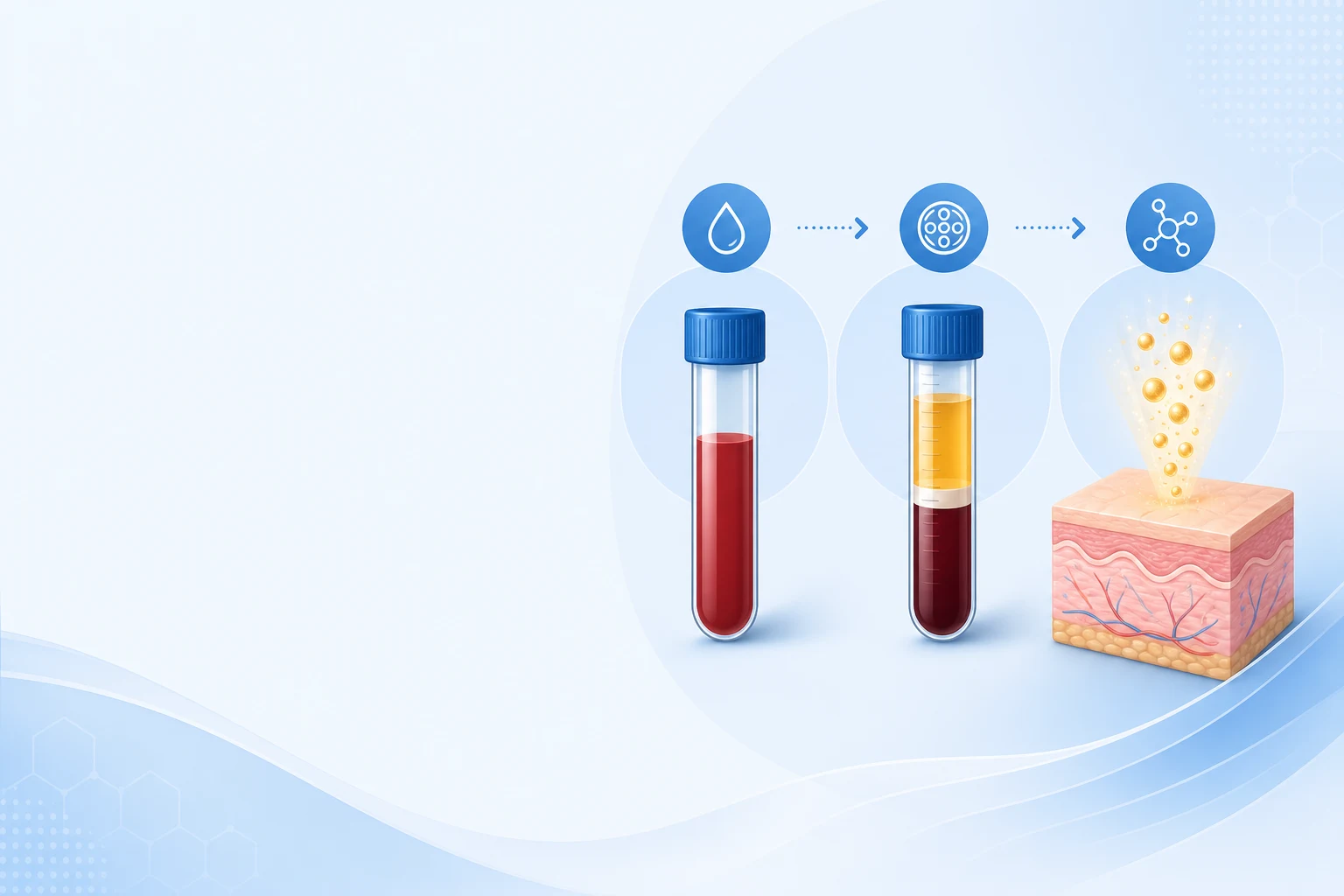
PRP starts with a standard blood draw from your arm. The blood is spun in a centrifuge to separate its components, and the plasma layer richest in platelets is extracted. Platelets carry growth factors — the signalling proteins your body uses to trigger repair — and injecting a concentrated dose into a target area is a way of amplifying that natural signal exactly where it is wanted.
Because the material is your own blood product, prepared and reinjected in the same session, allergic reaction risk is minimal. What varies — and varies a lot — is preparation quality: platelet concentration depends on the collection volume, the centrifuge protocol and the handling. Two clinics offering 'PRP' are not necessarily offering the same product.
Mechanism
1 · Draw
A standard blood sample is taken from your arm — similar to a routine blood test.
Mechanism
2 · Concentrate
A centrifuge separates the blood; the platelet-rich plasma layer is extracted.
Mechanism
3 · Deliver
The PRP is injected into the scalp or skin, delivering concentrated growth factors to the target area.
What the evidence supports PRP for
The best-supported aesthetic use is androgenetic (pattern) hair loss. Multiple controlled studies support PRP improving hair density and thickness in early-to-moderate thinning, particularly as part of a plan that may also include medical treatments. The key qualifier is 'early-to-moderate': PRP stimulates follicles that are weakened but alive — it cannot resurrect follicles that are long gone, which is why a shiny, fully bald area is not a PRP case.
For skin, PRP is used to support skin quality — fine texture, tone, and healing after procedures like microneedling or laser. The honest framing: improvements are real but gradual and subtle, building over a course of sessions. PRP is a support treatment for skin, not a replacement for the structural treatments (lasers, RF microneedling, injectables) that address specific concerns.
— Comparison
PRP uses: evidence and expectations
| Use | What's realistic |
|---|---|
| Hair loss (early–moderate pattern thinning) | The strongest evidence base — supports density and thickness across a course, often alongside medical treatment. |
| Skin quality & texture | Gradual, subtle support — often combined with microneedling; not a substitute for structural treatments. |
| Post-procedure healing | Used to support recovery after resurfacing or microneedling treatments. |
| Advanced baldness | Not a PRP case — follicles that are gone cannot be stimulated. An honest clinic screens this out at assessment. |
Hair loss (early–moderate pattern thinning)
- What's realistic
- The strongest evidence base — supports density and thickness across a course, often alongside medical treatment.
Skin quality & texture
- What's realistic
- Gradual, subtle support — often combined with microneedling; not a substitute for structural treatments.
Post-procedure healing
- What's realistic
- Used to support recovery after resurfacing or microneedling treatments.
Advanced baldness
- What's realistic
- Not a PRP case — follicles that are gone cannot be stimulated. An honest clinic screens this out at assessment.
Sessions, timeline and maintenance
PRP is a course, not a one-off. For hair, a typical plan starts with three or more sessions spaced about four weeks apart, with results assessed from around the third month — hair cycles are slow, and density changes take months to become visible. Maintenance sessions, commonly every several months, help hold the result.
For skin uses, courses are similar in shape: an initial series, gradual improvement over weeks to months, and periodic maintenance. Anyone evaluating PRP should budget — in time and money — for the course, not the single session, and a clinic quoting realistically will present it that way from the start.
Safety, and choosing where to have PRP in Singapore
PRP's safety profile is favourable because the injected material is your own: expected effects are limited to temporary soreness, swelling or pinpoint bruising at injection sites for a few days. The risks that do exist come from process, not product — non-sterile handling, poor-quality preparation, or injection by untrained hands.
That makes the provider checklist short and clear: a registered doctor performing the assessment and injections, licensed clinic premises, a proper centrifuge protocol, and an honest suitability screen that turns away cases PRP cannot help. DrPlus offers doctor-led PRP consultations in Singapore at Tanjong Pagar and East Coast, with suitability assessed individually before any course is planned.
— Frequently asked
Common questions
For early-to-moderate pattern hair loss, controlled studies support PRP improving hair density and thickness over a course of sessions. It works by stimulating weakened follicles that are still alive — which is why it cannot help areas that are fully bald, and why an honest assessment of your hair loss stage comes first.
A typical initial course is three or more sessions spaced around four weeks apart, with results assessed from month three onwards and maintenance sessions every several months thereafter. The exact plan depends on the concern and your response, which the doctor reviews as the course progresses.
PRP uses your own blood, so allergic reaction risk is minimal. Expected effects are temporary soreness, swelling or small bruises at injection sites. The meaningful risks come from poor handling or untrained injection — which is why PRP belongs in a licensed clinic with a doctor performing the procedure.
Numbing cream is applied before scalp or skin injections, and most patients describe the sensation as tolerable pinpricks with some pressure. The scalp can feel tender for a day or two afterwards — normal activity can usually resume immediately.
DrPlus offers doctor-led PRP consultations at our Singapore clinics in Tanjong Pagar and East Coast. Suitability is assessed individually first — including an honest screen of whether your concern is one PRP can actually help — before any course is planned or quoted.
— Related treatments
Continue with the relevant DrPlus treatment pages
Each page goes deeper into mechanism, suitability and recovery — your final plan is confirmed at consultation.
— Continue reading
PRP vs Minoxidil for Hair Loss: What a Doctor Considers
One is a daily topical, the other an in-clinic injection series. They are not rivals so much as different tools — here is how a doctor actually chooses.
 PRP & Regenerative
PRP and Exosomes for Acne Scars: A Supporting Role
PRP and exosomes are often marketed as scar cures. The honest picture is more useful: they are supporting players that help skin heal after the real work.