
DrPlus Skin Education · Singapore
Acne Scar Treatment in Singapore: How Doctors Match Treatment to Scar Type
There is no single machine that removes acne scars. What works is matching each scar type to the method built for it — here is how a doctor actually plans that.
On this page
Why scar type decides the treatment — not the machine
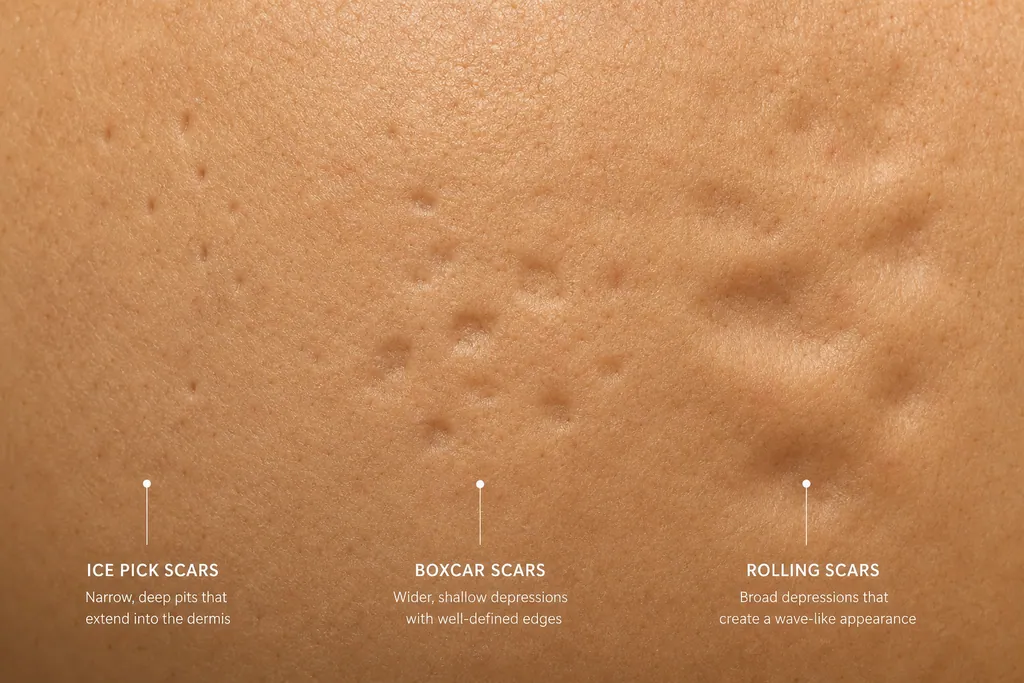
Acne scars are not one condition. When inflamed acne damages the deeper skin, healing can leave depressions with very different architecture: narrow, deep ice pick scars; sharp-edged boxcar scars; broad, undulating rolling scars tethered by fibrous bands; and flat brown or red post-acne marks that are not true scars at all. Each of these responds to a different mechanism — and no single device addresses all of them.
This is the single most useful thing to understand before comparing clinics in Singapore: a plan built around one machine is a plan built around what the clinic owns, not what your skin has. A doctor-led plan starts by mapping which scar types you carry and in what proportion, then sequences the methods that fit.
Ice pick
Narrow, deep channels that extend down into the dermis — like a small puncture wound.
Depth-first treatments usually needed
Boxcar
Wider, shallow-to-medium depressions with clearly defined, punched-out edges.
Often responsive to fractional resurfacing
Rolling
Wave-like undulations caused by fibrous bands tethering the skin downward.
Structural release commonly needed first
Pitted / marks
Includes deeper pits and flat post-inflammatory marks left after acne heals.
Pigment marks often respond to topicals + peels
Which treatment fits which scar
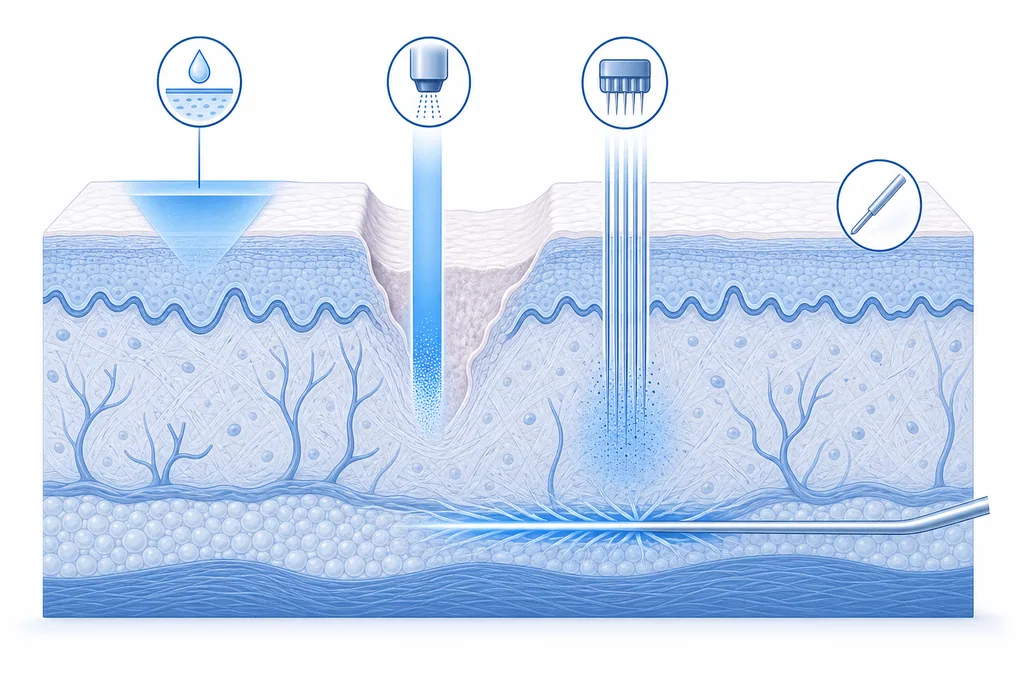
Rolling and tethered scars sit at the top of the planning order because they are anchored: fibrous bands beneath the surface pull the skin down, and no amount of surface resurfacing lifts a scar that is tied down from below. Subcision — releasing those bands with a needle or cannula under local anaesthesia — is the method built for this problem.
Ice pick scars are too narrow and deep for lasers to reach their base safely, so they are treated focally — most commonly TCA CROSS, where a high-strength acid is placed precisely into each pit to stimulate collagen from the bottom up. Boxcar scars and general uneven texture are the true resurfacing cases: fractional CO₂ laser and RF microneedling both remodel collagen across the treated area, with RF microneedling generally trading some intensity for shorter downtime and a gentler profile in pigmentation-prone skin.
Post-acne marks — the flat red or brown spots most people call scars — usually need none of the above. They are pigment and vascular changes that fade with time, and chemical peels or pico laser can speed that fading considerably.
— Comparison
Scar type → method, at a glance
| Scar type | Primary method | Why |
|---|---|---|
| Rolling / tethered | Subcision | Releases the fibrous bands pulling the scar down — resurfacing alone cannot |
| Ice pick | TCA CROSS | Focal acid placement reaches the narrow pit base that lasers cannot treat safely |
| Boxcar / texture | CO₂ laser or RF microneedling | Fractional collagen remodelling across the treated area |
| Post-acne marks | Chemical peels or pico laser | Pigment and redness fade — no structural repair needed |
Rolling / tethered
- Primary method
- Subcision
- Why
- Releases the fibrous bands pulling the scar down — resurfacing alone cannot
Ice pick
- Primary method
- TCA CROSS
- Why
- Focal acid placement reaches the narrow pit base that lasers cannot treat safely
Boxcar / texture
- Primary method
- CO₂ laser or RF microneedling
- Why
- Fractional collagen remodelling across the treated area
Post-acne marks
- Primary method
- Chemical peels or pico laser
- Why
- Pigment and redness fade — no structural repair needed
Why plans are sequenced, and what a course looks like
Because most faces carry a mix of scar types, effective plans combine methods in a deliberate order — commonly subcision first to release tethering, then resurfacing sessions (CO₂ laser or RF microneedling) spaced four to eight weeks apart, with focal TCA CROSS for any ice pick scars woven in between. Active acne is brought under control before scar work begins, because treating scars while new ones are forming is rowing against the tide.
Improvement is progressive rather than immediate. Each session triggers collagen remodelling that continues for roughly three months, so the skin you see six months into a plan is meaningfully different from the skin at week two. Clinics that promise dramatic single-session transformations are describing something other than how scar biology works.
— Pathway
A typical doctor-led scar plan
- 1
Scar mapping
The doctor identifies which scar types you carry, their depth, and whether active acne needs controlling first.
- 2
Release tethering
Subcision frees rolling and tethered scars so later resurfacing can actually lift them.
- 3
Resurface & treat focally
CO₂ laser or RF microneedling sessions spaced 4–8 weeks apart; TCA CROSS for ice pick pits.
- 4
Review & adjust
Progress is reviewed as collagen remodels; the plan adapts to how your skin responds.
- 1
Scar mapping
The doctor identifies which scar types you carry, their depth, and whether active acne needs controlling first.
- 2
Release tethering
Subcision frees rolling and tethered scars so later resurfacing can actually lift them.
- 3
Resurface & treat focally
CO₂ laser or RF microneedling sessions spaced 4–8 weeks apart; TCA CROSS for ice pick pits.
- 4
Review & adjust
Progress is reviewed as collagen remodels; the plan adapts to how your skin responds.
What acne scar treatment costs in Singapore — honestly
There is no single price for acne scar treatment in Singapore, because the treatment is a plan rather than a product. Cost is driven by three variables: which scar types you carry (and therefore which modalities are needed), whether methods are combined in the same plan, and how many sessions your skin realistically requires — typically a series rather than a one-off.
The practical consequence: any clinic quoting you a precise total before a doctor has examined your scars is guessing. A credible pathway is assessment first, then a written, itemised plan you can consider without pressure. That is the model DrPlus uses at its Tanjong Pagar and East Coast clinics — and sending a clear photo of your scars via WhatsApp is usually enough for a doctor to outline what your plan would involve before you commit to visiting.
Acne scar treatment in darker and pigmentation-prone skin
Many Singapore patients have skin tones that pigment easily after inflammation — which matters, because aggressive resurfacing in pigmentation-prone skin can trade scars for months of post-inflammatory hyperpigmentation (PIH). This does not make treatment unsuitable; it changes the settings and the sequence.
Practically, that means conservative fractional settings, a preference for RF microneedling (which spares the skin surface) in higher-risk skin, strict sun protection through the course, and sometimes pigment-calming preparation before resurfacing begins. A doctor experienced with Asian skin builds these safeguards in from the first session rather than reacting to PIH after it appears.
Choosing where to be treated in Singapore
The useful screening question is not which machine a clinic owns but how it plans: Does a doctor examine your scars before quoting? Does the plan name which scar types you have and which method addresses each? Are session counts and downtime stated honestly? Is active acne addressed first? Clinics that answer these plainly tend to plan treatment the same way.
DrPlus offers doctor-led acne scar consultations at its Singapore clinics in Tanjong Pagar (SBF Center) and East Coast (The Flow Mall). Every plan starts with scar mapping, and the doctor tells you plainly what improvement is realistic for your scar mix before anything is booked.
— Frequently asked
Common questions
It depends on your scar types. Rolling and tethered scars respond to subcision, ice pick scars to focal TCA CROSS, boxcar scars and texture to CO₂ laser or RF microneedling, and post-acne marks to peels or pico laser. Most people carry a mix, so the most effective approach is usually a sequenced combination matched to your scars at a doctor assessment — not a single machine.
Scar improvement is progressive: subcision commonly takes 1–3 sessions, RF microneedling 3–6, CO₂ laser 2–4 and peels 4–6, spaced four to eight weeks apart. Collagen remodelling continues for months after each session, so plans are judged over six months rather than weeks.
Cost depends on which scar types you carry, which modalities are combined, and how many sessions your skin needs — which is why credible clinics quote after a scar assessment, not before. At DrPlus, the doctor maps your scars first and you receive a written, personalised plan with no obligation to proceed.
Honest framing: treatment aims for substantial visible improvement — softer, shallower, less noticeable scarring — rather than complete erasure. The degree of improvement depends on scar depth and type, your skin's healing response, and completing the planned course. A doctor should tell you what is realistic for your scars before you start.
Yes, with the right adjustments. Pigmentation-prone skin needs conservative settings, often a preference for RF microneedling over aggressive ablative resurfacing, and strict sun protection to avoid post-inflammatory hyperpigmentation. This is a planning question your doctor addresses at assessment.
DrPlus offers doctor-led acne scar consultations and treatment at its Singapore clinics in Tanjong Pagar (SBF Center, 160 Robinson Road) and East Coast (The Flow Mall, 66 East Coast Road). You can WhatsApp a photo of your scars first and the doctor will outline what a plan would involve.
— Related treatments
Continue with the relevant DrPlus treatment pages
Each page goes deeper into mechanism, suitability and recovery — your final plan is confirmed at consultation.
Primary money page
Acne Scar Treatment in Singapore
The doctor-led service hub — scar types, treatment options and booking.
acne scar treatment and removal in SingaporeSupporting
Subcision in Singapore
The release technique for scars anchored by fibrous bands.
subcision for rolling and tethered scars in SingaporeSupporting
CO₂ Laser in Singapore
Resurfacing for boxcar scars and uneven texture.
fractional CO₂ laser resurfacing in SingaporeSupporting
RF Microneedling in Singapore
Collagen remodelling with shorter downtime — often preferred in pigmentation-prone skin.
RF microneedling in Singapore— Continue reading
 Acne Scars
Types of Acne Scars: Ice Pick, Boxcar, Rolling and Pitted Scars
Atrophic acne scars come in distinct shapes — and the shape often determines what treatment may actually help.
 Acne Scar Science
Acne Scar Treatment Comparison: CO₂ Laser, RF Microneedling, Subcision & Peels
There is no single 'best' acne scar treatment — only the right tool for a specific scar at a specific depth. This guide compares the four main options on the dimensions that actually decide outcomes.
 Acne Scars
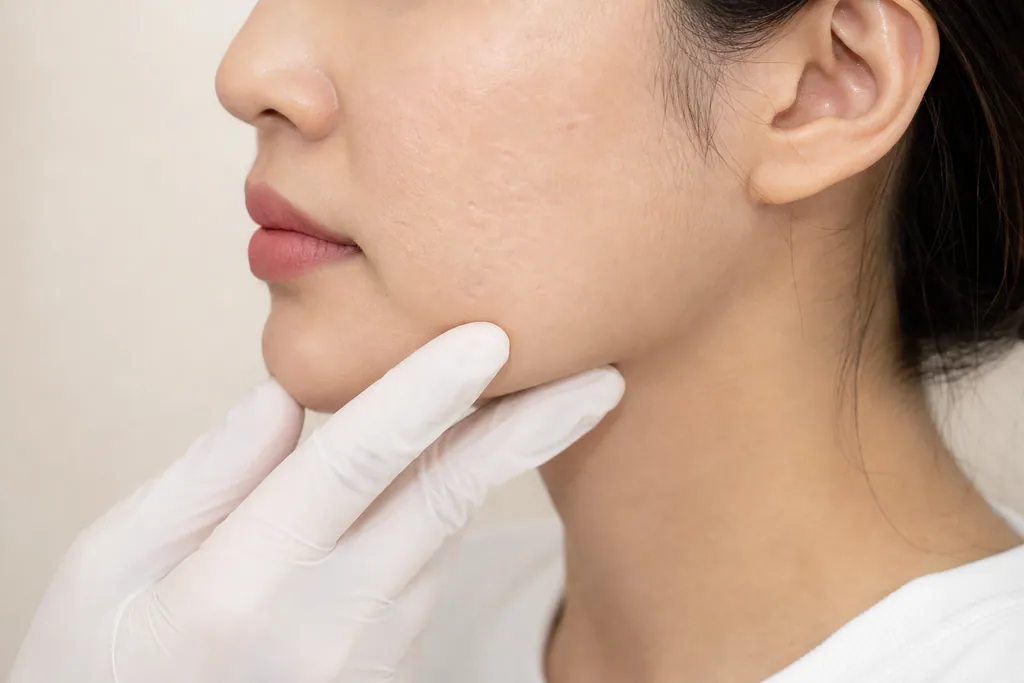
Subcision for Rolling Acne Scars: What to Know
Rolling scars are tethered from below. Until that tethering is released, surface treatments often do less than expected.