
DrPlus Skin Education · Acne Scars
How to Remove Acne Scars: A Decision Tree — Marks vs Scars, Home vs Clinic, and by Scar Type
Most advice on removing acne scars fails because it skips the first question — are they scars at all? This decision tree walks from marks vs scars, through home care's limits, to treatment by scar type.
Step 1 — Are they marks or scars?
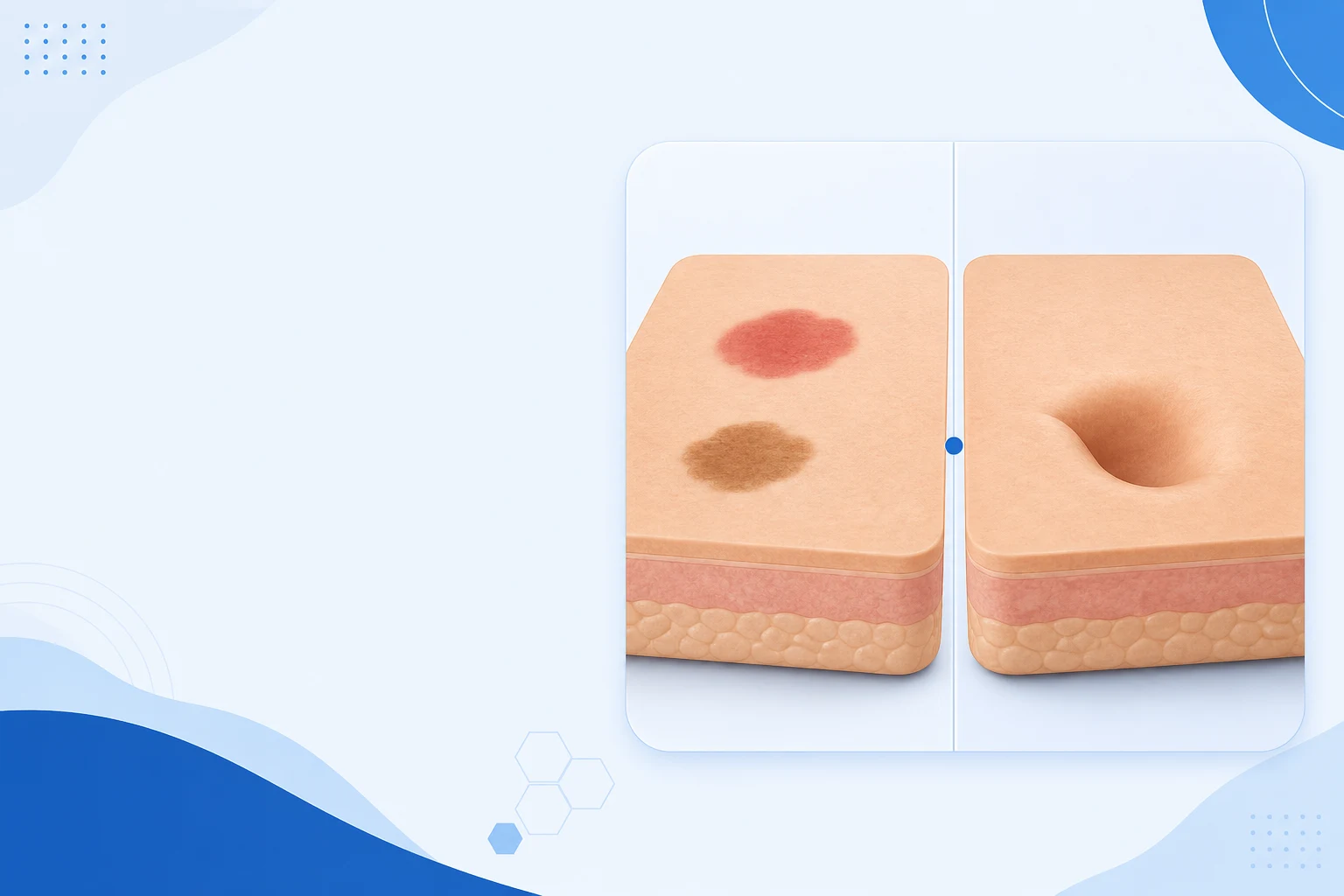
Before anything else, work out what you are looking at. Post-acne marks are flat patches of colour — red or pink (post-inflammatory erythema, PIE) from lingering blood vessels, or brown to dark (post-inflammatory hyperpigmentation, PIH) from excess melanin. They are smooth to the touch and largely vanish when the skin is stretched in good light. Acne scars are changes in the skin's contour: dents (rolling, boxcar, ice pick) or, less often, raised tissue. They cast a shadow however you stretch the skin.
The distinction decides everything that follows. Marks fade with time and respond to skincare and pigment lasers; scars do not fade and need procedures that change structure. Most people searching how to remove acne scars have a mixture, so the honest answer usually has two parts.
— Pathway
The decision tree in four questions
- 1
Flat or dented?
Stretch the skin in good light. If the colour largely disappears and it feels smooth, it is a mark. If a shadow or dip remains, it is a scar.
- 2
Is acne still active?
If yes, control it first — otherwise new marks and scars form behind the ones you treat.
- 3
Mark: red or brown?
Red (PIE) needs vascular-focused care; brown (PIH) needs pigment care and strict sun protection.
- 4
Scar: which type?
Rolling → subcision; boxcar → resurfacing; ice pick → TCA CROSS; mixed → sequenced combination.
- 1
Flat or dented?
Stretch the skin in good light. If the colour largely disappears and it feels smooth, it is a mark. If a shadow or dip remains, it is a scar.
- 2
Is acne still active?
If yes, control it first — otherwise new marks and scars form behind the ones you treat.
- 3
Mark: red or brown?
Red (PIE) needs vascular-focused care; brown (PIH) needs pigment care and strict sun protection.
- 4
Scar: which type?
Rolling → subcision; boxcar → resurfacing; ice pick → TCA CROSS; mixed → sequenced combination.
Step 2 — What home care can and cannot do
For marks, home care genuinely works, slowly. Daily broad-spectrum sunscreen is the single most effective step for brown marks, because UV deepens and prolongs pigment. Retinoids speed cell turnover; vitamin C, niacinamide, azelaic acid and alpha-hydroxy acids help lift pigment and even tone. Red marks respond less to topicals and more to time and, where needed, vascular-focused laser. Give any topical routine three months before judging it, and expect gradual fading rather than disappearance.
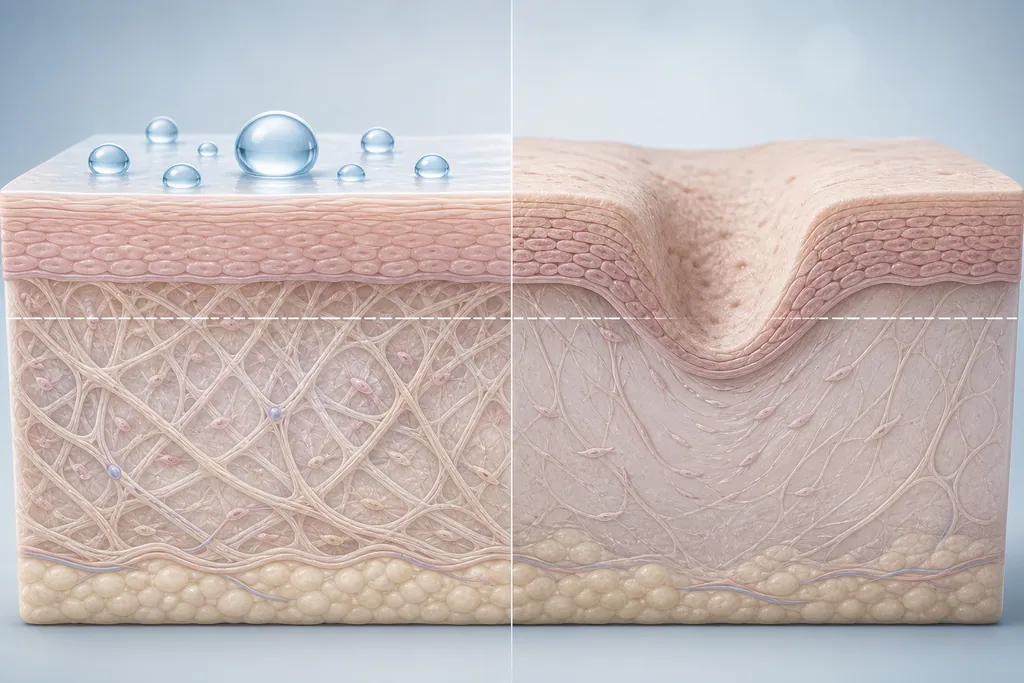
For scars, the ceiling is low and worth stating plainly. Creams, serums, silicone gels and 'scar removal' products act on the surface; a depressed scar is a collagen deficit in the dermis, and nothing applied to the surface rebuilds it. Retinoids can soften the edges of very shallow scars and improve overall texture, which is why they are a reasonable supporting step — but they are not a route to removing a rolling or boxcar scar. Dermabrasion kits, derma rollers and acid peels at home carry real risk of pigmentation and infection on Asian skin for little gain.
— Comparison
What each approach can realistically do
| Approach | Marks (PIE / PIH) | Depressed scars |
|---|---|---|
| Sunscreen daily | Essential — prevents deepening of brown marks | No effect on contour, but protects treated skin |
| Retinoids | Speeds fading | Softens very shallow edges; does not fill scars |
| Vitamin C / niacinamide / azelaic acid | Helps lift pigment and even tone | No structural effect |
| Silicone gel | No role | Raised scars only — nothing for dents |
| Home rollers / peels | Pigment risk outweighs benefit | Pigment and infection risk; no meaningful remodelling |
Sunscreen daily
- Marks (PIE / PIH)
- Essential — prevents deepening of brown marks
- Depressed scars
- No effect on contour, but protects treated skin
Retinoids
- Marks (PIE / PIH)
- Speeds fading
- Depressed scars
- Softens very shallow edges; does not fill scars
Vitamin C / niacinamide / azelaic acid
- Marks (PIE / PIH)
- Helps lift pigment and even tone
- Depressed scars
- No structural effect
Silicone gel
- Marks (PIE / PIH)
- No role
- Depressed scars
- Raised scars only — nothing for dents
Home rollers / peels
- Marks (PIE / PIH)
- Pigment risk outweighs benefit
- Depressed scars
- Pigment and infection risk; no meaningful remodelling
Step 3 — Treating true scars by type
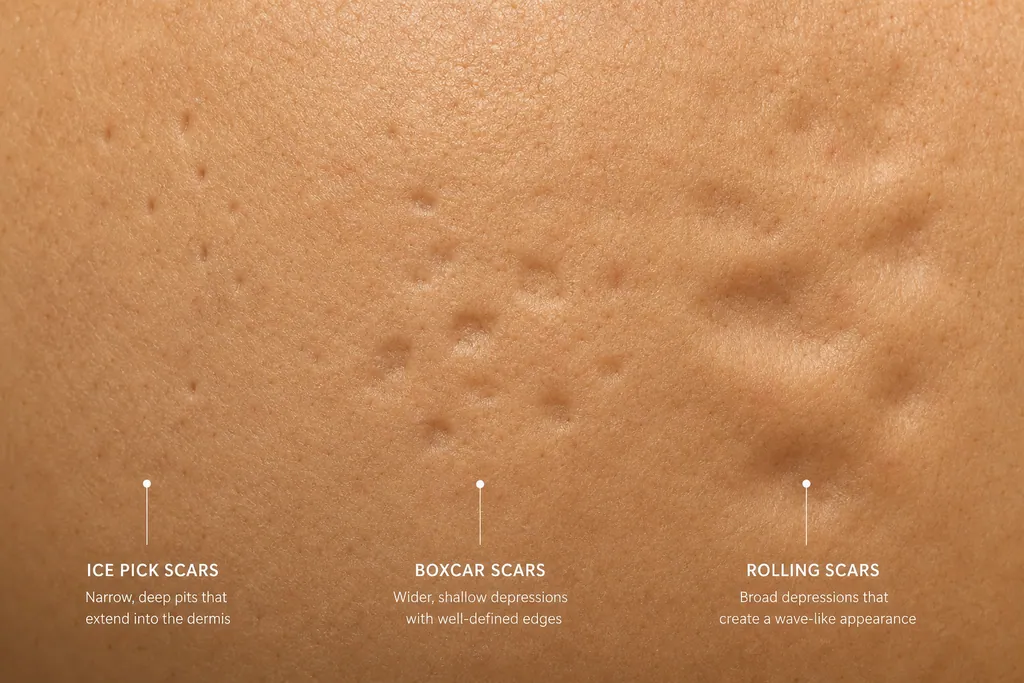
Rolling scars are shallow, wave-like depressions tethered to the tissue beneath by fibrous bands. The treatment that addresses the cause is subcision — a needle passed under the scar to release the band — usually followed by resurfacing to smooth the surface. Boxcar scars have sharp edges and a flat base; they respond to resurfacing that remodels collagen across the scar — fractional CO₂ laser or RF microneedling, the latter often preferred on darker skin because of lower pigment risk. Ice pick scars are narrow and deep; lasers barely reach them, so they are treated scar by scar with TCA CROSS, a high-strength acid applied into the pit to provoke collagen from the base.
Most faces carry a mix, which is why a real plan is a sequence rather than a single device: subcision first to release tethers, resurfacing sessions four to eight weeks apart, TCA CROSS worked in between, and pigment care alongside. Deep, broad depressions may also benefit from filler as a lift while collagen builds. Each step improves the scar population by a proportion; stacked over months, the proportions compound.
Treatment option
Acne scar treatment hub
Best for: Mixed scarring — the sequenced planHow a doctor maps scar types and sequences subcision, resurfacing and TCA CROSS.
Learn moreTreatment option
Subcision
Best for: Rolling, tethered scarsReleases the fibrous bands pulling the surface down.
Learn moreTreatment option
RF microneedling
Best for: Boxcar and rolling scars on Asian skinCollagen remodelling beneath the surface with less pigment risk.
Learn moreTreatment option
Acne scar treatment in Singapore
Best for: Being seen at Tanjong Pagar, East Coast or NovenaThe same scar-type-led approach at our Singapore clinics.
Learn moreWhat 'remove' realistically means
Acne scars are not removed in the way a mole is removed. Treatment remodels the dermis so that depressions become shallower, edges softer and the overall surface more even; across a full programme, improvement is measured as a proportion of the original scarring, and it continues to develop for three to six months after the last session as collagen matures. The amount of improvement varies by scar type, depth, skin and how completely the plan is followed, and results vary by individual.
Setting that expectation early protects your money. Products and clinics that promise complete removal are describing something acne scar treatment does not do; a plan that explains which scars will improve most, which least, and over what timeline is describing what it actually does.
When to stop experimenting and get assessed
If you have given a sensible topical routine three months and your 'marks' have not budged, you are probably looking at scars. If you can feel dents, see shadows under side-lighting, or have texture that makeup settles into, home care has reached its ceiling. An assessment under magnification settles the mark-versus-scar question in minutes, maps the scar types, confirms whether active acne is controlled, and produces a plan — often cheaper than another year of products.
DrPlus assesses acne scars at the Johor Bahru clinic in Iskandar Puteri and at three Singapore clinics — Tanjong Pagar, East Coast and Novena — with the same scar-type-led approach in both markets: diagnosis first, a written plan, and no obligation to proceed.
— Frequently asked
Common questions
No treatment removes acne scars completely. Procedures such as subcision, resurfacing and TCA CROSS remodel the dermis so scars become shallower and less visible — improvement is measured as a proportion over months, and results vary by individual. Flat marks, by contrast, can fade almost entirely with time and pigment care.
You can fade marks at home — daily sunscreen, retinoids and brightening ingredients such as vitamin C, niacinamide or azelaic acid, given three months. You cannot remove depressed scars at home: they are a collagen deficit in the dermis that surface products cannot rebuild, and home rollers or peels carry pigment and infection risk on Asian skin.
There is no fast route. Marks fade over weeks to months with sun protection and pigment care, and pico laser can speed brown marks. Scars need procedures spaced four to eight weeks apart, with collagen continuing to remodel for three to six months after the last one. Plans that promise speed are usually treating the wrong thing.
Rolling scars → subcision, often followed by resurfacing. Boxcar scars → fractional CO₂ laser or RF microneedling. Ice pick scars → TCA CROSS. Red and brown marks → pigment and vascular care, with pico laser for brown marks. Most faces are a mix, so most plans combine these in sequence.
Control the acne first. Treating scars while breakouts continue means new marks and scars form behind the ones you are treating, and inflamed skin tolerates procedures poorly. A doctor can manage both in one plan, sequencing acne control before scar work.
Not depressed scars. Aloe, honey, lemon and similar remedies do nothing to the collagen deficit under a scar, and acidic home remedies can irritate and darken Asian skin. For flat marks, sun protection and evidence-based brightening ingredients do more than any kitchen remedy.
— Related treatments
Continue with the relevant DrPlus treatment pages
Each page goes deeper into mechanism, suitability and recovery — your final plan is confirmed at consultation.
Primary money page
Acne Scar Treatment Hub
Where a doctor maps your scar types and sequences the plan.
scar-type-led acne scar treatment in Johor BahruSupporting
Acne Scar Treatment in Singapore
The same approach at Tanjong Pagar, East Coast and Novena.
acne scar treatment by scar type in SingaporeSupporting
Pigmentation & Marks Care
For the flat marks that are not scars at all.
treatment for red and brown post-acne marksSupporting
Subcision
Releases the bands beneath rolling scars — usually the first stage.
subcision for tethered rolling acne scars— Continue reading
 Acne Scars
Acne Marks vs Acne Scars: How to Tell the Difference
The most useful question before treating 'acne scars' is whether they are scars at all. Marks fade; scars are contour. Telling them apart changes everything.
 Acne Scars
Types of Acne Scars: Ice Pick, Boxcar, Rolling and Pitted Scars
Atrophic acne scars come in distinct shapes — and the shape often determines what treatment may actually help.
 Acne Scars
Deep Acne Scars: Why Skincare Can't Fix Them and What Can
Skincare is powerful for marks and skin quality — but deep scars sit in a layer creams cannot reach. Here is the honest explanation, and what actually lifts them.
Laser Treatment for Acne Scars: Which Laser for Which Scar? CO₂ vs Pico vs Erbium vs RF Microneedling
'Laser for acne scars' covers four very different technologies. This guide matches each to the scar types it actually treats — and names the scars no laser reaches.