
DrPlus Skin Education · Acne Scars
Laser Treatment for Acne Scars: Which Laser for Which Scar? CO₂ vs Pico vs Erbium vs RF Microneedling
'Laser for acne scars' covers four very different technologies. This guide matches each to the scar types it actually treats — and names the scars no laser reaches.
Four technologies hiding behind one phrase
When people search for laser treatment for acne scars, they are usually comparing a single price or a single clinic's device. But 'laser' here spans four technologies that reach different depths, deliver energy in different ways and suit different scars. Fractional CO₂ vaporises microscopic columns of tissue and heats the surrounding dermis, provoking strong collagen remodelling. Pico (picosecond) lasers deliver ultra-short pulses that shatter pigment and, in fractional handpieces, create tiny injury zones in the upper dermis. Erbium lasers ablate with much less residual heat than CO₂. RF microneedling, often sold alongside lasers, is not a laser at all: insulated needles deliver radiofrequency heat into the dermis while the surface is largely spared.
Each has a place. The mistake is choosing the device before the scar type, which is why this guide works the other way round.
— Comparison
The four technologies at a glance
| Technology | How it works | Suits | Downtime | Pigment risk on Asian skin |
|---|---|---|---|---|
| Fractional CO₂ | Ablates micro-columns + heats dermis | Boxcar scars, texture, scar edges | 5–7 days redness/crusting | Moderate — conservative settings needed |
| Pico laser | Photoacoustic pigment shattering; fractional mode for mild texture | Red/brown marks, mild texture | Hours to 1–2 days | Low |
| Erbium (incl. Fraxel-type) | Precise ablation, little heat | Shallow boxcar, texture, finer control | 3–5 days | Low to moderate |
| RF microneedling | Needle-delivered RF heat beneath surface | Rolling and boxcar scars, especially darker skin | 1–3 days | Low — surface spared |
Fractional CO₂
- How it works
- Ablates micro-columns + heats dermis
- Suits
- Boxcar scars, texture, scar edges
- Downtime
- 5–7 days redness/crusting
- Pigment risk on Asian skin
- Moderate — conservative settings needed
Pico laser
- How it works
- Photoacoustic pigment shattering; fractional mode for mild texture
- Suits
- Red/brown marks, mild texture
- Downtime
- Hours to 1–2 days
- Pigment risk on Asian skin
- Low
Erbium (incl. Fraxel-type)
- How it works
- Precise ablation, little heat
- Suits
- Shallow boxcar, texture, finer control
- Downtime
- 3–5 days
- Pigment risk on Asian skin
- Low to moderate
RF microneedling
- How it works
- Needle-delivered RF heat beneath surface
- Suits
- Rolling and boxcar scars, especially darker skin
- Downtime
- 1–3 days
- Pigment risk on Asian skin
- Low — surface spared
Match the device to the scar, not the other way round
Boxcar scars — sharp-edged, flat-bottomed — are the classic laser target: resurfacing softens the edges and lifts the base through collagen remodelling. Fractional CO₂ gives the most remodelling per session; erbium gives finer control with gentler recovery; RF microneedling achieves similar remodelling from beneath with the lowest pigment risk, which is why it is often first choice on medium to dark Asian skin. Rolling scars are a different problem: they are tethered down by fibrous bands, and no amount of surface energy releases a band. Subcision does; resurfacing or RF microneedling afterwards smooths the released surface. Ice pick scars are too narrow and deep for any fractional column to reach the base — TCA CROSS, applied scar by scar, is the treatment, with lasers used on the surrounding skin.
Post-acne marks — red PIE and brown PIH — are not scars and need a pigment or vascular approach. Pico laser is the device here, and it is also a reasonable choice for mild textural irregularity after the structural work is done. Treating a face of marks with CO₂, or a face of ice pick scars with pico, is the most common way laser treatment 'fails'.
— Pathway
Scar type → device
- 1
Boxcar
Fractional CO₂ or erbium for resurfacing; RF microneedling when pigment risk is the priority.
- 2
Rolling
Subcision first (not a laser), then RF microneedling or fractional laser to smooth the released surface.
- 3
Ice pick
TCA CROSS scar by scar (not a laser); lasers for the surrounding texture only.
- 4
Red / brown marks
Pico laser for brown marks and mild texture; vascular-focused approaches for red marks.
- 1
Boxcar
Fractional CO₂ or erbium for resurfacing; RF microneedling when pigment risk is the priority.
- 2
Rolling
Subcision first (not a laser), then RF microneedling or fractional laser to smooth the released surface.
- 3
Ice pick
TCA CROSS scar by scar (not a laser); lasers for the surrounding texture only.
- 4
Red / brown marks
Pico laser for brown marks and mild texture; vascular-focused approaches for red marks.
Lasers on Asian skin: the pigment question
Medium to dark skin tones produce pigment readily in response to heat and injury, so the main risk of laser treatment for acne scars in Malaysia and Singapore is post-inflammatory hyperpigmentation — a brown patch that outlasts the scar improvement if the energy was too aggressive. This does not rule out CO₂; it changes how it is used: lower densities, conservative energy, more sessions, strict sun protection and sometimes pigment-suppressing preparation beforehand. It is also the reason RF microneedling has become so widely used for acne scars in this region — the surface is spared, so the pigment trigger is much smaller.
A doctor who treats Asian skin regularly will discuss this trade-off openly: the most powerful device per session is not always the right one for your skin, and a gentler device over more sessions can deliver more total improvement with less risk.
When no laser is the answer
Three situations call for something other than a laser. Tethered rolling scars need subcision — a laser plan that skips it will resurface a surface that is still being pulled down. Ice pick scars need TCA CROSS — fractional columns cannot reach a narrow, deep pit's base. And active acne needs control before any resurfacing — treating scars through ongoing breakouts creates new scars and risks spreading inflammation. In each case a laser may still appear in the plan, but as a later stage rather than the answer.
Most real plans are therefore combinations: subcision, then RF microneedling or CO₂ sessions four to eight weeks apart, TCA CROSS worked in for the pits, and pico for residual marks at the end. The right question is not 'which laser is good for acne scars' but 'which procedures, in what order, does my scar mix need'.
Treatment option
CO₂ laser in Johor Bahru
Best for: Boxcar scars and textureFractional ablative resurfacing with settings planned for Asian skin.
Learn moreTreatment option
CO₂ laser in Singapore
Best for: The same resurfacing at our Singapore clinicsTanjong Pagar, East Coast and Novena — conservative protocols for darker skin.
Learn moreTreatment option
Pico laser in Johor Bahru
Best for: Red and brown post-acne marksThe pigment laser — marks and mild texture, not depressed scars.
Learn moreTreatment option
RF microneedling
Best for: Rolling and boxcar scars on darker skinDermal heating from beneath with the surface spared.
Learn moreHow a doctor actually chooses
At DrPlus — in Johor Bahru and at our Singapore clinics — the choice of device follows a scar map made under magnification: the proportion of rolling, boxcar and ice pick scars, their depth, your skin tone and whether acne is controlled. From that map comes a sequence rather than a device: which procedure first, which laser or RF platform for resurfacing, how many sessions, how far apart, and what pigment precautions apply. You receive the plan in writing with no obligation to proceed. Results vary by individual and are tracked with standardised photographs at each review.
— Frequently asked
Common questions
It depends on the scar type. Fractional CO₂ or erbium for boxcar scars and texture; RF microneedling (not technically a laser) for rolling and boxcar scars on darker skin; pico laser for red and brown marks and mild texture. Tethered rolling scars need subcision and ice pick scars need TCA CROSS — no laser alone treats either.
They do different jobs. CO₂ remodels collagen for depressed boxcar scars and texture, with more downtime and more pigment care needed. Pico targets pigment — red and brown marks — and mild texture, with little downtime, but does little for depressed scars. Many plans use both at different stages.
PicoSure is one brand of picosecond laser. Like other pico devices, it helps post-acne pigment and mild texture and is gentle on Asian skin, but it is not a substitute for subcision, fractional resurfacing or TCA CROSS when scars are depressed. The brand matters less than matching the device class to your scar type.
Typically three to four resurfacing sessions (CO₂, erbium or RF microneedling) spaced four to eight weeks apart, with collagen continuing to remodel for three to six months after the last. Pico for marks is usually a short series. Session counts vary by scar depth, skin tone and the device's settings; results vary by individual.
Yes, with conservative settings and pigment precautions — lower densities, more sessions, strict sun protection and sometimes pigment-suppressing preparation. RF microneedling is often chosen on darker skin because the surface is spared. The main risk is post-inflammatory hyperpigmentation, which an experienced doctor plans around.
Usually because the device did not match the scar type — resurfacing rolling scars that were still tethered, or treating ice pick scars with fractional columns that cannot reach their base — or because active acne kept forming new scars. A scar map and a sequenced plan address both.
— Related treatments
Continue with the relevant DrPlus treatment pages
Each page goes deeper into mechanism, suitability and recovery — your final plan is confirmed at consultation.
Primary money page
CO₂ Laser in Johor Bahru
The resurfacing workhorse, with settings planned for Asian skin.
fractional CO₂ laser for boxcar acne scars in Johor BahruSupporting
CO₂ Laser in Singapore
The same resurfacing at Tanjong Pagar, East Coast and Novena.
fractional CO₂ laser for acne scars in SingaporeSupporting
Pico Laser in Johor Bahru
The pigment laser — marks, not depressed scars.
pico laser for post-acne marks and mild textureSupporting
RF Microneedling
Dermal remodelling with the surface spared.
RF microneedling for acne scars on Asian skin— Continue reading
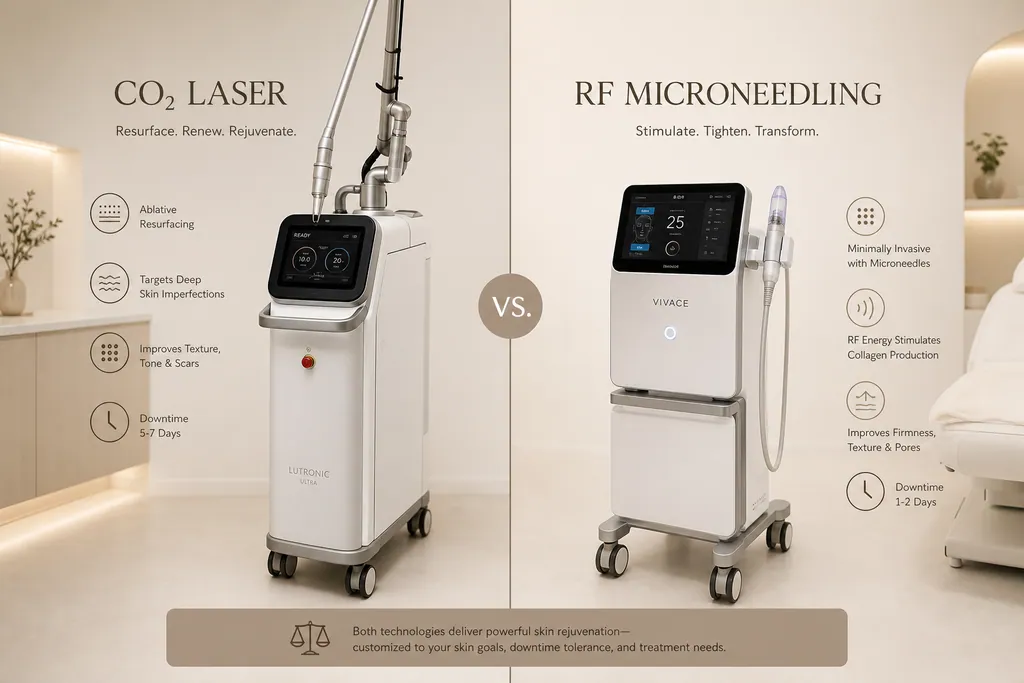 Acne Scars
CO₂ Laser vs RF Microneedling for Acne Scars
Two of the most common acne scar treatments — and they work in genuinely different ways. Here is how to think about them.
CO₂ Laser vs Pico Laser: Different Tools for Different Jobs
One vaporises skin to rebuild texture; the other shatters pigment without breaking the surface. Comparing CO₂ and pico is less 'which is better' and more 'which problem do you actually have'.
CO₂ vs Fraxel vs Erbium: Untangling the Laser Names
People search for 'CO₂ Fraxel laser' every day — but Fraxel is a brand, and CO₂ is a laser type, and the phrase mixes them. Here is the map that makes every laser menu readable.
Why Lasers Alone May Not Fix Every Acne Scar
Lasers are superb at what they do — resurfacing the surface. But many acne scars are not surface problems. Understanding that mismatch explains why laser alone sometimes plateaus, and why combinations work better.