
DrPlus Skin Education · Acne Scars
Red vs Dark Acne Marks: PIE and PIH Explained — Why the Colour Decides the Treatment
Red marks and dark marks after acne look like the same problem and are treated completely differently. The colour tells you the cause — and the cause tells you what will work.
Two colours, two completely different causes
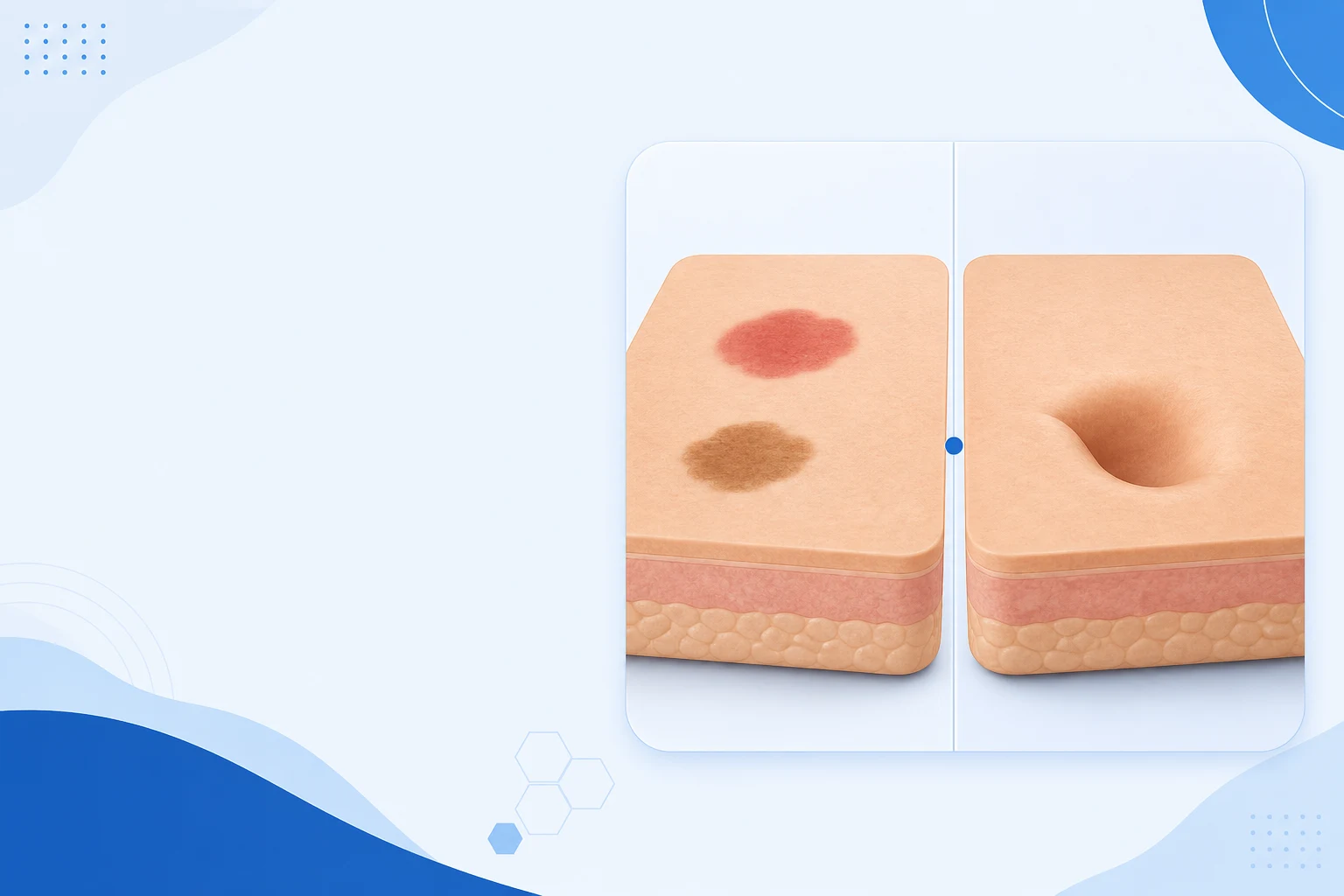
After a pimple heals, the skin often keeps a flat mark where it was. In lighter skin the mark tends to be red or pink; in medium to dark Asian skin it is more often brown, grey-brown or nearly black; many people have both. These are commonly called 'red acne scars' and 'dark acne scars', but neither is a scar — a scar is a change in contour — and, more importantly, they are not the same problem wearing two colours.
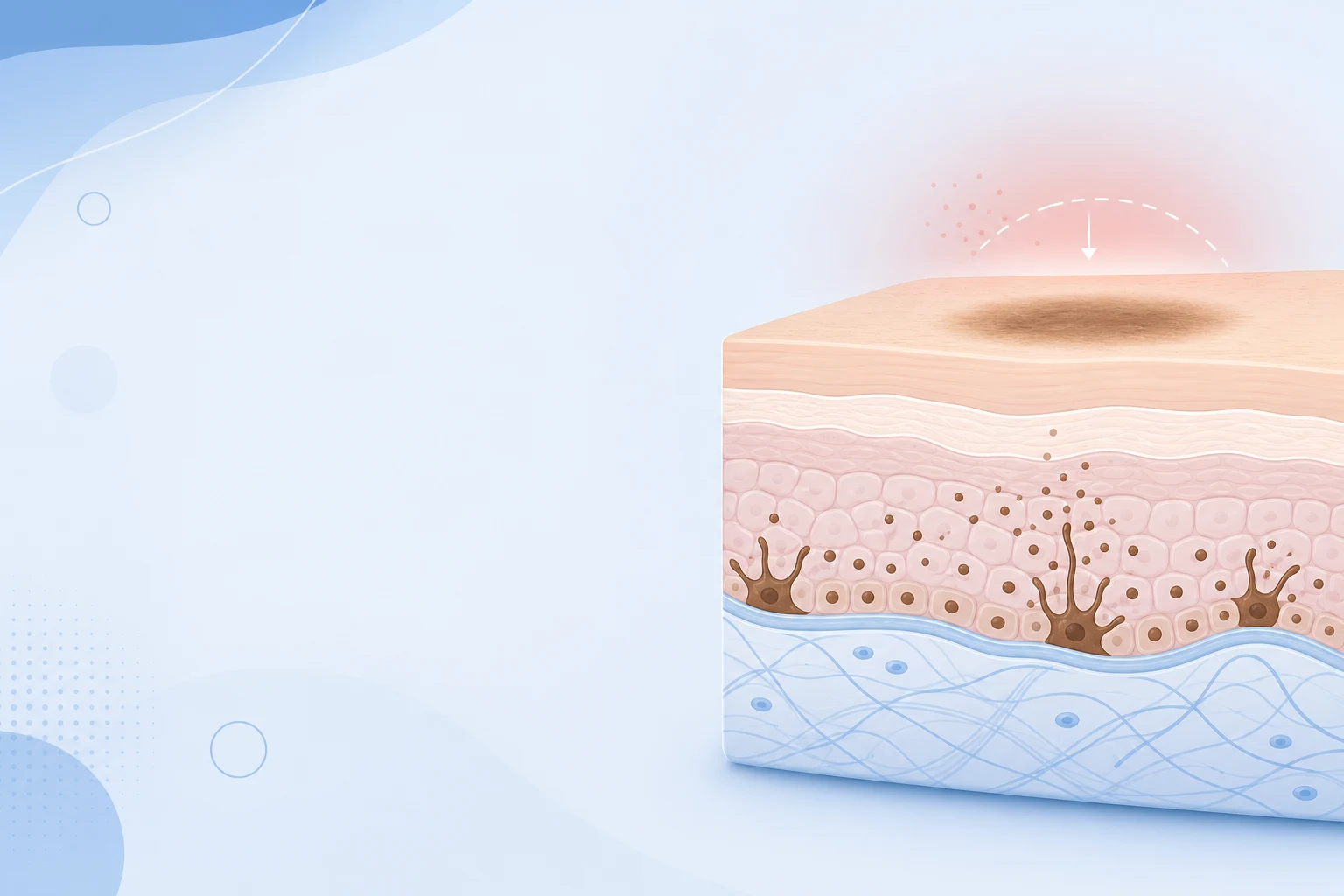
A red mark is post-inflammatory erythema (PIE): the inflammation of the pimple dilated and damaged the tiny blood vessels in the upper dermis, and they have not yet recovered. The colour you see is blood. A dark mark is post-inflammatory hyperpigmentation (PIH): the same inflammation stimulated melanocytes to overproduce melanin, which has been deposited in the epidermis and sometimes dropped into the dermis. The colour you see is pigment. Everything about treating them follows from that difference.
— Comparison
PIE vs PIH at a glance
| Feature | Red marks (PIE) | Dark / black marks (PIH) |
|---|---|---|
| What it is | Dilated or damaged capillaries | Excess melanin from inflammation |
| Colour | Pink, red, purplish | Light brown to grey-brown to black |
| Who gets it most | Lighter skin tones | Medium to dark Asian and darker skin |
| Pressure test | Blanches (fades) under a glass slide | Does not blanch |
| Made worse by | Heat, picking, harsh actives, alcohol flushing | UV exposure, picking, irritation, some fragrances |
| Natural course | Fades over 3–12 months | Fades over 3–24 months; longer with sun and deeper pigment |
What it is
- Red marks (PIE)
- Dilated or damaged capillaries
- Dark / black marks (PIH)
- Excess melanin from inflammation
Colour
- Red marks (PIE)
- Pink, red, purplish
- Dark / black marks (PIH)
- Light brown to grey-brown to black
Who gets it most
- Red marks (PIE)
- Lighter skin tones
- Dark / black marks (PIH)
- Medium to dark Asian and darker skin
Pressure test
- Red marks (PIE)
- Blanches (fades) under a glass slide
- Dark / black marks (PIH)
- Does not blanch
Made worse by
- Red marks (PIE)
- Heat, picking, harsh actives, alcohol flushing
- Dark / black marks (PIH)
- UV exposure, picking, irritation, some fragrances
Natural course
- Red marks (PIE)
- Fades over 3–12 months
- Dark / black marks (PIH)
- Fades over 3–24 months; longer with sun and deeper pigment
How to tell them apart at home
Press a clear glass slide — or simply a fingertip — firmly onto the mark for a second and look as you release. A red PIE mark blanches: the pressure empties the dilated vessels and the colour fades, then returns. A dark PIH mark does not change, because melanin does not move under pressure. Where a mark is purplish or brownish-red, it is often both, and you will see partial blanching.
Then check for contour. Stretch the skin gently in good side-lighting. If the colour disappears and the surface is smooth, it is a mark alone. If a dip or shadow remains after the colour fades, there is a scar beneath the mark, and the scar will need its own structural treatment regardless of what you do about the colour.
Treating red marks (PIE)
Because PIE is a blood-vessel problem, pigment-brightening products do little for it — a common frustration for people who buy 'dark spot' serums for red marks. What helps: time, since damaged capillaries recover over months; avoiding triggers that dilate vessels further (heat, hot showers, aggressive scrubbing, picking, alcohol); anti-inflammatory and barrier-repairing skincare (niacinamide, azelaic acid, centella); and, for persistent redness, vascular-targeted treatment at a clinic. Pulsed-dye and certain other vascular lasers target haemoglobin in the vessels; some pico and fractional devices also improve PIE indirectly by remodelling the upper dermis. Sunscreen still matters, because UV prolongs inflammation.
Retinoids help by thickening the dermis over time so vessels show less, but they can increase redness initially — introduce them slowly. Vitamin C is a reasonable supporting ingredient for both PIE and PIH. Give any topical routine three months.
Treating dark and black marks (PIH)
PIH is a pigment problem, and the first treatment is prevention of more: daily broad-spectrum sunscreen (SPF 30 or above, reapplied), because UV directly stimulates the melanocytes that are already over-producing. Without it, every other step is undermined. Then brightening and turnover: retinoids to speed shedding of pigmented cells; azelaic acid, niacinamide, vitamin C, tranexamic acid and alpha-hydroxy acids to suppress pigment transfer and lift what is there. Over three to six months these fade epidermal PIH substantially in most people.
Where pigment has dropped into the dermis — typically the greyer, more stubborn marks on darker skin — topicals plateau, and this is where pico laser earns its place: picosecond pulses shatter melanin into fragments the body clears, with lower heat and lower risk of worsening the pigment than older lasers. Gentle chemical peels can help epidermal PIH. The one thing to avoid is aggressive treatment: strong peels, high-energy lasers or harsh home remedies on darker skin can produce new PIH on top of the old. Results vary by individual, and the goal is fading over months, not disappearance in weeks.
— Pathway
A sensible PIH sequence
- 1
Stop the trigger
Control active acne and stop picking — every new inflamed lesion is a new mark.
- 2
Protect
Daily broad-spectrum sunscreen, reapplied. Non-negotiable for brown marks.
- 3
Brighten and turn over
Retinoid at night; azelaic acid, niacinamide, vitamin C or tranexamic acid by day. Three months before judging.
- 4
Escalate if it plateaus
Pico laser for dermal pigment; gentle peels for epidermal — chosen by a doctor for your skin tone.
- 1
Stop the trigger
Control active acne and stop picking — every new inflamed lesion is a new mark.
- 2
Protect
Daily broad-spectrum sunscreen, reapplied. Non-negotiable for brown marks.
- 3
Brighten and turn over
Retinoid at night; azelaic acid, niacinamide, vitamin C or tranexamic acid by day. Three months before judging.
- 4
Escalate if it plateaus
Pico laser for dermal pigment; gentle peels for epidermal — chosen by a doctor for your skin tone.
When you have both — or a scar underneath
Most faces with post-acne marks carry a mixture: fresher red marks from recent lesions and older brown marks from earlier ones, sometimes with dents beneath. The sequence that works is to stop new lesions, protect from UV, run a brightening routine that also calms inflammation, and let time do what it will for the red marks. Then reassess at three months: persistent red marks may warrant vascular treatment; stubborn brown marks may warrant pico; any dents need structural treatment — subcision, resurfacing or TCA CROSS — planned separately from the colour.
DrPlus assesses post-acne marks and scars at the Johor Bahru clinic in Iskandar Puteri and at three Singapore clinics — Tanjong Pagar, East Coast and Novena. A doctor distinguishes PIE from PIH from scar under magnification, and the plan treats each on its own terms, with no obligation to proceed.
Treatment option
Pigmentation & marks care
Best for: Brown and red post-acne marksDoctor-led care for PIH and PIE in Johor Bahru.
Learn moreTreatment option
PIH treatment in Singapore
Best for: Dark marks at our Singapore clinicsPigment-focused treatment for post-inflammatory hyperpigmentation.
Learn moreTreatment option
Pico laser in Johor Bahru
Best for: Stubborn dermal pigmentPicosecond pulses shatter melanin with low heat — suited to Asian skin.
Learn moreTreatment option
Acne scar treatment hub
Best for: When there is a dent beneath the markStructural treatment for the scar, planned separately from the colour.
Learn more— Frequently asked
Common questions
Red marks are post-inflammatory erythema — damaged capillaries, not scars or pigment. They fade over months. Help them by avoiding heat, picking and harsh scrubbing, using anti-inflammatory skincare (niacinamide, azelaic acid, centella) and daily sunscreen, and, if they persist beyond six to twelve months, asking about vascular-targeted treatment at a clinic. Brightening serums for 'dark spots' do little for red marks.
Dark marks are post-inflammatory hyperpigmentation — excess melanin. Daily sunscreen is the first step, because UV deepens them. Add a retinoid at night and brightening ingredients (azelaic acid, niacinamide, vitamin C, tranexamic acid) by day for three months. If they plateau, pico laser or gentle peels chosen for your skin tone can clear the deeper pigment.
Red marks typically fade over three to twelve months. Dark marks take three to twenty-four months, longer on darker skin, with sun exposure, or when pigment has dropped into the dermis. Treatment shortens both timelines but does not make them vanish in weeks; results vary by individual.
No. Both are flat colour changes that fade. A scar is a change in contour — a dent or raised area — that does not fade. Stretch the skin in good light: if a shadow or dip remains after the colour fades, there is a scar beneath the mark that needs structural treatment separately.
Pico laser is primarily a pigment laser and is most effective for brown marks. Some pico and fractional devices improve red marks indirectly by remodelling the upper dermis, but persistent redness is better addressed by vascular-targeted treatment. A doctor will choose based on which colour dominates.
Medium to dark skin produces melanin readily in response to inflammation, so the same pimple that leaves a red mark on lighter skin leaves a brown one on Asian skin. UV exposure, picking and irritation all amplify the response — which is why sun protection and gentle, non-irritating skincare are the foundation of treatment.
— Related treatments
Continue with the relevant DrPlus treatment pages
Each page goes deeper into mechanism, suitability and recovery — your final plan is confirmed at consultation.
Primary money page
Pigmentation & Marks Care
Doctor-led care for brown PIH and red PIE marks.
post-acne pigmentation treatment in Johor BahruSupporting
PIH Treatment in Singapore
Pigment-focused care at Tanjong Pagar, East Coast and Novena.
post-inflammatory hyperpigmentation treatment in SingaporeSupporting
Pico Laser in Johor Bahru
Picosecond pulses for dermal PIH on Asian skin.
pico laser for stubborn post-acne pigmentSupporting
Acne Scar Treatment Hub
For the structural scar, once the colour is understood.
acne scar treatment for dents beneath the marks— Continue reading
 Acne Scars
Acne Marks vs Acne Scars: How to Tell the Difference
The most useful question before treating 'acne scars' is whether they are scars at all. Marks fade; scars are contour. Telling them apart changes everything.
 Pigmentation
Post-Inflammatory Hyperpigmentation (PIH): Treatment Guide
Those brown marks left after a spot heals are PIH — a pigment problem, not a scar. The good news: it fades, and the right care speeds it up.
Post-Inflammatory Hyperpigmentation After Acne Scar Treatment
The most common disappointment after scar treatment in darker skin is not a scar that didn't improve — it's a new dark mark. Here's why PIH happens, who is at risk, and how it is prevented and managed.
How to Remove Acne Scars: A Decision Tree — Marks vs Scars, Home vs Clinic, and by Scar Type
Most advice on removing acne scars fails because it skips the first question — are they scars at all? This decision tree walks from marks vs scars, through home care's limits, to treatment by scar type.