
DrPlus Skin Education · Acne Scars
Do Dermatix and Hiruscar Work on Acne Scars? What Silicone Gels Can and Cannot Do
Dermatix and Hiruscar are the two scar gels on every Malaysian pharmacy shelf. Whether they help your acne scars depends entirely on what kind of scar you have — and most people buy them for the kind they cannot treat.
What Dermatix and Hiruscar actually are
Dermatix is a topical silicone gel (cyclopentasiloxane and related polymers) that dries to a thin, breathable film. Silicone sheets and gels have been used on surgical and burn scars for decades; the proposed mechanism is that the film hydrates the top layer of the scar, normalises the signalling of the cells that produce collagen, and so softens and flattens scar tissue that is raised or still maturing. Hiruscar's main ingredient is mucopolysaccharide polysulfate (MPS), an anti-inflammatory and moisturising compound, combined with allium cepa (onion) extract, allantoin and vitamins B3 and E; its post-acne variant adds brightening ingredients. Both are sold for 'scars', which is where the confusion starts.
Neither product is a medicine in the sense of a prescription treatment, and neither is designed for the kind of scar most acne leaves behind. Understanding that is more useful than any review.
— Comparison
Dermatix vs Hiruscar at a glance
| Dermatix | Hiruscar | |
|---|---|---|
| Key ingredient | Silicone polymers (film-forming) | MPS + allium cepa + allantoin + vitamins |
| Proposed mechanism | Hydrates and normalises collagen signalling in raised scars | Anti-inflammatory, moisturising; brightening in post-acne variant |
| Evidence base | Reasonable for hypertrophic/keloid scars with months of use | Weaker; small studies, mostly on raised or fresh scars |
| Depressed acne scars | No mechanism to fill | No mechanism to fill |
| Flat marks (PIH) | No role | Post-acne variant may modestly help pigment; sunscreen matters more |
Key ingredient
- Dermatix
- Silicone polymers (film-forming)
- Hiruscar
- MPS + allium cepa + allantoin + vitamins
Proposed mechanism
- Dermatix
- Hydrates and normalises collagen signalling in raised scars
- Hiruscar
- Anti-inflammatory, moisturising; brightening in post-acne variant
Evidence base
- Dermatix
- Reasonable for hypertrophic/keloid scars with months of use
- Hiruscar
- Weaker; small studies, mostly on raised or fresh scars
Depressed acne scars
- Dermatix
- No mechanism to fill
- Hiruscar
- No mechanism to fill
Flat marks (PIH)
- Dermatix
- No role
- Hiruscar
- Post-acne variant may modestly help pigment; sunscreen matters more
Three kinds of 'acne scar' — and the gels help one
Acne leaves three distinct kinds of aftermath. Flat marks — red (post-inflammatory erythema) or brown (post-inflammatory hyperpigmentation) — are colour changes with no change in texture. Depressed scars — rolling, boxcar and ice pick — are dents where collagen was lost. Raised scars — hypertrophic scars and keloids — are lumps where collagen overgrew, most common along the jawline, chest, shoulders and back. Silicone gel's entire mechanism is about calming overactive collagen production, which means its target is the third group.
Most Malaysians buying Dermatix or Hiruscar for 'acne scars' have the first or second kind. For flat marks, the gel is not harmful but does little the skin would not do on its own; for depressed scars, it cannot work, because there is nothing to flatten — the scar needs filling or rebuilding from below, which only procedures do. This is the honest reason the reviews are so mixed: the product is fine; the diagnosis is usually wrong.
When Dermatix or Hiruscar genuinely helps acne
Two situations. First, raised acne scars: the firm, pink or skin-coloured bumps that remain along the jaw, on the chest or across the shoulders and back after deep acne. Applied twice daily for two to three months, silicone gel can soften, flatten and fade these, particularly when they are young. If a raised scar keeps growing beyond the original spot, itches or hurts, it is behaving like a keloid and needs a doctor's injections rather than a gel — but silicone can be useful between sessions. Second, prevention: on a freshly healed deep lesion in someone who tends to scar thickly, starting silicone once the skin has closed may reduce the chance of a raised scar forming.
For the post-acne brightening variants, the ingredient list — niacinamide and similar — can modestly help brown marks, but the single most effective step for PIH is daily sunscreen, and a dedicated brightening routine does more than a scar gel repurposed for pigment.
— Pathway
A sensible way to use scar gels for acne
- 1
Identify the scar
Raised bump → gel may help. Flat mark → sunscreen and brightening instead. Dent → gel cannot help; see the clinic pathway.
- 2
Wait for closed skin
Apply only to healed, intact skin — never on open or inflamed lesions.
- 3
Commit to months
Twice daily for 8–12 weeks before judging. Scars remodel slowly.
- 4
Escalate if it grows
A raised scar that spreads, itches or hurts is a keloid — injection-led treatment, not more gel.
- 1
Identify the scar
Raised bump → gel may help. Flat mark → sunscreen and brightening instead. Dent → gel cannot help; see the clinic pathway.
- 2
Wait for closed skin
Apply only to healed, intact skin — never on open or inflamed lesions.
- 3
Commit to months
Twice daily for 8–12 weeks before judging. Scars remodel slowly.
- 4
Escalate if it grows
A raised scar that spreads, itches or hurts is a keloid — injection-led treatment, not more gel.
What works for the scars the gels cannot treat
Flat marks fade with time, sunscreen and brightening ingredients (retinoids, vitamin C, niacinamide, azelaic acid), and brown marks that plateau respond to pico laser. Depressed scars need procedures that rebuild or release collagen: subcision for tethered rolling scars, fractional CO₂ laser or RF microneedling for boxcar scars, TCA CROSS for ice pick scars, and usually a sequenced combination for mixed faces. Raised scars that have become keloids need intralesional injections, sometimes with laser — the approach used on our keloid pages.
The money spent on a year of scar gels for a depressed scar would, in most cases, have covered a doctor's assessment and the first stage of a plan that actually changes the scar. That is not an argument against the gels — it is an argument for diagnosing first.
Treatment option
Acne scar treatment hub
Best for: Depressed scars — the gels' blind spotHow a doctor sequences subcision, resurfacing and TCA CROSS by scar type.
Learn moreTreatment option
Keloid and raised scar removal
Best for: Raised acne scars that keep growingInjection-led flattening when a gel is no longer enough.
Learn moreTreatment option
Pigmentation & marks care
Best for: Brown and red marks mistaken for scarsSunscreen, brightening and pico laser for post-acne pigment.
Learn moreTreatment option
Acne scar treatment in Singapore
Best for: Being seen at our Singapore clinicsThe same scar-type-led approach at Tanjong Pagar, East Coast and Novena.
Learn moreWhen to stop buying gels and get assessed
If you have used a scar gel consistently for three months and the scar is unchanged, it is almost certainly not the kind the gel treats. If you can feel a dent, see a shadow under side-lighting, or the scar is raised and growing, itching or painful, an assessment is the next step. A doctor distinguishes marks, depressed scars and raised scars in minutes under magnification and tells you which — if any — a gel is worth continuing for.
DrPlus assesses acne scars at the Johor Bahru clinic in Iskandar Puteri and at three Singapore clinics — Tanjong Pagar, East Coast and Novena — with a written plan and no obligation to proceed. Results vary by individual.
— Frequently asked
Common questions
Only on raised acne scars. Dermatix is a silicone gel that softens and flattens hypertrophic scars and small keloids over two to three months of twice-daily use. It has no mechanism to fill depressed (rolling, boxcar, ice pick) scars and no role in fading flat marks, which is what most people buy it for.
Hiruscar is an MPS-based gel with anti-inflammatory and moisturising ingredients; its post-acne variant adds brightening agents. Evidence is weaker than for silicone. It may modestly help fresh or raised scars and brown marks, but it cannot lift depressed scars, and daily sunscreen does more for pigment.
For raised scars, silicone gel (Dermatix) has the stronger evidence base. For brown marks, neither is the right tool — a brightening routine with sunscreen works better. For depressed scars, neither works at all; the comparison is beside the point until you know your scar type.
Eight to twelve weeks of consistent twice-daily use on closed skin. If a raised scar has not softened or flattened by then, or if the 'scar' is actually a dent or a flat mark, further use is unlikely to help and an assessment is the next step.
No. Silicone and scar gels are for healed, intact skin. Applying them to active or open lesions can trap bacteria and oil. Treat the acne first; start the gel once the skin has closed if you tend to form raised scars.
Because reviewers have different scar types. Someone with raised scars may see real flattening; someone with dents or flat marks sees nothing, because the product has no mechanism for either. The gel is consistent — the diagnoses behind the reviews are not.
— Related treatments
Continue with the relevant DrPlus treatment pages
Each page goes deeper into mechanism, suitability and recovery — your final plan is confirmed at consultation.
Primary money page
Acne Scar Treatment Hub
For the dents no gel can lift — subcision, resurfacing and TCA CROSS, planned by scar type.
acne scar treatment for depressed scars in Johor BahruSupporting
Keloid & Raised Scar Removal
When a raised scar outgrows what silicone can do.
injection-led treatment for raised acne scars and keloidsSupporting
Acne Scar Treatment in Singapore
The same approach at Tanjong Pagar, East Coast and Novena.
acne scar treatment by scar type in SingaporeSupporting
Pigmentation & Marks Care
For the flat marks that are not scars at all.
treatment for brown post-acne marks— Continue reading
Hypertrophic and Keloid Acne Scars: Why Some Acne Scars Are Raised, and How They Are Treated
Most acne scars are dents. A minority are lumps — hypertrophic scars and keloids — and they need the opposite treatment. Here is how to recognise them and what flattens them.
Serums and Creams for Acne Scars: Which Ingredients Do Anything — and Where Their Ceiling Is
Retinol, vitamin C, niacinamide, AHAs — the ingredients are real, and so are their limits. This guide sorts what topicals do for post-acne marks from what they cannot do for true scars.
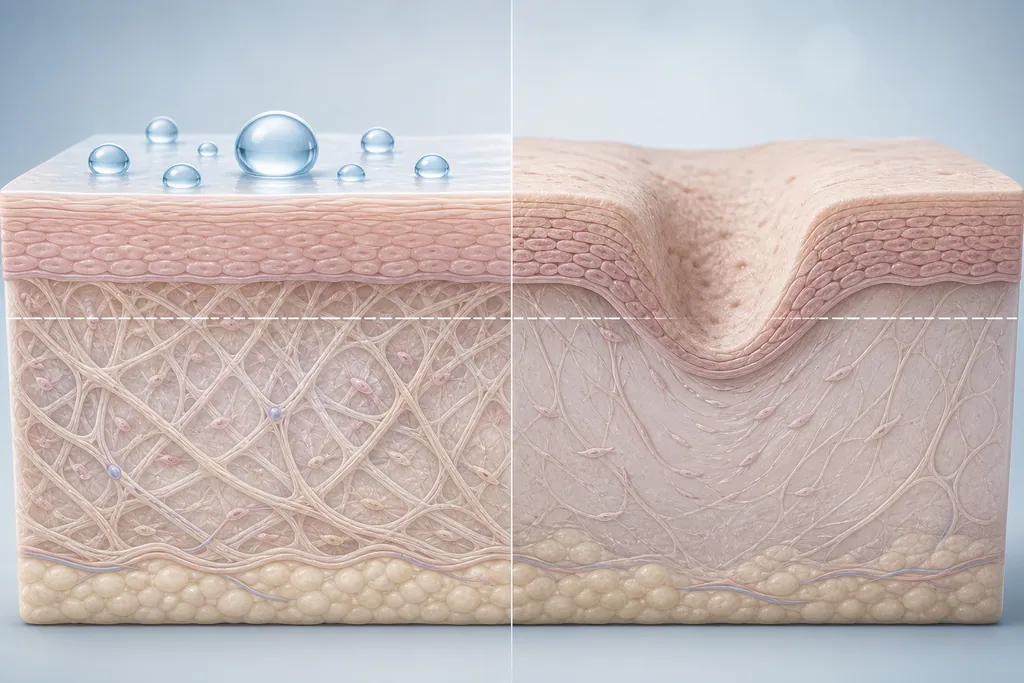 Acne Scars
Deep Acne Scars: Why Skincare Can't Fix Them and What Can
Skincare is powerful for marks and skin quality — but deep scars sit in a layer creams cannot reach. Here is the honest explanation, and what actually lifts them.
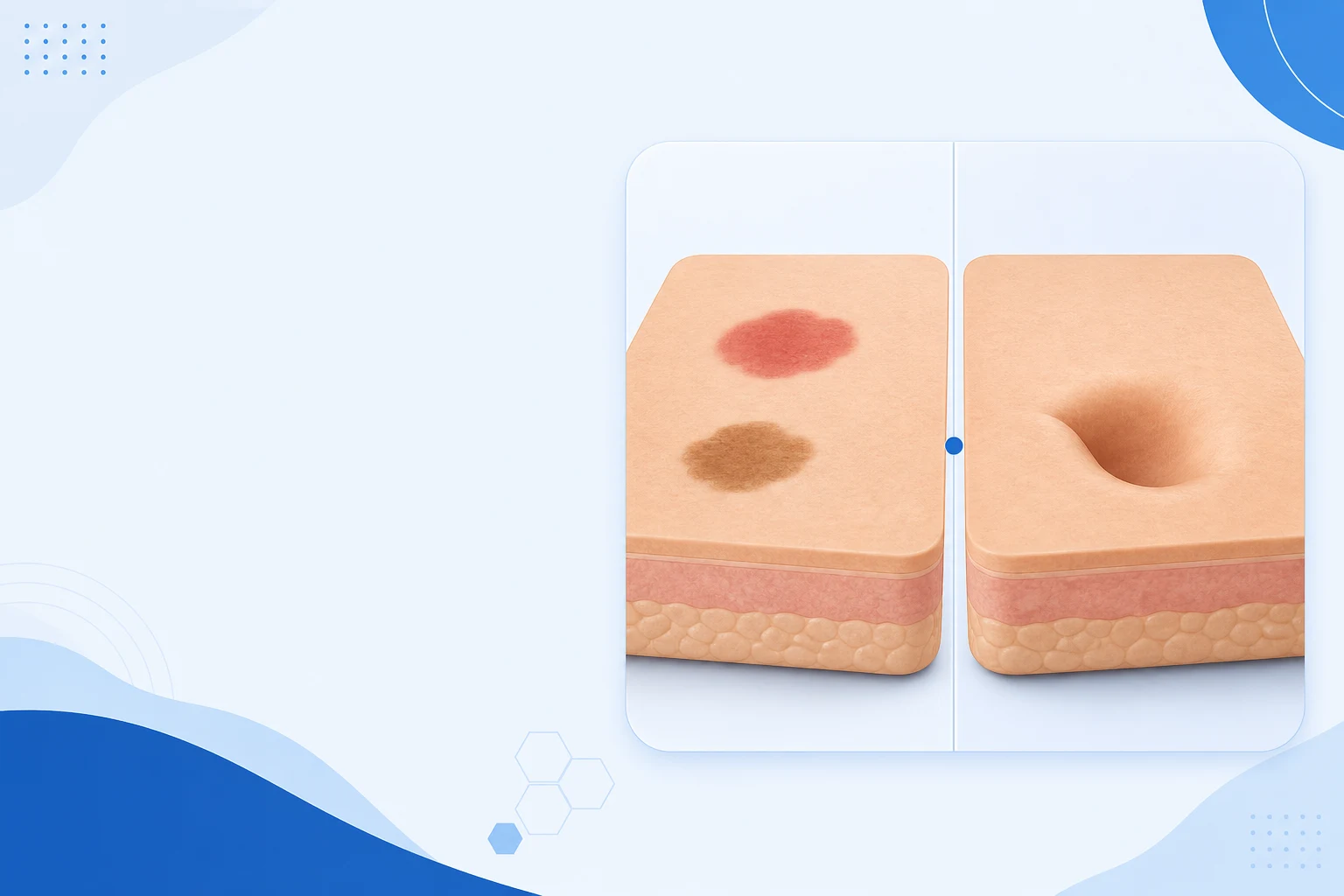 Acne Scars
Acne Marks vs Acne Scars: How to Tell the Difference
The most useful question before treating 'acne scars' is whether they are scars at all. Marks fade; scars are contour. Telling them apart changes everything.