
DrPlus Skin Education · Acne Scars
Serums and Creams for Acne Scars: Which Ingredients Do Anything — and Where Their Ceiling Is
Retinol, vitamin C, niacinamide, AHAs — the ingredients are real, and so are their limits. This guide sorts what topicals do for post-acne marks from what they cannot do for true scars.
Where topicals act — and where acne scars live
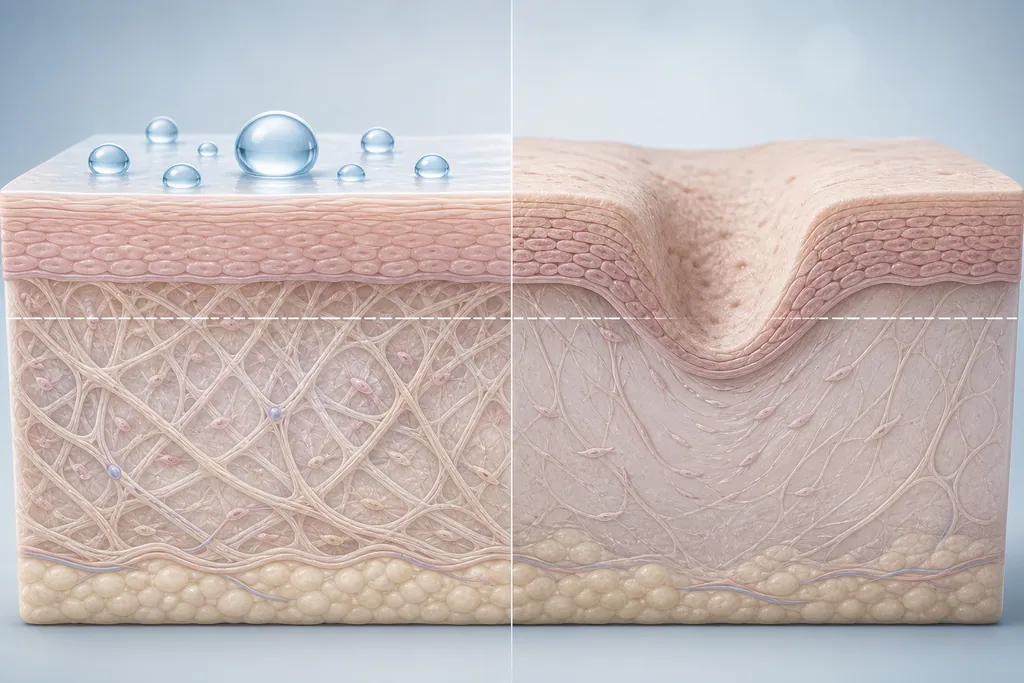
Every serum and cream works in the epidermis and, to a limited extent, the upper dermis: that is as far as a molecule applied to the surface penetrates in meaningful amounts. Post-acne marks are an epidermal and upper-dermal problem — melanin deposited after inflammation, or dilated capillaries just below the surface — which is why topicals can genuinely help them. Depressed acne scars are different: they are a deficit of collagen in the mid to deep dermis, with the surface pulled down into the gap. No topical has a mechanism to rebuild that collagen at depth, which is why a product that helps marks does nothing visible for dents.
This single fact explains most of the disappointment with acne scar skincare. The ingredients below work; they work on marks and on surface texture. Knowing their ceiling lets you use them for what they do and stop waiting for what they cannot.
The ingredients that do something, and what each does
Retinoids (retinol over the counter; tretinoin and adapalene on prescription) speed cell turnover, disperse pigment and, over many months, thicken the dermis slightly — the one topical class with a modest effect on very shallow texture. Vitamin C (L-ascorbic acid and its derivatives) inhibits melanin production and protects against UV damage, helping both brown and, to a degree, red marks. Niacinamide reduces pigment transfer to skin cells, calms inflammation and strengthens the barrier — a versatile, well-tolerated choice. Azelaic acid addresses pigment, inflammation and active acne at once, making it useful when breakouts and marks overlap. Alpha-hydroxy acids (glycolic, lactic, mandelic) exfoliate pigmented surface cells and smooth texture. Tranexamic acid targets stubborn pigment, especially where it has been slow to fade.
— Comparison
Ingredient → what it does for post-acne skin
| Ingredient | Brown marks (PIH) | Red marks (PIE) | Depressed scars |
|---|---|---|---|
| Retinoids | Speeds fading | Modest, over time | Very shallow texture only; no fill |
| Vitamin C | Inhibits pigment; antioxidant | Some benefit | None |
| Niacinamide | Reduces pigment transfer | Calms inflammation | None |
| Azelaic acid | Good — also treats active acne | Some benefit | None |
| AHAs (glycolic, lactic, mandelic) | Exfoliates pigmented cells | Little | Surface smoothing only |
| Tranexamic acid | Stubborn pigment | Little | None |
| Sunscreen | Prevents deepening — essential | Prevents prolongation | Protects treated skin |
Retinoids
- Brown marks (PIH)
- Speeds fading
- Red marks (PIE)
- Modest, over time
- Depressed scars
- Very shallow texture only; no fill
Vitamin C
- Brown marks (PIH)
- Inhibits pigment; antioxidant
- Red marks (PIE)
- Some benefit
- Depressed scars
- None
Niacinamide
- Brown marks (PIH)
- Reduces pigment transfer
- Red marks (PIE)
- Calms inflammation
- Depressed scars
- None
Azelaic acid
- Brown marks (PIH)
- Good — also treats active acne
- Red marks (PIE)
- Some benefit
- Depressed scars
- None
AHAs (glycolic, lactic, mandelic)
- Brown marks (PIH)
- Exfoliates pigmented cells
- Red marks (PIE)
- Little
- Depressed scars
- Surface smoothing only
Tranexamic acid
- Brown marks (PIH)
- Stubborn pigment
- Red marks (PIE)
- Little
- Depressed scars
- None
Sunscreen
- Brown marks (PIH)
- Prevents deepening — essential
- Red marks (PIE)
- Prevents prolongation
- Depressed scars
- Protects treated skin
The Ordinary, La Roche-Posay, Cetaphil, Eucerin: brands as ingredient categories
Searches for brand-name products 'for acne scars' are really searches for ingredients in a familiar bottle. The Ordinary sells single-ingredient formulations — niacinamide, azelaic acid, retinol, glycolic acid, vitamin C — at various concentrations, which makes it easy to build a routine ingredient by ingredient. La Roche-Posay's post-acne ranges typically combine niacinamide, exfoliating acids and soothing bases suited to sensitive skin. Cetaphil and Eucerin lean toward barrier repair and gentle brightening — useful for keeping irritated skin calm, which matters because irritation itself causes pigmentation on Asian skin. None of these brands has a product that fills a depressed scar, because no such topical exists.
Choose by ingredient, concentration and how your skin tolerates it. Introduce one active at a time, pair exfoliating acids and retinoids with care, and prioritise a strong moisturiser and daily sunscreen over adding a fourth serum.
— Pathway
A realistic routine for post-acne marks
- AM
Protect and brighten
Gentle cleanse → vitamin C or niacinamide → moisturiser → broad-spectrum sunscreen, reapplied.
- PM
Turn over
Gentle cleanse → retinoid (start 2–3 nights a week) or azelaic acid → moisturiser.
- 1–2× wk
Exfoliate
An AHA on non-retinoid nights, if tolerated. Stop if stinging or redness persists.
- 3 mo
Reassess
Marks should be fading. Dents will not have changed — that is the signal to consider clinic treatment.
- AM
Protect and brighten
Gentle cleanse → vitamin C or niacinamide → moisturiser → broad-spectrum sunscreen, reapplied.
- PM
Turn over
Gentle cleanse → retinoid (start 2–3 nights a week) or azelaic acid → moisturiser.
- 1–2× wk
Exfoliate
An AHA on non-retinoid nights, if tolerated. Stop if stinging or redness persists.
- 3 mo
Reassess
Marks should be fading. Dents will not have changed — that is the signal to consider clinic treatment.
Where the ceiling is — and what sits above it
After three to six months of a consistent routine, most brown marks are substantially lighter and red marks are settling. Very shallow surface texture may look slightly smoother. That is the ceiling. Rolling scars will still roll, boxcar scars will still have edges, ice pick scars will still be pits, because the collagen beneath them has not been rebuilt. Above the ceiling sit the procedures: subcision to release tethered rolling scars, fractional CO₂ laser or RF microneedling to remodel boxcar scars, TCA CROSS for ice pick scars, and pico laser for stubborn pigment the topicals could not clear.
Skincare and procedures are not rivals. A good topical routine prepares skin for treatment, reduces pigment risk after it, and maintains the result. The mistake is expecting the routine to do the procedure's job.
Treatment option
Acne scar treatment hub
Best for: The dents skincare cannot reachSubcision, resurfacing and TCA CROSS sequenced by scar type.
Learn moreTreatment option
Pigmentation & marks care
Best for: Marks that plateau on topicalsPico laser and doctor-led pigment care for stubborn PIH.
Learn moreTreatment option
Acne scar treatment in Singapore
Best for: Being seen at our Singapore clinicsThe same scar-type-led approach at Tanjong Pagar, East Coast and Novena.
Learn moreWhen to move from skincare to assessment
If three months of a sensible routine have faded your marks but left dents, you have reached the ceiling and the next step is structural. If the routine is causing persistent stinging, redness or new dark patches, stop — irritation on Asian skin produces the very pigmentation you are trying to clear. And if acne is still active, the routine is fighting a moving target; control the breakouts first. DrPlus assesses post-acne skin at the Johor Bahru clinic in Iskandar Puteri and at three Singapore clinics — Tanjong Pagar, East Coast and Novena — and will tell you plainly which of your concerns skincare can still handle and which need a procedure. Results vary by individual.
— Frequently asked
Common questions
For brown marks: a retinoid at night plus vitamin C, niacinamide or azelaic acid by day, and daily sunscreen. For red marks: niacinamide and azelaic acid to calm inflammation, plus time. For depressed scars: no ingredient fills them — they need procedures such as subcision, resurfacing or TCA CROSS.
Retinol fades marks by speeding turnover and, over many months, can soften very shallow surface texture. It does not fill rolling, boxcar or ice pick scars, because it cannot rebuild collagen at the depth where those scars sit.
Vitamin C helps brown marks by inhibiting pigment production and offers some benefit for red marks and overall tone. It has no effect on depressed scars. Use a stable formulation in the morning under sunscreen.
The Ordinary sells single ingredients — niacinamide, azelaic acid, retinol, glycolic acid, vitamin C — that help post-acne marks when used consistently and tolerated. Like every brand, it has nothing that fills a depressed scar. Choose by ingredient and concentration, introduce one at a time, and pair with sunscreen.
Give a routine three months before judging. Brown marks typically lighten noticeably in three to six months; red marks settle more slowly. If dents have not changed at three months — and they will not have — that is the point to consider clinic treatment.
Irritating routines can. Over-exfoliating, layering too many actives or using products that sting produces inflammation, and inflammation on Asian skin produces pigmentation — new dark marks on top of the old. Introduce actives slowly, moisturise well and stop anything that causes persistent redness.
— Related treatments
Continue with the relevant DrPlus treatment pages
Each page goes deeper into mechanism, suitability and recovery — your final plan is confirmed at consultation.
Primary money page
Acne Scar Treatment Hub
Subcision, resurfacing and TCA CROSS, planned by scar type.
clinic treatment for the acne scars skincare cannot reachSupporting
Pigmentation & Marks Care
Pico laser and pigment care when topicals have done what they can.
doctor-led treatment for post-acne marks that plateauSupporting
Acne Scar Treatment in Singapore
The same approach at Tanjong Pagar, East Coast and Novena.
acne scar treatment by scar type in SingaporeSupporting
Chemical Peels
The clinic step up from at-home acids.
doctor-strength peels for post-acne marks and texture— Continue reading
 Acne Scars
Deep Acne Scars: Why Skincare Can't Fix Them and What Can
Skincare is powerful for marks and skin quality — but deep scars sit in a layer creams cannot reach. Here is the honest explanation, and what actually lifts them.
Do Dermatix and Hiruscar Work on Acne Scars? What Silicone Gels Can and Cannot Do
Dermatix and Hiruscar are the two scar gels on every Malaysian pharmacy shelf. Whether they help your acne scars depends entirely on what kind of scar you have — and most people buy them for the kind they cannot treat.
Red vs Dark Acne Marks: PIE and PIH Explained — Why the Colour Decides the Treatment
Red marks and dark marks after acne look like the same problem and are treated completely differently. The colour tells you the cause — and the cause tells you what will work.
How to Remove Acne Scars: A Decision Tree — Marks vs Scars, Home vs Clinic, and by Scar Type
Most advice on removing acne scars fails because it skips the first question — are they scars at all? This decision tree walks from marks vs scars, through home care's limits, to treatment by scar type.